
Decades-old DNA mystery solved after strands are captured zipping together for the first time
Sheffield researchers have, for the first time, directly observed two DNA molecules locking together, shedding light on a fundamental biological process that has eluded scientists for decades.
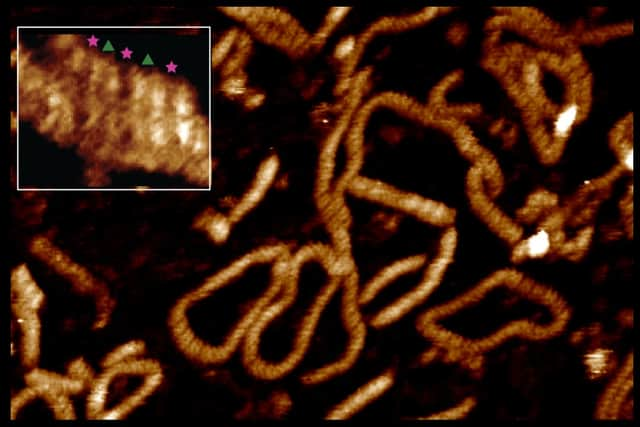

This breakthrough, achieved by researchers at the University of Sheffield and the University of York, provides new insight into how DNA molecules overcome their natural repulsion to interact - a process central to many cellular functions.
DNA molecules, both carrying negative charges, would typically repel each other. Yet, within living cells, they must come together for crucial processes such as genetic recombination, gene silencing, chromosome packaging, and even mechanisms related to cancer development. Until now, the precise way in which these molecules manage to pair up had remained a mystery.
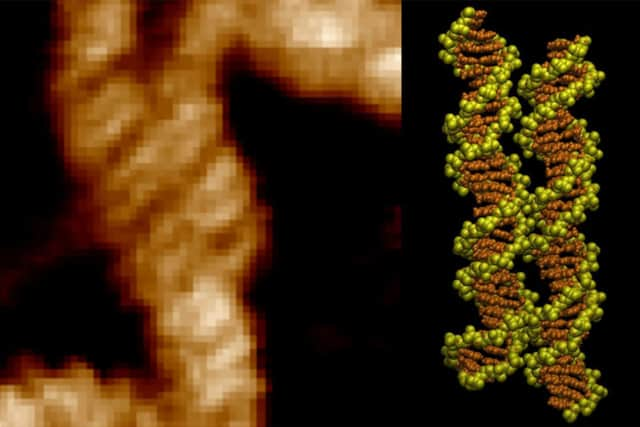
Using atomic force microscopy, the research team was able to capture images of short DNA fragments aligning with remarkable precision, groove for groove. Complementary computer simulations revealed the role of positively charged metal ions - including nickel, magnesium, and calcium - which act as molecular bridges, fitting into the grooves of the DNA and effectively locking the strands together.
Dr. Thomas Catley, co-lead author from the University of Sheffield, described the significance of the findings: “To be able to directly visualise this long-hypothesised mechanism for the first time was incredible. The advanced imaging techniques at our disposal have allowed us to uncover these key DNA interactions which have implications in many key cellular processes. It opens the door to studying other DNA interactions that, until now, have only existed as theory.”
The research also supports a theory known as the “DNA zipper” model, proposed over 20 years ago, which suggested that salt ions could allow DNA molecules to interlock like spiral staircases. The team’s experiments and simulations confirmed that double-charged metal ions act as connectors, holding the DNA strands together.
Professor Agnes Noy, from the University of York, highlighted the potential impact: “This discovery could help researchers identify regions of the genome specially involved in DNA pairing. These regions may become particularly important when mutations disrupt normal cellular processes and contribute to cancer.”
The study also found that DNA pairing is not uniform, with certain sequences forming stronger contacts and creating hotspots for alignment. The research, published in Nucleic Acids Research, demonstrates how fundamental scientific curiosity can lead to breakthroughs with broad implications for biotechnology and our understanding of genome organisation.
The study, Imaging and mechanism of DNA–DNA recognition mediated by divalent ions, is published in the journal Nucleic Acids Research.