
Drone footage shows ‘lost’ 17th-century Chatsworth House garden revealed by recent hot weather
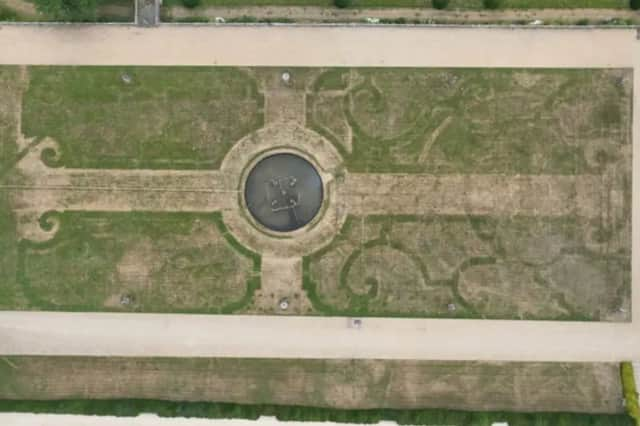
The recent hot weather in Derbyshire has revealed the outline of an ornate 17th-century garden 'The Great Parterre' at Chatsworth House
Drone footage shows the outline of an ornate 17th-century garden design beneath the south lawn of Chatsworth House in Derbyshire - revealed by the recent record-high temperatures and long periods without rain.
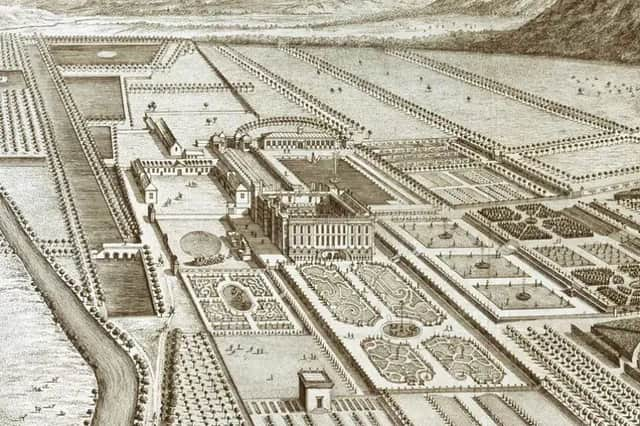
Around 1699, 'The Great Parterre' - an ornamental arrangement of flower beds and paths - was created for the 1st Duke of Devonshire to complement the new South façade of the house.
The garden measured 473 by 227 feet and followed the fashion at the time for formal gardens. It was covered over and replaced with a new design around 1730, in changes introduced by the 3rd Duke.
Chatsworth says the grass that was laid to replace the flowerbeds and paths burns more quickly when temperatures are high and dry as it has shorter roots, creating a contrast and temporarily revealing the swirling patterns of the First Duke's original garden underneath.

Weather monitoring equipment in the Chatsworth Garden has recorded temperatures peaking at +30℃ in May, June, and July this year, signifying prolonged dry periods.
Compared to Derbyshire and East Midlands climate averages, Chatsworth's spring and early summer were noticeably sunnier with around 33% more hours of sunshine (530.8hrs), and considerably drier with 32% less rainfall (108.2mm).
The hottest temperature at Chatsworth in recent years was 38.1℃, recorded on Tuesday 26 July 2022, on the Salisbury Lawn. The next hottest day was over 100 years earlier in 1911 at 34.4℃.
While the 2022 heatwave was the most extreme on record, hours of sunshine and mm of rainfall recorded between 2022 and present day show a shift in Chatsworth's climate towards sunny springs, prolonged dry periods, and occasional bouts of very heavy rainfall.
Chatsworth’s garden team is introducing new water management systems, such as increasing organic matter in the soil and seeking to improve water infiltration. By improving soil structure, the team is able to gain better water absorption and reduce run off during heavy rainfall.
Learn more about how the Chatsworth Garden Team is carefully managing water, soil, biodiversity, and planting to create a more sustainable and resilient landscape in a Summer talk on Friday 7 August, 'Sustainable Beauty: Chatsworth's Ornamental Garden'.