
Review: Lessons of Noughts & Crosses make for powerful theatre & help us to better understand divided society
Noughts and Crosses runs at Sheffield’s Lyceum Theatre until Saturday, May 23
In periods of economic and political turbulence as we are experiencing at the moment, powerful art and literature can provide us a lens through which it is possible to better understand what is going on around us.
Noughts & Crosses, which opened at Sheffield’s Lyceum Theatre this week, offers such a lens. It is breathtaking in its unflinching portrayal of the brutal reality of an inherently racist society which breeds violence and state corruption and pushes people to their limit.
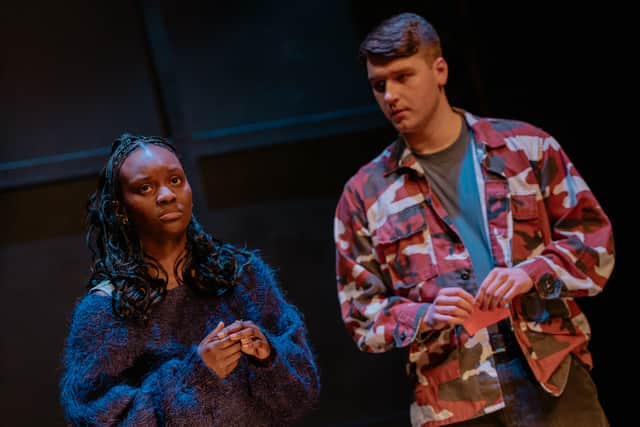

This production has been adapted from Malorie Blackman’s highly acclaimed book for the stage by Sabrina Mahfouz, and makes for a thought-provoking - but hard-going - two-and-a-half hours of theatre.
With a small, but talented, cast of just eight, a constant flurry of changing costumes, voices, and class indicators such as accents are used to mark the change of character.
The minimalist set of basic furniture and a set of panels, illuminated and turned into television screens at points, are used expertly, as the story takes the viewer from school, to the homes of the families at the centre of the story, to a café and even a private beach.
Noughts and Crosses doesn’t just transport the viewer from place to place, but through time too.
Brianna Douglas’ portrayal of Sephy as she goes from an idealistic young girl to an empowered teenager on the cusp of adulthood, using changes in voice, posture and body language to mark the character maturing, was captivating.
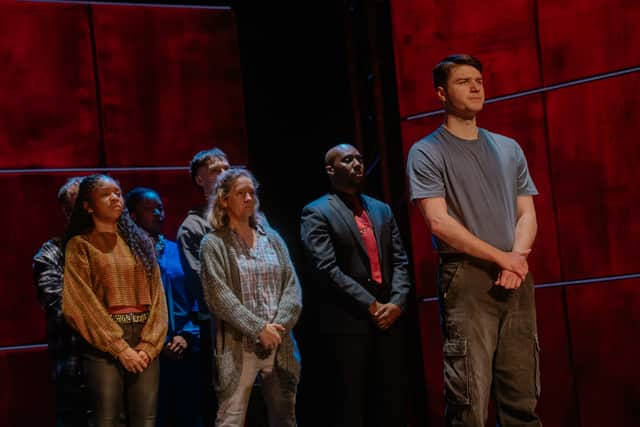
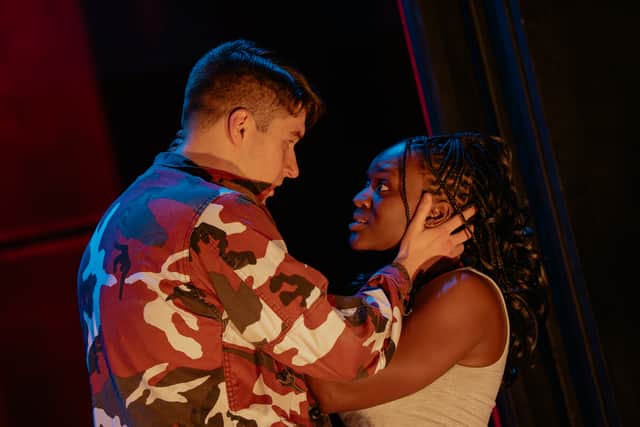
The childish joy expressed by Sephy over her relationship with Lewis Tidy’s Callum, as they go from childhood besties to star-crossed lovers provide moments of much-needed levity, which are few and far between.
It all feels so Shakespearean, with their relationship, the warring tribes and the confessional soliloquies of both characters, at times featuring rhyming couplets that create a familiar rhythm.
Turning historic racism on its head so that it is white people - the “noughts” - who are oppressed at the hands of the black ruling class - the “crosses” is a clever but simple construct; which pushes the viewer to reconsider the insidious nature of racism in our society.
South African apartheid, the rise of paramilitary groups seen in Northern Ireland during the troubles, are all reflected in Noughts & Cross, and make for a dystopian world that feels both familiar and unknown.
This is also paralleled through the lexicon of pejorative terms created just for the world inhabited by the story.
The terms do not carry the historical weight of decades of them being used to discriminate against a group of people in the consciousness of the viewer.
But the shock with which such terms are received provide the necessary context and force the viewer to question whether we have all become too desensitised to the abhorrent words on which they are based.
At a time when society feels more divided than any other time in living memory, Noughts & Crosses feels like important theatre and asks the viewer to imagine the strides forward society could take if everyone was committed to eradicating racial prejudice.