
Sheffield bins: City council proposes smaller black bin to boost recycling

Householders could have to switch blue and black bins to boost recycling in Sheffield.
The council says putting general rubbish in the smaller blue bin, normally used for recycling card and paper, could help reduce the amount of general waste produced and increase the amount which is recycled.
It cites Bristol, which has a small ‘black bin’, and is top for recycling among seven major cities, with a 45 per cent rate. Sheffield is fourth, with a 32 per cent rate.
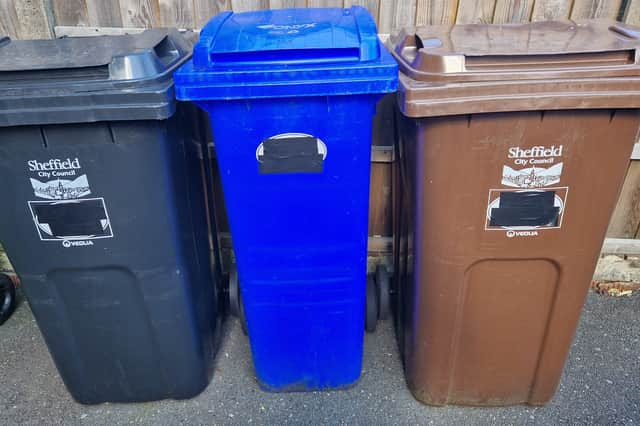

Blue bins were introduced in 2018 after smaller blue boxes - later issued with waterproof ‘hats’ - proved overwhelmingly unpopular.
But, the report notes, 87 per cent of respondents in a survey said they were dissatisfied with the blue bin said it was too small for all the items they would like to recycle.
Sheffield collects 40 per cent less paper and card than average for all local authorities in England, figures show.
Switching blue and black bins is among eight possibilities in a forthcoming public consultation. They include: an extra brown bin, a new, larger blue bin and ‘flipping’ blue with brown to make more space for paper.
A Sheffield City Council report states: “Restricted residual collections typically result in increased recycling as householders are more likely to use the recycling services to their fullest, as they don’t have the space to dispose of recyclable materials as general waste.”

Currently, all households in Sheffield have a black bin for non-recyclable waste - which is burned in the Veolia incinerator on Bernard Road - a blue bin for paper and card, and a brown bin for glass, cans and plastic bottles, which are recycled.
Meanwhile, the Environment Act 2021, will require council contractor Veolia to collect more items by April 2026, including plastic pots, tubs and trays, plastic tubes and cartons, which are currently burned.
All bin services are provided by Veolia through an Integrated Waste Management Contract with the council that runs until 2038.
Changes to services “and associated capital and revenue costs” will be paid to Veolia, the report adds.