
Pocket radio saved Sheffield policeman's life in terrifying gun attack, says retiring police boss

A former Sheffield policeman has told how a colleague's life was saved after he was shot at point blank range in the city centre.
Explaining the massive improvements in personal protective equipment provided to modern officers, David Hartley, who has just retired as assistant chief constable in South Yorkshire, told how a colleague was shot with a sawn off shotgun.
But his life was saved when an huge, old fashioned police radio he had in the breast pocket of his uniform stopped the blast.
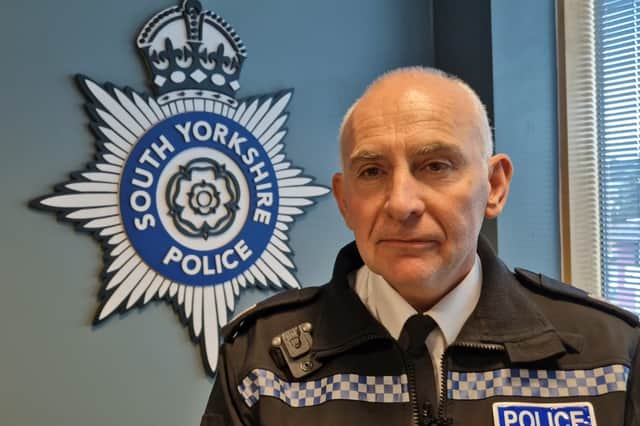

He told how when he started with South Yorkshire Police, officers had no protection beyond a truncheon and handcuffs - but now officers also have body armour, gas, an extendable baton, tasers, and ‘quick handcuffs’.
He said: “The reference point for me for how it was back in the day, was back in, I think, 1992, before body army and any of the enhanced protection came along. I remember were were on nights, and in the city centre, expecting a busy night. We’d had a briefing around a potential sex offender who wore a long mac and we’d been told to look out for him.
“Two of my colleagues saw someone of that description, pulled up along side him on Pinstone Street, wound the window down to speak to this individual. And it wasn't the person we’d been briefed on. By pure bad look, or good luck in terms of keeping the public safe, it happened to be someone who was armed.
“They’d got a sawn-off shotgun tied to their wrist with a lanyard, a series of knives and other things under this mac, and instantly, without any warning, shot a colleague of mine, who was the acting sergeant on the shift.
“So looking at protective equipment, that acting sergeant was the only sergeant I’ve ever known who went on patrol in their dress tunic, with the big stripes on the sleeves, the thing we would go to formal events in now, he wore that operationally. Through a quirk of good luck the big Motorola radio with a huge battery on it of the day, he always had in his top left hand pocket of the tunic.
“When he was shot at point blank range, that radio took the entire blast from that shotgun, and remarkably, didn’t take his life. His colleague in the drivers seat, took the ricochet of that and both his arms were shot, but they both survived and that was through pure luck of a tunic that no one else did, and a massive radio.
“If we look and compare and contrast with today, with body armour, armed response, and the way that we manage intelligence, around firearms, I’d like to think that we’re no longer relying on really good luck . We’ve got inbuilt structures and processes and equipment that would mean that if you face a similar instance like that, you’re not relying on a bit of good fortune.”
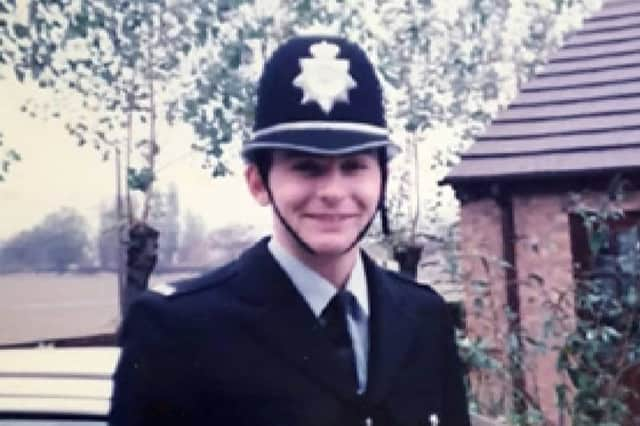
Mr Hartley started with the police in October 1991, aged 22.
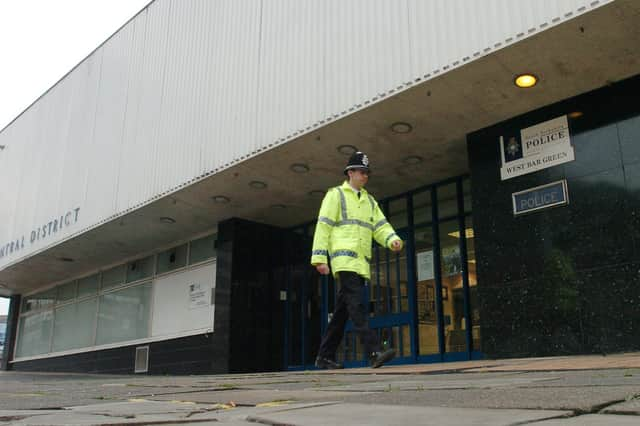
His first day in the force saw him on a night shift at West Bar Police Station, which is now a hotel.
He remembers his first arrest as one of the most dramatic, involving a man who had assaulted his partner at Barkers Pool. As he and his tutor constable tried to arrest him, the huge man picked them both up off the floor with his two arms.
“We knew that was going to be a lively arrest, and it certainly proved to be,” he said. “It was least two vans that were needed to finally get him into Bridge Street custody office.”
Some 30 years on, he feels that what police officers try to do is broadly the same as the day he started, in terms of serving the public and coming between the public and harm, but feels it has changed dramatically in how it is done.
As well as the personal protective equipment, there are now mobile phones and body cameras.
“They are very much better equipped than we were,” he said.
Among those newer officers who are so much better equipped are Mr Hartley’s own son and daughter. He says he was delighted when they decided to join, but it was they who had made their own decisions on it.
He said: “They seem to be enjoying the team spirit, and that sense of not knowing what you’re going to next, and very much the demand of the active queue which is an exciting place to be. You rely on each other to keep each other safe, and the communities rely on us to keep them safe. It’a actually a really rewarding job.”
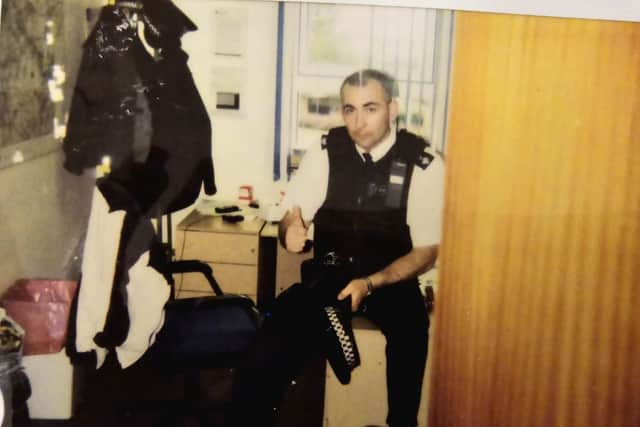
He went on patrol with both for the first time, on his last day in the job.
He feels things have improved in terms of the police’s ability to manage crimes scenes, in terms of drones and technology. He feels the courage and common sense that is needed remains the same, but improvements around technology are marked.
He felt the most exciting time in the job were his first 10 years doing shifts on ‘the front line’, where there was great camaraderie and mutual reliance on each other.
But from his own point of view, much of his pride about the job has come with the way he has dealt with incidents which have been complex and pressurised. For him that has often been dealing with high risk complex firearms operations.
He was the officer in charge of the firearms operation involved in the hunt for Raoul Moat, in Northumbria. It involved 50 per cent of all available armed officers in the UK operating as part of the operation in 2010. But he says he feels his pride is in the entire organisation.
“I see what the force delivers each of every day,” he said.
“Police officers are normal people. brothers, sisters, mums, dads, they’re just people who decide upon this career and then do remarkable things. in terms of service delivery. My pride is in the entire organisation.”