
The forgotten Sheffield hero whose work in the city helped save millions of lives

Sheffield scientist recorded the first treatment of 1930s wonderdrug
It was a miracle drug that saved millions of lives.
But the Sheffield scientist whose work in the city brought it into use as a treatment for the first time has largely been forgotten.
.jpeg?trim=694,0,694,0&crop=&width=640&quality=65)

Now, the name of Cecil Paine, the man who was the first to succesfully use the antibiotic, penicillin, as a treatment, has been put onto a blue plaque, as his lifesaving work is recognised in the city where he worked.
The name most famously linked to penicillin has always been Sir Alexander Fleming, His laboratory discovered the mould which produced the drug by accident in 1928.
But years later, it was Dr Paine who became the first to use it clinically as a treatment, when he used it to treat eye infections at Sheffield Royal Infirmary. Since then, it estimated that 82 million lives have been saved through antibiotics around the globe.
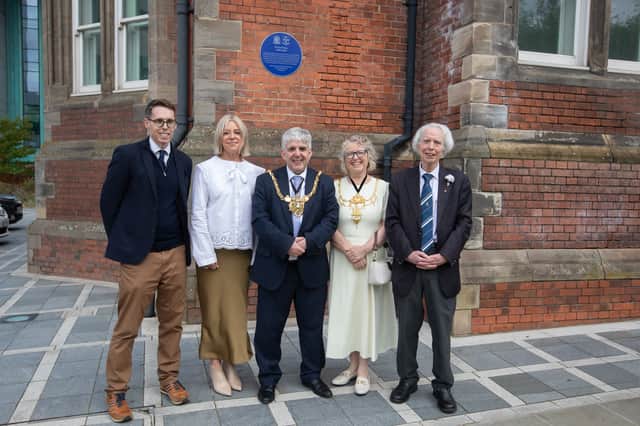
Experts at Sheffield University say it was Dr Paine who paved the way for the therapeutic use of penicillin.
It was researchers at the university who first documented successful use of penicillin to treat human infections
That is why they have installed a blue plaque to the Jessop Building, once the city’s Victorian maternity hospital, marking the work of Dr Paine, a member of the University of Sheffield’s Pathology Department, who carried out the first documented medical use of unpurified penicillin in 1930.
Paine himself worked at one stage at the Jessop’s Norton annexe, and worked at the Jessop for many years until he retired.
The pathologist, who took up an academic post at the University of Sheffield in 1932, made medical history when he used an early form of penicillin to treat the eye infections of two babies and a miner.
The mould from which the penicillin was derived was given to Paine by Alexander Fleming, who had been Paine’s lecturer at St Mary’s Hospital Medical School in London.
Fleming published details of the discovery of penicillin as an antibacterial agent in 1928, but it had not been used successfully as a medicine.
After using it on his patients, Paine, shared his findings with Fleming and Howard Florey, Professor of Pathology at Sheffield Medical School from 1932 to 1935.
Along with a team from Oxford, Sir Howard Florey then went on to purify penicillin, conducting the first clinical trial of the drug in 1941.
Others, including Fleming, had previously had no notable success using penicillin on patients before Paine’s success.
Stay informed about Sheffield and South Yorkshire. Get more stories like this and the day’s top headlines with our free daily newsletter
His role was largely forgotten, until it was publicised in the 1980s, following an interview with Florey for a book on penicillin.
Sheila Francis, Professor of Cardiovascular Biology at the University of Sheffield, said: “Cecil Paine’s contribution to one of the world’s most important medical discoveries is little-known, but his pioneering work helped pave the way for a treatment that has saved millions of lives around the globe.
“We honour and commemorate his life and remarkable achievements in the city where he lived.
“Paine’s work is part of the University of Sheffield’s proud tradition of making discoveries that transform lives.”
- RELATED: "Strokely Come Dancing" returns to Sheffield after 10 years
- RELATED: Why Sheffield fruit fly population is surging in autumn - and what to do about them
- RELATED: Tiny white flies swarm Sheffield - this is why
- RELATED: 'Is Andy Burnham's dream of decent care for elderly so terrifying?' - Nancy Fielder