
The Crucible’s Twelfth Night is an engaging and humorous adaptation of entanglement and confusion in love
The Crucible Theatre continues its Shakespeare season with Twelfth Night, directed by Jamie Glover
Following The Crucible Theatre’s acclaimed production of King Lear, the returning company of actors is joined by Mathew Horne, of Gavin and Stacey fame, who stars as Malvolio in this delightful comedy.
-in-Twelfth-Night--Photo-by-Manuel-Harlan.jpeg?trim=833,0,833,0&crop=&width=640&quality=65)

If King Lear was the harbinger of tragedy, Twelfth Night delivers a comedic palette cleanser following a visually striking opening.
David Birrell's Feste, the narrative ‘Fool’, kickstarts proceedings, symbolic umbrella in tow, as crashing waves signal an incoming storm. Laden with ladders and ropes, the ensemble constructs a ship with dramatic flair.
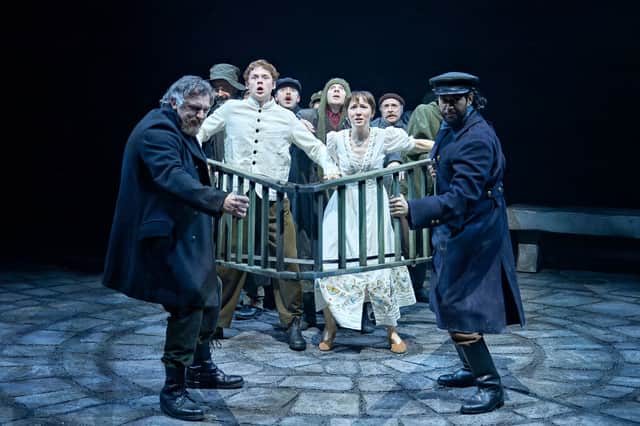
The brutal sea storm causes an excellently choreographed shipwreck, separating twins Viola (Bebe Sanders) and Sebastian (Harry Redding), each believing the other to be dead.
After reaching Illyria, Viola assumes the male identity of Cesario and enters the service of Duke Orsino (Fode Simbo).
Orsino commands Cesario to court the wealthy countess Olivia on his behalf. However, Olivia falls in love with Cesario, who has developed feelings for Orsino. The romantic entanglement only deepens further with the resurfacing of Sebastian.
-and-Bebe-Sanders-(Viola)-in-Twelfth-Night--Photo-by-Manuel-Harlan.jpeg?trim=0,0,0,0&width=640&quality=65)
Amid the confusion, Illyria's court devolves into a frenzy of manipulation, anchored by Sir Toby Belch (Milo Twomey) and Sir Andrew Aguecheek (James Chetwood). Chetwood’s comedic capability is fully embraced, bringing endearing levity to Aguecheek, while Twomey’s Belch plans chaotically malevolent schemes behind his jovial exterior.
Olivia’s steward Malvolio (Mathew Horne) vainly attempts to enforce order but is cruelly tricked into believing Olivia loves him and sets about trying to woo her – disastrously. Part of a mischievous plot propagated by Katie Wimpenny’s brilliantly twisted and zesty Maria, it brings down the austere steward, who is ultimately ridiculed, and imprisoned.
As the self-serving, pompous Malvolio, Mathew Horne serves as the star vehicle for this production. Delivering each line with a commanding confidence that commands the audience's full attention. His stage presence is genuinely captivating.
Horne skillfully navigates Malvolio's arc from rigid arrogance to complete absurdity, balancing humour with the poignant and genuinely sad downfall of the character.
-and-members-of-the-company-in-Twelfth-Night--Photo-by-Manuel-Harlan.jpeg?trim=0,0,0,0&crop=&width=640&quality=65)
Director Jamie Glover's adaptation demonstrates exceptional attention to detail in characterisation.
Bebe Sanders embodies Viola with a nobility and temperance, counterpointing Harry Redding's decisive Sebastian.
Justina Kehinde brings elegance and poise to Countess Olivia, with lovely comedic nuance in her interactions with Sanders.
Katie Wimpenny is a particular standout as Maria, possessing an ingenious capacity for comic timing. Her expressive physicality and vocal delivery allow her to mould Shakespeare’s text into something both frenetic yet impeccably controlled.
Praise belongs to the entire ensemble, whose evident trust and cohesion create a seamless performance that thoroughly earned their standing ovation.
Genevieve Dawson's skillfully integrated live score and poignant vocals, effortlessly delivered by Birrell's Fool, only serve to enrich the production's surreal and at times absurd atmosphere without ever weighing it down.
-and-Katie-Wimpenny-(Maria)-in-Twelfth-Night--Photo-by-Manuel-Harlan.jpeg?trim=83,0,83,0&crop=&width=640&quality=65)
Amanda Stoodley’s set design also deserves praise, the cobblestone flooring and mechanised stone benches create an ever-changing set that works to great effect.
The stage design is perfectly accentuated by Richard Howell’s lighting, which neatly sets the tone for each scene from the vivid shifts between sun and moon to the overhead light that casts a singular ray upon the broken and caged Malvolio. Both the staging and lighting are seemingly simple yet ever so effective.
Visually, the production is anchored by a cyclical theme symbolised by the opening and closing umbrella imagery. This recurring symbol establishes a crisp theatrical symmetry, unifying the work as its closing moments mirror its start, signalling the end of a chaotic voyage.
-in-Twelfth-Night--Photo-by-Manuel-Harlan.jpeg?trim=83,0,83,0&crop=&width=640&quality=65)
In contrast to the company’s heavy performance of King Lear, Glover’s Twelfth Night moves at a far swifter clip, with a lively pace propelling it through its tumultuous second act.
-in-Twelfth-Night--Photo-by-Manuel-Harlan.jpeg?trim=0,0,0,0&width=640&quality=65)
Making Shakespeare accessible can be difficult, but Glover’s engaging adaptation overcomes this by leaning into the play’s celebratory spirit and modern sensibilities. Love is rendered as a powerful, irrational madness – one that disrupts ordinary existence yet essential to human joy and connection.
Underneath the chaotic romantic confusion remains a humanity and playful reverence that continues to endear.
Twelfth Night is being performed at the Crucible, Sheffield, from October 10 - October 31, 2026.
For more information and to book tickets, go to: https://www.sheffieldtheatres.co.uk/events/king-lear
- RELATED: Sheffield’s best independent businesses - according to readers
- RELATED: Review: William Shakespeare’s Twelfth Night at Sheffield’s Crucible Theatre
- RELATED: Sheffield artist's mission to keep "rare" craft alive
- RELATED: Roger Waters’ son brings Pink Floyd tribute show to Sheffield — Get tickets (aff)