
Henrik Pedersen might have confirmed Sheffield Wednesday plan after dropping formation hint
Sheffield Wednesday are set to have a very different look about themselves ahead of the coming season.
Less than three weeks stand between Sheffield Wednesday and the start of the 2026/27 season.
The Owls will welcome Bolton Wanderers to Hillsborough for their first competitive outing of the upcoming campaign on Saturday, August 8, taking on the Greater Manchester outfit in the first round of the Carabao Cup for the second season running.
Unlike last season, though, Wednesday will head into the contest following a rigorous pre-season campaign.
Twelve months on from the most chaotic summer the Owls have ever experienced, there is a wave of excitement and optimism surrounding S6. New signings are coming through the door at a decent pace, off-field improvements are being made at Hillsborough and at Middlewood Road, and the players are experiencing a proper pre-season campaign.
Ahead of flying out to Budapest on Sunday, the Owls stepped up their pre-season preparations with their first victory of the summer on Saturday, beating Preston North End 3-2 at the Lilywhites’ Euxton training ground. The contest was split into two 60-minute halves and Wednesday came out on top via goals from Jamal Lowe, Louie Barry and Reece Johnson.
Except for goalkeeper Joe Lumley, who started both halves, Wednesday started each half with an entirely different XI. Manager Henrik Pedersen, for the first hour, went with a team that could resemble something close to what he considers as his strongest XI, while some of Wednesday’s fringe players and youngsters took care of matters for the second hour.
The nature of behind-closed-doors games means that specific details are often hard to come by, with managers and coaching staff wanting to keep their cards close to their chests. But judging by the starting XI Pedersen deployed in the first half against Preston, it would suggest Wednesday, certainly in possession, set up with a 4-2-3-1 system.
A back four, from right to left, of Liam Palmer, Gabriel Otegbayo, Sil Swinkels and Max Lowe started ahead of goalkeeper Lumley. Barry Bannan and Nathaniel Chalobah, who has recently been training with the Owls despite being released at the end of last season, anchored the midfield, sitting just in front of the back four, while Jordi Liongola, Callum Slattery and Barry operated as an attacking trio behind lone striker Lowe.
A four-at-the-back system could, potentially, see new recruit Liongola play in a more advanced role on the right flank. He has a versatile profile, meaning he would provide Pedersen with plenty of flexibility. A 4-2-3-1 system would almost certainly see fellow new signing Slattery operate as a No. 10, while Bannan and newest recruit Billy Mitchell would sit at the base of midfield.


Last season, of course, Wednesday played with either a 5-3-2 or a 3-4-1-2 to try and give themselves as much solidity as possible amid their lack of quality and attacking threat. With the squad in the process of being rebuilt and some solid signings being made, the onus will be on Wednesday to take games to the opposition this coming season, meaning supporters will want to see an attack-minded approach.
Although some supporters questioned Pedersen’s tactical approach last season, it is worth remembering just how undercooked Wednesday’s squad was for the Championship. They were starved of quality all over the pitch, particularly in forward areas, meaning Pedersen had no choice but to set up with a back five because of the limitations elsewhere in the squad.
As Wednesday went on a run of ten games without scoring just after Christmas, Pedersen was urged to move to a 4-4-2 in a bid to make his side more threatening in forward areas. But without any natural wingers, it was never going to be possible.
Fortunately, Wednesday are now in the process of strengthening their attacking options, meaning Pedersen, as suggested by Saturday's starting XI against Preston, could be about to permanently change the Owls' shape to make them a more adventurous team.
Speaking to The Wednesday Word earlier this year, Pedersen said: “I have more or less never played with a back five before; I love to play with a back four.
“I have got a big injection from the Red Bull philosophy, the basic philosophy of Red Bull, with a very high and a very aggressive press with a lot of intensity, a lot of sprint metres.
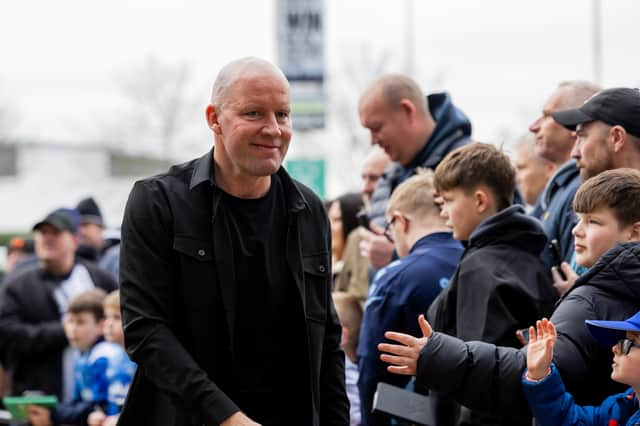
“It is a pressing style we call ball-oriented pressing, where you want to create overloads around the ball so you can use this overload to play vertically forward when you win the ball. It is a hunting, defensive style.
“At the same time, we also want to be dominant on the ball, but it is in a more vertical way. I don’t just want to have the ball to have the ball; I want to use it when we have to create and to be dominant.”
In League One, Wednesday will be expected to control games and get on the front foot. A permanent switch to a back four will, of course, boost their hopes of doing just that.
With the squad rebuild continuing to gather momentum, Pedersen is being provided with the tools he needs to implement his system and create a team capable of putting his philosophy into practice.
Last season, let's be fair, he had no chance of doing that.