
UKIP protestor's complaint at being 'kettled' on Sheffield street by police who would not let them use toilet

A protestor at an anti-immigrant UKIP rally in Sheffield last weekend has complained how marchers were ‘kettled’ by police and not allowed to leave to use toilets.
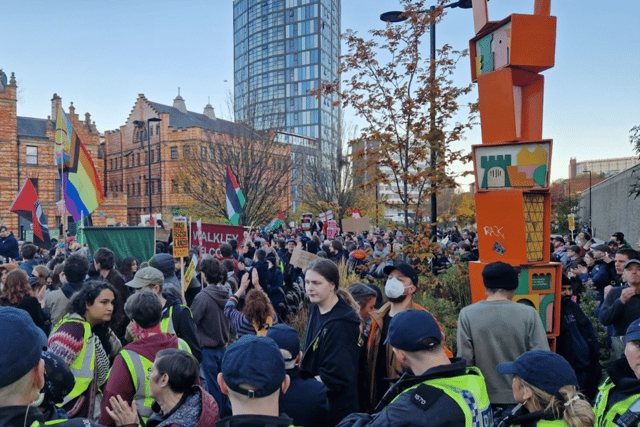
The march in Sheffield city centre last Saturday (November 8) saw over 150 UKIP supporters and around six times as many counter-protestors come within yards of each other at Lady’s Bridge on the Wicker.


The march was attended by party leader Nick Tenconi and was advertised as: “Reclaim Sheffield from the Far Left! Do you want your city back?”
Hundreds of police officers drawn from as far as Durham and Manchester forces separated the two, and protesters were kettled on adjacent streets - Blonk Street and Castlegate - with a strongly-guarded ‘sterile zone’ through which no one could pass.
Now, one protestor for UKIP, Donald MacKay, who is also party’s leader in Scotland, has shared his upset at how marchers on Blonk Street were not allowed to leave when they wanted or allowed to use toilets.
He told The Star: “South Yorkshire Police kettled us on Blonk Street for well over an hour.
“I’m 65, and once we were on Blonk Street it had already been nearly an hour since we left the muster point [Tudor Square]. I wanted to leave to use the toilet and get a coffee.
“I was told by officers at the Wicker entrance no one was allowed out. The two officers I spoke to were not disagreeable, but categorically said we could not leave.
“There were 150 people there of all ages including babies, and no planning about where these people would be allowed to use the toilet. We weren’t going to go in the street, we aren’t animals.
“We were having a legal protest, whether someone agrees with us or not, and it seems wrong to me that we were not allowed to leave when we pleased.”
What did the legal conditions enforced on the march say?
The day before the protest, South Yorkshire Police published the route protestors would be required to take, where counter-protestors would be required to gather, and how UKIP supporters would be required to disperse by 3.30pm.
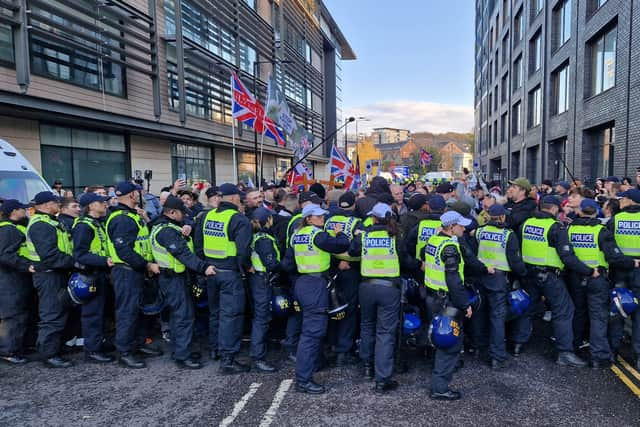
For this, the force cited Section 12 and 14 of the Public Order Act 1984, which was also broadcast on electronic screens at the protest.
While S.14 law can be used by a senior police officer to restrict the movements of public assemblies and “kettle” them should they feel it poses a risk of public disorder, the boards at the protest did not state plainly that either group were, at that point, now required to stay in their locations.
The conditions published before the march read: “Once they [the protestors] reach their destination of Blonk Street, they must stay in the designated area on Blonk Street between the Wicker and Five Weirs Walk and leave the area by 3.30pm.”
Mr MacKay feels this did not make clear that the police had the power to prevent protestors from leaving at all before 3.30pm.
What did South Yorkshire Police say?
The Star asked South Yorkshire Police what the formal strategy on the day was for when protestors would be allowed to leave Blonk Street and how this was circulated to the public, as well as whether consideration was made about toilets.
A spokesperson said: “As with all protests, our role at any planned event is to balance the rights of those who wish to protest, together with those who may be impacted by it.
“Legal conditions were imposed on the protesting groups on Saturday (November 8) to help us maintain public safety.
“We take a dynamic and proportionate approach in these situations and keep our response under constant review as events evolve.
“At one point during the afternoon, in order to avoid a direct confrontation between groups thus preventing disorder and ensuring public safety, both groups were held in their designated areas for a period of time before being safely dispersed with the assistance of our officers, prior to 3.30pm.
“The legal conditions that were applicable to the protesting groups were communicated prior to the protests via our own communication channels and through conversations with the event organisers.
“On the day of the protest, the legal conditions were further communicated to attendees via an on-site digital van and leaflets handed out on the day by our protest liaison teams.
“These teams were then also able to liaise directly with protesting groups to communicate any dynamic decisions that had to be taken on the day.”
In response, The Star asked at what point this ‘dynamic decision’ was taken.
The spokesperson added: “The legal conditions imposed on the day stipulated that once those supporting UKIP reached their destination of Blonk Street, they had to remain in the designated area on Blonk Street between The Wicker and Five Weirs Walk and leave the area by 3.30pm.
“Due to the presence of a nearby group and to prevent a breach of the peace, a dynamic decision was made to hold those supporting UKIP in their designated area for a period of time until they could be safely dispersed with the assistance of our officers. This happened prior to 3.30pm.”
The protest on November 8 saw seven people arrested including a woman aged 38, for actual bodily harm, and a man, 39, for affray.
Four men - aged 54, 39, 33 and 23, and a 34-year-old woman - were arrested on suspicion of breaching the legal conditions police imposed to ensure public safety under Sections 12 and 14 of the Public Order Act 1986.