
'I’ve been into space and lived in Star City - but still fondly remember Redgates and the Hole in the Road'
The first British person in space Helen Sharman on her Sheffield childhood, Project Juno, Artemis, other life forms and how we use space.
Dr Helen Sharman from Sheffield has recounted how a radio advert led her to becoming the first British person in space at the age of 27.
Helen Sharman grew up in Grenoside, before the family moved to Greenhill when she was eight years old. Reflecting on her Sheffield childhood, she fondly remembers being taken to Redgates to choose a toy with birthday or Christmas money. Another of her childhood memories is being allowed to go and watch the fish tank in the Hole in the Road.
When Neil Armstrong landed on the Moon in 1969, Sharman, aged six at the time, remembers doing school projects on the Apollo missions, which generated some interest, yet they still felt somewhat removed from the mission with it being an American program.


Sharman told The Star: “We were a bit interested in that like everybody was, but it wasn't anything to do with us, that was the Americans and we never thought that anything like that would happen to us. We didn't know about any British rockets. There was some being developed but we didn't know about that and it certainly hadn't made any headlines. There was no chance, as far as I could see, of being an astronaut”.
Sharman studied chemistry at the University of Sheffield but “had no interest in going into space because it wasn’t going to happen.”
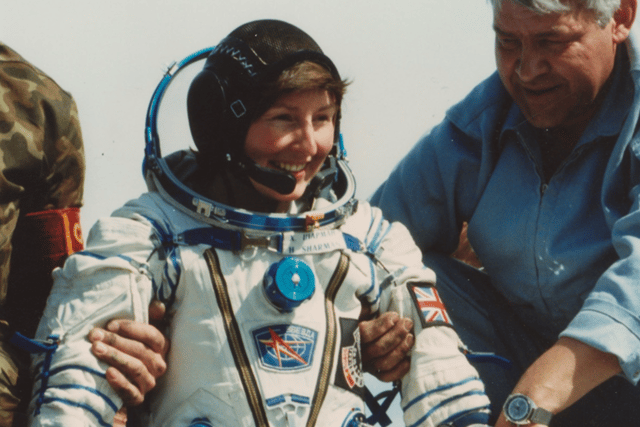
In June 1989, Sharman heard on her car radio, “Astronaut wanted. No experience necessary" - an advertisement for the Anglo-Soviet Project Juno. 13,000 people applied for the opportunity to train with cosmonauts and do experiments in space. After a series of tests, including medical, psychological, manual dexterity and G-forces, Sharman and Major Timothy Mace were successful.
By November, they were already starting their 18 months training which involved three months of language and physical training - with the training thereafter delivered in the Russian language - theoretical work, practical work such as understanding the life support systems, the simulators and some emergency training.
Sharman lived in Star City, a military base northeast of Moscow, where cosmonauts have lived and trained since the 1960s. Star City even has a school for the children of the people who work there to attend.
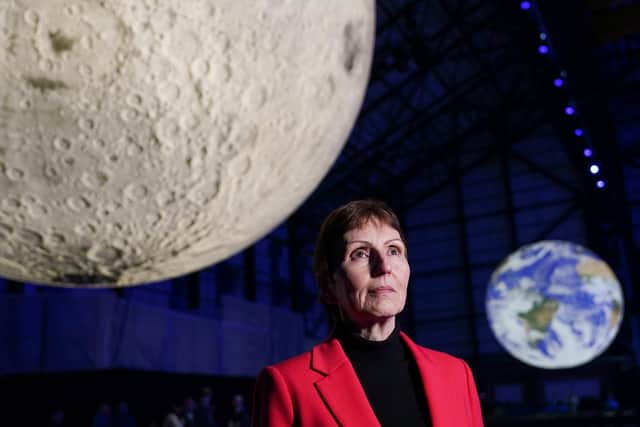
One person was to go into space, while the other remained on the ground as a backup. Sharman says she “always assumed that I would be back up” to Mace, a man who was a bit older with an army background, but was selected to be the prime astronaut from the UK and launched on 18 May 1991.
She said: “I think just everybody expected that the person who comes from the army, who flies helicopters, who's a man, would be the prime astronaut, and then the person who has done science at university, and then gone to work in UK industry, well, she would get to be the backup. And so that was kind of the social norms and I just sort of accepted that that was the scenario that I was living in.”
Sharman finds she does not explicitly have to “shout” about women’s rights, although she admires people who do, as the fact that she’s the first British astronaut and a woman normalises that “women do these things and can be first.”

Sharman said: “I can go into a school and talk to a group of young people and just say, yes I am the first British astronaut, and they can see that I’m a woman. And actually if I give a talk and talk about my training and then what I did in space and so on, I rarely get asked questions from the young people about, well, isn't it harder for you because you were a woman? Because they can see, well, I just did it, and of course, yes. I normalise the fact that women do these things and women can be first so I think that's really powerful and lovely.”
Sharman was 27 years old when she went into space, but says she didn’t feel young and “there was no time at which I ever felt incompetent or that I wasn't going to be able to fulfil any expectations.”
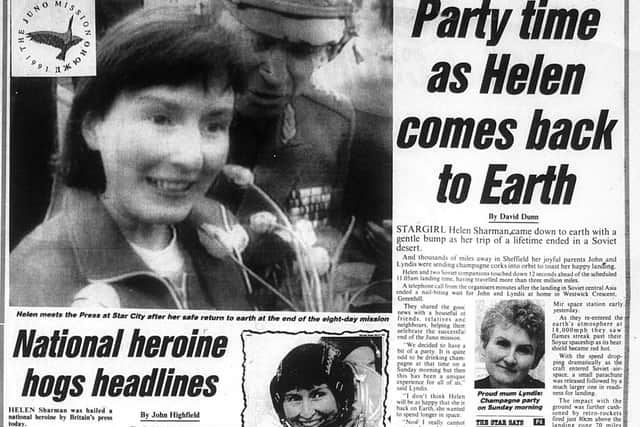
She explains how moving to London after university and tacking new things head on, like navigating the capital with the A to Z, gave her confidence.
Sharman said: “I suppose if you get through challenges and you don't get knocked back, you get to feel more confident just in your own abilities.”
In April, the world was captivated by Artemis II - which saw four crew members fly around the Moon in the Orion capsule. Artemis III, Artemis IV (the first lunar landing of the program) and Artemis V are planned for the coming years.
Sharman believes part of what makes the public so interested in human spaceflight is that “we put ourselves in their shoes”.
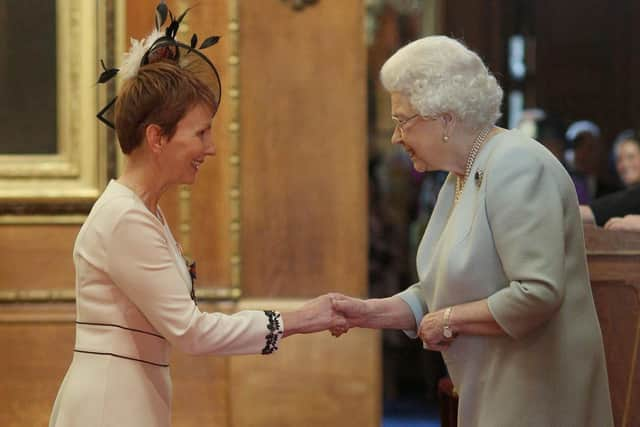
She said: “We feel for them. We see how they're sitting for the launch. We wonder how they're managing just four of them in that spacecraft together.
“When they send us the photographs back, it's not some camera or a satellite that's taking the photograph, it's a human being that's seen that image and has taken that photograph and so I think we're seeing it through their eyes. I think that's what makes it so special, we're imagining ourselves there.
“It's that level of humanity as well and particularly for the Artemis crew. They shared some really human moments like the time when they were all hugging each other because they were quite emotional after they'd announced that they'd like to have a part of the Moon named after Reid Wiseman's wife who died recently. It’s all that humanity, that’s what makes us get involved in it.”
Sharman believes Britain giving more support, financial and in other ways, to the human spaceflight programme within the European Space Agency would enable the country to take part in the developing space economy.
Sharman said: “When we're really struggling with the cost of living, it's difficult to justify huge investment, but I think as soon as we come out of this difficult time, that's really the time to start putting a lot more investment into space in general, but that's not just on space technology because it will affect so much more that we use on Earth.”
One example she gives is a startup working on making chemotherapy drugs in space.
She said: “When they're made on earth, the chemotherapy drug is really thick and viscous so you have to go to hospital, you have to spend hours having a drip to get the chemo drugs into your system. But if you make this in space, you can manage to get a chemotherapy drug that you could just inject under your skin, so you could do that at home. So that can completely transform the way that people manage their own chemotherapy treatment.”
Sharman believes there “must be some other life” in the universe.
She said: “There's billions of stars in the universe and many more planets so somewhere there must be some other intelligent life. I don't believe we've come across it yet. We think we might actually under the surface of Mars, that's probably the most likely nearby place that we could discover other life form, possibly if there's liquid water still underneath the surface of Mars.
“I think life doesn't have to be based on the exact same chemicals that we are. So for a long time people thought it had to be based on carbon but actually I think it could equally be based on something else like maybe silicon. There's a lot of silicon in the universe. We do have to be quite careful when we're looking for other life forms that we don't assume that it's just the same chemicals as us.
“It is quite exciting because we always wonder, how would we communicate with it? And how different would it be?”
She believes it’s important to have conversations around the responsibility humans have to be “good custodians of space”.
Sharman said: “We could get to Mars, let's say, and find other life. So just because we're very adaptable doesn’t mean to say that we should therefore take over that other life form.
“We all ought to be thinking a little bit about how do we use space? And the ethics of taking stuff out of the moon. How much should we be taking? Should we be allowed to mine an asteroid? Who should own the material that we get from the asteroid? Or maybe the products that are made with that material, to which country should the taxes be paid when those products are sold?”
Sharman says the wider public should be part of this discussion, which could simply look like chatting with neighbours and friends about the responsibility we have in space.
- RELATED: Southey Social Club's fight for survival
- RELATED: Why extreme weather means Sheffield NHS will be busier in summer as well as winter
- RELATED: Boy, 17, accused of sex attacks at train station and college
- RELATED: Remembering Sheffield broker, 33, killed in 9/11 terrorist attacks 25 years ago today