
Welcome for Sheffield communities strategy that pledges to involve people in council decision-making
Sheffield charity, community and voluntary group leaders have praised a new council strategy that aims to involve them more closely in decision-making.
The council’s new communities strategy was approved on Wednesday (October 15) by a meeting of the strategy and resources committee. Leaders of five organisations joined the meeting to explain how they had been partners in creating the strategy over the past nine months.

The strategy maps out how the council will “work with communities to understand challenges, design responses and take action together” in the next 10 years. It defines three types of community, based on place, interests and identity.
The strategy document admits: “It is important to be honest that sometimes communities haven’t been given the support, resources or been listened to by the council when they needed it.
“The report of the Race Equality Commission sets out starkly how minoritised communities in Sheffield were failed by the council, and how access to services and funding were not fair. The Lowcock report into the street trees dispute showed how the council failed to listen to and engage with people’s concerns.
“The city’s experience of the Covid-19 pandemic demonstrated how the council needs to work to deliver for Sheffield’s communities, reflecting their different needs and circumstances.
Flexible
“This meant doing things like working to build trust and confidence in each other, listening to community organisations and groups, and being flexible about how the council delivers services.
“From the engagement around this strategy, it’s clear that people want the council to build on these lessons.
“The riots and unrest across the country in the summers of 2024 and 2025 made many communities and organisations in Sheffield fear for their safety.
“Sheffield’s response to this has been a clear message of unity and a rejection of racism and violence. The council has an important role in bringing communities together and holding conversations to address tensions in our city.”
The committee also approved the establishment of a grant fund of £2.2m using funds from the public health grant reserve, to be used to help fund community projects.
Council director of customer experience and communities Tom Smith said: “It has genuinely been a collaborative effort in terms of members, officers and communities.”
Strength
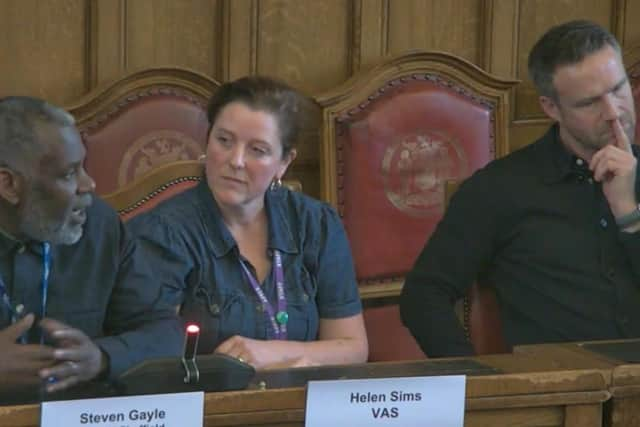
Steve Gayle from Age UK said: “For me, the process has highlighted the strength of partnership working in our city,” adding that much of the work has been driven by voluntary sector organisations facing challenging circumstances.
He said he is looking forward to being involved in the next stage of the process.
Helen Sims of Voluntary Action Sheffield said that councillors’ approval of the strategy is “very much the start”. “If this is the kind of partnership and participation work we will build, I think it looks really, really positive.”
She said that challenges include ensuring that the principles are embedded in all the council’s work.
Matt Dean of Zest said: “Thank you for making sure it wasn’t just another survey.” He said it is an opportunity to put communities at the centre of decision-making.
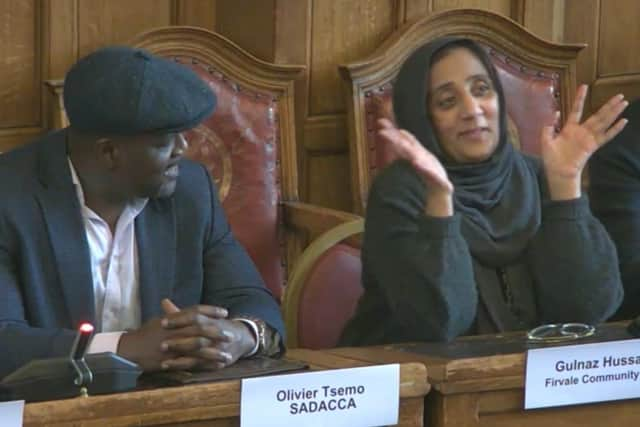
Olivier Tsemo of Sheffield and District African Caribbean Community Association (SADACCA) added: “We have in our hands an outstanding piece of strategy. We have had our challenges but we have learned a lot from each other.”
Outcomes
He also said one of the biggest challenges is how the strategy will become embedded in all council departments.
Later in the meeting he said: “Just imagine a city with more than 286 ethnicities. To improve the outcomes for anyone is not easy.”
Gulnaz Hussain of Fir Vale Community Hub commented that it is difficult for council officers to come out and hear what people really feel about council services, sometimes in an interrogatory manner.
She said that the voices of Asian women are often not heard, so it was very important that a safe space had been created so that they could express their opinions.
Coun Fran Belbin said: “It starts to feel as if we are listening better and we are acting on our listening better. It doesn’t mean that the whole council just snaps into acting correctly with communities, it needs to be a culture change.”
Coun Kurtis Crossthorn said that, despite his early reservations, there had truly been cross-party involvement in the process, as well as cross-city involvement. He thought the council should recognise that there are voluntary sector organisations that can deliver some things better than the council and let them deliver them.
Sceptical
Coun Douglas Johnson said that he had also been sceptical “because for years the council’s relationship with community was one of active distrust”. He said the fact that the process had taken place is already a sign of success.
He also welcomed an associated faith and belief charter but asked what about those of no faith. The charter promotes a positive, collaborative relationship between the council and city faith organisations of all types.
Coun Zahira Naz said that communities, particularly those in deprived areas, need to feel the benefit directly on the ground.
Committee chair and council leader Coun Tom Hunt said that there will also be a review of the community infrastructure levy (CIL) which is “not sustainable as it stands”. The levy is charged on developments that are given planning permission to fund improvements in neighbourhoods and the review would look at how it is allocated.
Council chief executive Kate Josephs thanked colleagues for their work and said the process had taken place with “energy and honesty”.
She added that the strategy is part of the council’s journey of change, which is what everyone should come to expect and take for granted in the future.