
'Race is their distraction. We need to talk about what actually matters': Sheffield councillor Minesh Parekh

Crookes and Crosspool councillor Minesh Parekh shares his thoughts after The Star’s exclusive interview with Nathaniel Menday...
Never in my lifetime has race been so prominent, or have conversations about race been so dominant. It feels like all that is being talked about.
I know there are times before when this has also been the case. My mum grew up in Coventry in the 1970s. I’ve heard the stories. I knew racism was more pronounced then than when I was growing up.
I just allowed myself to believe things were different. Permanently, I should say, because they were for a time.
Even in Sheffield, the furthest point away from the shoreline as we could possibly be, I still speak to people who tell me that the only issue that matters to them, the only thing they’re concerned about, is stopping small boats.

It’s hard to hear that phrase without hearing what sits underneath it: a rejection of people who look and sound different – they are not like us and that is somehow dangerous.
But when you are able to step back, it’s fascinating that politicians and the press have been able to convince thousands of people that their primary concern, the thing that needs to be fixed above all else, is small boat crossings.
Not our health service, not social care, not fixing our buses or creating new jobs. But people fleeing from conflict abroad.
There are of course the grifters and liars who push these narratives and hope to advance themselves by sowing seeds of mistrust.
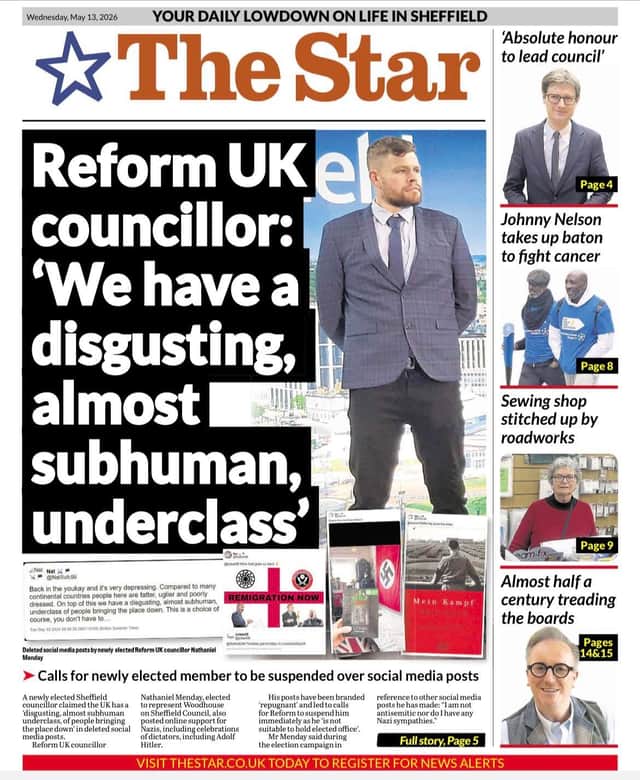
A former Reform councillor in Woodhouse told The Star that he believes “culture is downstream from ethnicity”, and that he doesn’t think “you are English just because you are born here”.
He’s not alone in this. Restore Britain, the latest far-right fringe party, has started advocating for “ethno-nationalism”. In recent weeks their supporters have told Rishi Sunak he isn’t and can never be English. They use a definition of “white Briton” that would preclude both Prince Philip and King Charles.
This is patently ridiculous. But they use their shock-jockeying to get attention, to get people talking about their own talking points rather than something that really matters.
Nathaniel Menday tells The Star that he likes “edgy jokes” and to “push boundaries”. And here he is, with articles about him and me commenting afterwards, a feedback loop that keeps us responding to a debate set on their terms.
I’m reminded that small boats have not always been viewed the way they are now. Recent crossings are a relatively new phenomenon and themselves a consequence of the Brexit vote.
A book I’m reading at the moment, God is an Englishman – take this as a recommendation – opens with a reminder that in the year 597, forty men crossed the Channel in small boats. From them spread a novel idea: Christianity.
One of their number, St Augustine of Canterbury, founded the organised church in England and established Canterbury Cathedral. True to form, the founder of what eventually led to the Church of England was of course born in Italy, but he lived in a time time when race and origin were far less significant.
Menday or Rupert Lowe might say that I, as a third-generation migrant, am not and can never be English. It’s because they have nothing else to offer, whether to me or to the millions of people in this country who want and deserve a better life.
Reform and Restore’s billionaire donors profit from our misery. They want our NHS to be privatised, our public services cut, and our jobs offshored. They are not happy we have a Labour Prime Minister talking about a National Care Service - care is a big money maker for American hedge funds. They want councils to go bankrupt from paying for it and for people to lose their homes in order to get it.
So they ask for distractions and they receive them, in a never-ending media debate about race and migration.
I am English, as is King Charles. But I’m not going to go out of my way to prove it to people who think that “culture is downstream from ethnicity”. They may hide behind concerns about culture, integration and shared values but when it comes down to it, more often than not they’re either eugenicists that want to measure skulls or bigots trying to recreate an England that only ever existed in rose-tinted nostalgia.
We should reject the half-fat view they’re offering us. England is and has always been far more than that.
Rather than who can pass someone else’s test of belonging, the more interesting question is whether everyone who lives here is able to build a secure and dignified life. When families are struggling and work is insecure, we should be talking about who benefits from that failure – and what we can do together to fix it.