
On the Wildside: Are Kestrels on the rise?
A photograph by local naturalist and wildlife photographer Peter Gribbon called to mind one of our most familiar birds of prey, the Kestrel.
The picture is a super close-up of this most evocative falcon, the subject of the Barnsley-set book and film ‘Kes, a kestrel for a knave’.
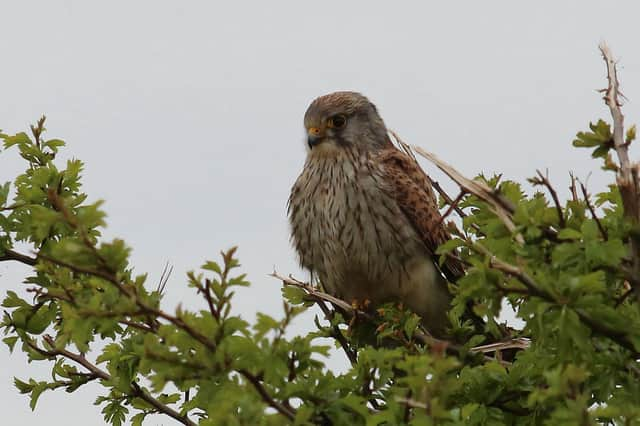

Also known as the ‘Windhover’ and quite commonly, but mistakenly, called a ‘Hawk’, the Kestel survived pesticide pollution and human persecution pretty well. Indeed, it quickly adapted to nesting in urban, high-rise buildings, and hunting along motorway and dual-carriageway verges. Along such linear habitats are rich pickings of field mice and field voles, plus insects like ground beetles. In expanding twentieth-century urban towns and cities like Sheffield, Kestrels also took up residence in the numerous abandoned quarries once used for stone and for brick-making. Indeed, it was in just such a location that as a young teenager, I watched my first pair of nesting Kestrels. This was in the old Woodside Quarry off Derbyshire Lane, Sheffield. At that time, these were the only birds of prey for a very long way around and were probably saved from the predations of ‘eggers’ by the precipitous cliff-face.
However, in recent decades there has been a rapid population growth of other raptors, such as Peregrine Falcons, Common Buzzards, Sparrowhawks, and Red Kites. These increases are welcomed but maybe not by Kestrels which may be squeezed out by competition from bigger, more aggressive species, and even killed and eaten in the case of Peregrines. These big falcons are very intolerant of other birds of prey in their territories. Surveys suggest Kestrel numbers in the UK stand at around 40,000 breeding pairs but this is a fall of nearly 40% in thirty years, losses probably due to intensive farming. Hopefully, improved conservation management of valuable habitat like scrub and wildflower meadows such as in Sheffield’s Graves Park, is helping these beautiful raptors. Indeed, the ‘Creation and Management of Scrub and Meadows’ are the subject of our forthcoming Sheffield-based conference on May 20 and 21 this year to help raise awareness.
Professor Ian D. Rotherham, researcher, writer & broadcaster on wildlife & environmental issues, is contactable on [email protected]; follow Ian’s blog (https://ianswalkonthewildside.wordpress.com/) and Twitter @IanThewildside