
Giant horny spiders head into Sheffield homes looking for a mate
They’re looking for mates...
I wrote last week about Michael Parker’s big spiders in Deepcar, and events have triggered this continuation.
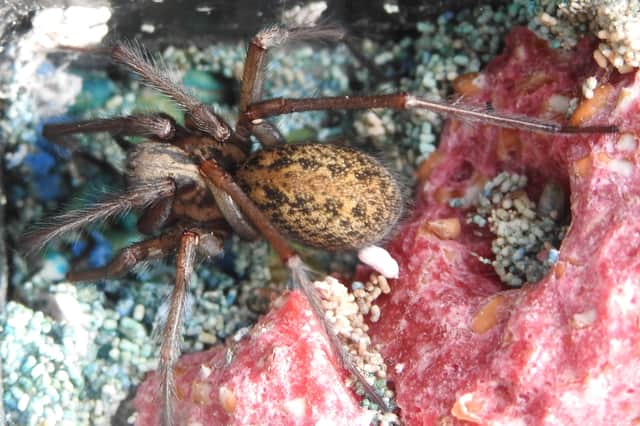

Essentially, there are several big spiders in this particular group, some quite common, others rather rare, many becoming commoner.
Some are “synanthropic” i.e., closely associated with people’s habitations. Others rarely venture indoors. Most of the Tegenaria group (now more correctly called Eratigena) are rather large and with legs often long in proportion to the body and sometimes rather hairy. (Interestingly, some spiders ‘listen’ with their hairy legs – but that is for another day).
So, for those who don’t like long-legged, big, hairy spiders (i.e., arachnophobes), these really are your worst nightmare! The males tend to have longer legs and smaller bodies than females, and the “palps” which look like an extra pair of legs at the front of the head, are expanded for reproductive purposes.
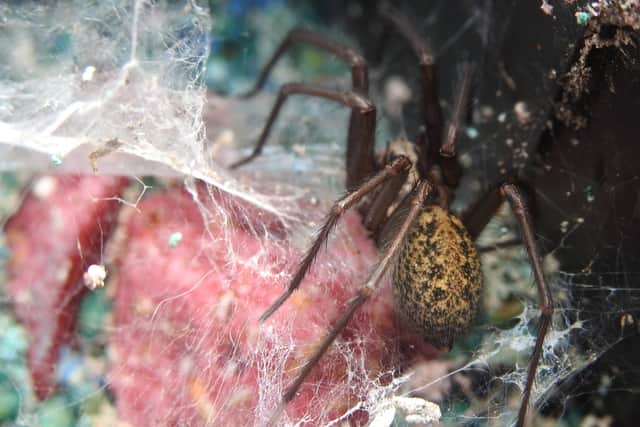
Both sexes use the palps for cleaning and to aid feeding.
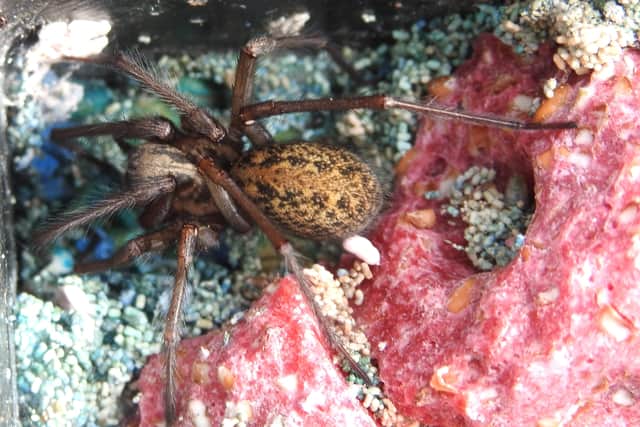
Males signal using these and transfer sperm to receptive females during mating. They then, try to escape without being eaten. I think Michael’s spider was the quite common Tegenaria gigantea, whereas the one pictured here is a female Tegenaria saeva in a container left outside my house; rather large with a decent-sized body and medium-long legs.
Around September, these impressive beasts go searching for females to mate with and this is when you are most likely to spot them scuttling across your living room carpet. They can be expected especially during long, hot summers and until the first frosts!
I have previously said these spiders are harmless, and mostly this is true. Nevertheless, having been summoned to remove a rather large, very long-legged individual from the carpet on our stairs, I carefully swept it up into the palm of my hand. Surprisingly, (for me at least), the spider bit me – and it hurt like a sting.
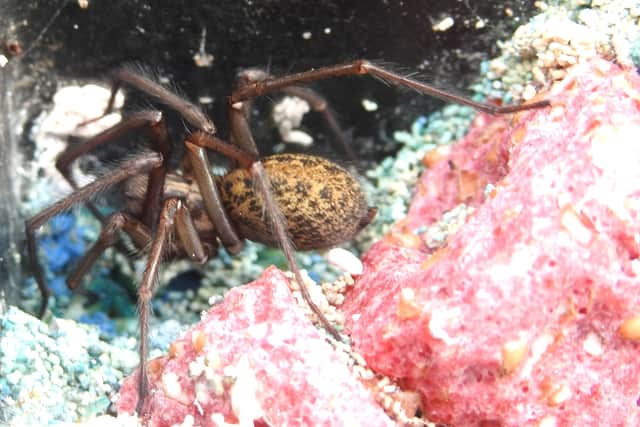
On a scale of painful stings and bites this would scarcely register, but even so, I was taken aback.
There was a tiny mark and a little redness but no more, but this dispels the “they don’t bite” argument!
The beastie was large, but it was night-time and quite dark so hard to discern reliable identification details. It was a male and presumably seeking a female. Was it I wonder, the fabled “Cardinal Spider” Tegenaria parietina?
Professor Ian D. Rotherham, researcher, writer & broadcaster on wildlife & environmental issues, is contactable on [email protected] ; follow Ian’s blog (https://ianswalkonthewildside.wordpress.com/ ) and Twitter @IanThewildside; BlueSky @ianthewildside.bsky.social