
Car park murder accused 'threw bottle' at victim Lee Davies but did not stab him, jury told
The man prosecutors claim may have inflicted the fatal wound on an associate in a Rotherham car park admits throwing a bottle and glass at the victim in self-defence - but did not stab or use a knife on him, a jury has been told.
Lee Davies died from a single stab wound to the left, top side of his chest, which penetrated cartilage between his ribs and breast bone through to his heart’s right ventricle, in the early hours of Tuesday, June 18, 2024.
Martin Shaw, Jake Shaw and Simon Welsh are all accused of murdering Mr Davies, aged 38, in an incident in a car park off Drummond Street. The three defendants deny Mr Davies’ murder and have been on trial at Sheffield Crown Court for the last three weeks.
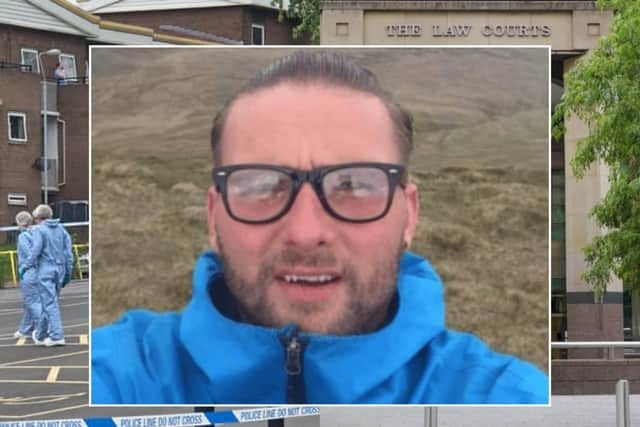

Opening the Crown’s case against the three defendants, prosecutor Craig Hassall KC has previously told the jury of six men and six women that at the time of the alleged murder the three defendants and Mr Davies were known to each other, and were all “drug users who would regularly spend time in Rotherham town centre.”
Mr Hassall told the jury an eye witness has suggested the fatal incident arose out of an argument over a £10 bag of crack cocaine, resulting in a “two-sided” fight, “with the three defendants on one side, and Mr Davies on the other.”
Mr Hassall alleges that one of the the three defendants, most likely Mr Welsh, produced a knife and stabbed Mr Davies, as one of the others shouted “stab him.”
Simon Welsh was acting in “self-defence” but did not stab victim, jury told
In his closing speech today (Thursday, April 10, 2025), Mark McKone KC, representing Mr Welsh, told the jury of six men and six women: “Mr Welsh was acting in self-defence and clearly, Simon Welsh denies that he stabbed Lee Davies with a knife. Simon Welsh also says he did not know anyone else had a knife with them. Therefore he says he did not encourage anyone else to stab Lee Davies with a knife, and knew nothing about a knife being used.”
Mr McKone said it is the defence case that Lee Davies was the aggressor that night, that alcohol “drastically” changed his personality and turned him into a “bully,” particularly when denied drink or drugs.
It is the defence case that Mr Welsh’s refusal to share his gin with Mr Davies resulted in the latter becoming aggressive towards the three defendants.

Mr McKone suggested Mr Davies’ “hunger for trouble” on the night of the fatal incident showed no signs of abating.
There was no time when Mr Davies did not pose a danger to the three defendants,” Mr McKone said, and that had he not suffered a fatal injury, he may himself have gone on to inflict serious injuries upon another.
Mr McKone said Mr Welsh, aged 38, “accepts throwing a bottle and throwing glass” and “accepts punching Lee Davies in the back of the head.”
He added, however, that Mr Welsh did not use, or stab, Mr Davies with a knife, and had “no intention to cause him really serious harm.”
Post-mortem and missing murder weapon
Mr Hassall has previously told the jury that for the defendants to be guilty of murder, the prosecution does not need to prove they set out to kill Mr Davies, but simply that they intended to cause him “really serious bodily harm.”
The prosecutor has also asserted that “each of the defendants either inflicted the fatal blow, assisted the person who did, or encouraged the person who did.”
Mr Hassall said participating in the violence leading up to the fatal, including throwing punches, could constitute “assisting.”
The murder weapon has never been recovered, but forensic pathologist Charlie Wilson concluded, following a post-mortem examination, that Mr Davies died from a stab wound to his chest, which is believed to have been caused by a bladed article approximately 10cm in length.
Mr Wilson suggested the precision with which the fatal wound was caused, along with its depth, are indicative of an incision caused by a knife of that length. He suggested a more ‘irregular and jagged’ wound would be present, had it been caused by a shard of broken glass. He deemed suggestions that the fatal stab wound could have been caused by broken glass thrown at Mr Davies as ‘totally implausible,’ the court has previously heard.
Use of glass on murder victim who died from fatal stab wound would be “bizarre thing to make up”
Continuing in his closing speech, Mr McKone said: “Simon Welsh said in his evidence he was trying to scare Lee Davies away. In his words, it was ‘really hard work, he wouldn’t stop’.”
He told the jury he accepted they were likely to conclude that the findings of the pathologist that Mr Davies died of a stab wound caused by a bladed article - as opposed to sustaining the fatal wound with a shard of broken glass thrown at him - because “he is the expert.”
Mr McKone suggested that had Mr Welsh indeed stabbed Mr Davies with a knife, as the prosecution allege, it would be a “bizarre thing for Simon Welsh to make up that he thought he had killed Lee Davies with glass - in a murder trial.”
In addition, Mr Welsh could have suggested that the wounds inflicted with the knife were not “as serious” had he used a knife on Mr Davies, Mr McKone said.
He continued: “There’s a real possibility that around the same time was throwing glass, someone else quickly used a knife to stab Lee Davies, without Simon Welsh seeing the knife as he was focused on what he was doing - and not focused on what someone else was doing.”
“Simon Welsh cannot be seen stabbing Lee Davies with a knife”
Furthermore, Mr McKone suggested that had Mr Welsh really been in possession of a knife throughout the fatal incident, he would not have needed to use the “less effective weapon” of broken glass upon Mr Davies.
Jurors were told that in the view of Mr McKone, and his defence team, the CCTV they have been shown in evidence matches up with Mr Welsh’s account.
He added that despite what the prosecution allege concerning the CCTV evidence, “Simon Welsh cannot be seen stabbing Lee Davies with a knife,” that he “cannot be heard dropping a knife.”
It is the prosecution case that Mr Martin Shaw was the one to pick up the knife, which has since vanished.
Mr McKone suggested that if Mr Welsh had really just stabbed Mr Davies with a knife he “would not have wanted to be without it” and is unlikely to wanted to leave it to someone else to pick it up.
Alleged GBH incident seven months earlier
Mr Welsh of Doncaster Road, East Dene, Rotherham, also faces an additional charge of inflicting grievous bodily harm with intent, which he denies. The assault is alleged to have taken place in the same covered Tesco car park, off Drummond Street, around seven months earlier on November 6, 2023.
He is accused of attacking a man by the name of Michael Williams, who has since died from cancer.
Mr Hassall said the attack upon Mr Williams also arose out of a ‘rather trivial altercation’, during which he threw ‘two vicious punches’ whilst Mr Williams was unconscious on the tarmac of the car park.
Prior to the jury being sworn in this morning, Mr Welsh pleaded guilty to a lesser offence of causing Mr Williams grievous bodily harm without intent, but this has been rejected by prosecutors.
Mr Hassall explained: “What else could he have intended when he threw two really hard punches at the head of a man who was already unconscious in that supermarket car park?”
Mr McKone told jurors that while Mr Welsh did act in a “disgraceful” manner towards Mr Williams, and did act “unlawfully” he did not have an intent to cause grievous bodily harm.
The incident, said Mr McKone, unfolded after Mr Williams “threatened” Simon Welsh, and began acting in a violent manner.
“Simon Welsh accepts he went beyond reasonable force,” Mr McKone said, but added that it was a “fast-moving” incident, which caught Mr Welsh off-guard.
Defendants’ denials
Mr Welsh, Mr Jake Shaw, aged 27, of Canklow Road, Canklow, and Mr Martin Shaw, aged 46, of no fixed abode, all deny murdering Mr Davies.
Mr Welsh also denies a further charge of inflicting grievous bodily harm.
The trial continues.