
How to protect eyes and watch Wednesday’s partial solar eclipse safely

Protection, pinhole cameras, colanders - here’s how to see the eclipse safely
As Britain prepares to witness Wednesday’s partial solar eclipse, eye health experts at Optegra Eye Clinic Sheffield are urging the public to take simple precautions to protect their sight.

It’s a warning that cannot be stated strongly enough - avoid looking directly at the sun, even for a few seconds.
A danger posed by every eclipse is that carefree viewers will look at the spellbinding spectacle of the moon passing in front of the sun without protection - and risk permanently damaging their eyes and even blinding them.
With eclipse-viewing expected to capture the nation’s attention, Optegra’s chief medical officer, Mr Amir Hamid, shares this expert advice on how to enjoy this incredible natural phenomenon safely, without putting eyesight at risk.
He said: “Looking directly at the sun during an eclipse can cause permanent damage to the retina, the back of the eye, even when the sun is partially obscured by the moon.
“While watching the eclipse can be an unforgettable experience, it is important to view it in a way that protects your eyes from the sun’s powerful rays.”
Simple ways to view the eclipse
Mr Hamid says there are two simple ways to enjoy the eclipse safely:
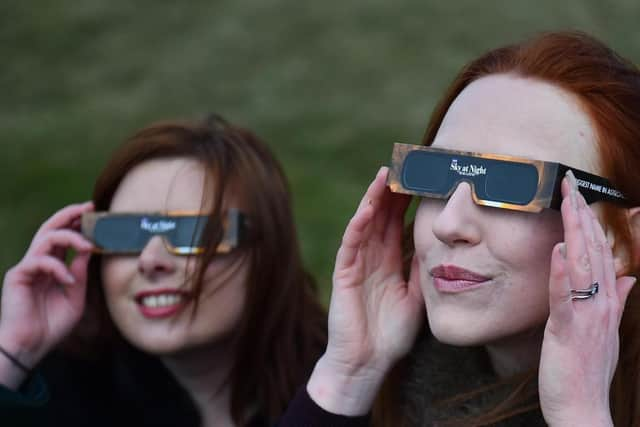
Wear specialist eclipse glasses - if you want to look directly at the eclipse, use specialist solar-viewing glasses that meet the ISO 12312-2 safety standard. Ordinary sunglasses do not provide sufficient protection only certified glasses are appropriate as they block out radiation and 99 per cent of sun’s light.
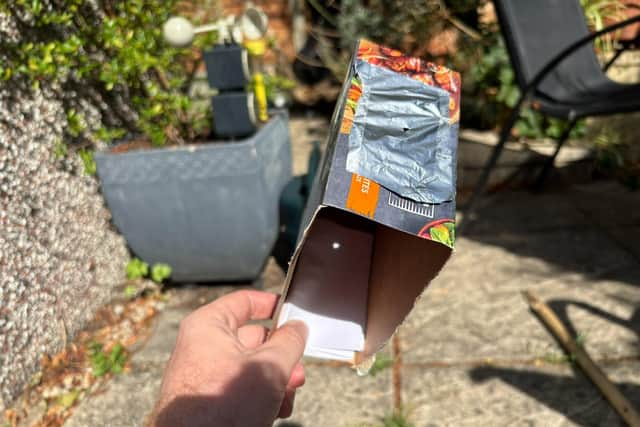
Make a simple pinhole projector - a simple pinhole viewer is an easy way to watch the eclipse without looking directly at the sun. Simply make a small hole in a piece of card and hold it in front of another piece of card/paper to crate an image of the sun. As the eclipse progresses, you will see the projected image change shape as the moon casts its shadow. Get crafty and this can be done using a cereal box to make a mobile projector!
A kitchen colander! - Similar to the pin hole projector, holding a kitchen colander up in front of a piece of card will also show the shadow of the moon over the sun.
Finally, never use ordinary cameras, binoculars or telescopes – looking at the sun through optical equipment without a correctly fitted solar filter can cause serious eye injury.
Mr Hamid continues: “The simplest rule is that if you are looking directly at the sun, you need specialist solar protection. If you don’t have suitable eclipse glasses, indirect viewing is the safest option.”
Can I look at the eclipse through my phone? - A viral tip shared online is to view the eclipse through your phone’s camera, either the main camera, or by facing away and looking at the sun in the selfie camera. But this is not recommended - 1) looking up at the sun to take a photo can easily result in accidentally getting the sun in your eye and causing damage, and 2) NASA warned during the US total eclipse in 2024 this is very likely to damage the phone: “The phone sensor could be damaged just like any other image sensor if it’s pointed directly at the Sun.”
Optegra Eye Health Care is a specialist provider of ophthalmic services. Established in 2007, with its first hospital opening in 2008, it has completed over one million eye procedures from its 74 eye hospitals across the UK, Czech Republic, Poland, Slovakia and Holland.
- RELATED: Sheffield mum and daughter star in Boots campaign after cancer journey (aff)
- RELATED: Sheffield star influencer meets local homeless pets
- RELATED: Fatal accident fears as children hang off eight-storey NHS office
- RELATED: Road safety boost as lollipop lady starts work at notorious accident blackspot