
When Two Faiths Break Bread Together
Last month, the coinciding of two significant events in the Christian and Islamic faiths resulted in a meaningful interfaith community celebration at Firth Park Methodist Church.
For the first time in 33 years, Lent and Ramadan ran alongside each other.

Both are sacred seasons of fasting, prayer, and spiritual reflection, but they belong to different religious traditions and follow different practices.
Yet, they both culminate in major moments of renewal and celebration in the Christian and Islamic calendars. Easter, marking the death and resurrection of Jesus Christ, and Eid al Fitr, marking the end of Ramadan.
The overlap of these two periods provided a unique opportunity for believers across both faiths to reflect not only on their own traditions but on the shared human values that sit beneath them. It was a moment that invited deeper empathy. A reminder that while our rituals may differ, the desire for spiritual connection and personal transformation is something many of us hold in common.
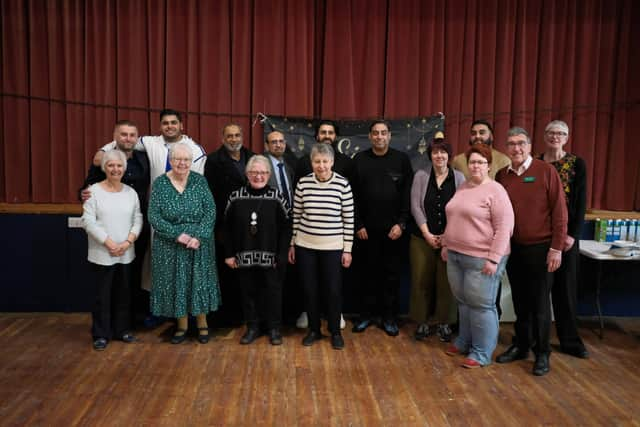
The event at Firth Park Methodist Church, which featured a community meal and reflections from faith leaders, brought together people from across the area.
Conversations flowed naturally across faith boundaries. What could easily have been a symbolic gesture instead became something much more practical and intimate: a community sitting down together to listen, share, and connect. And a universal message of peace, love, and community.
Funded by Firth Park councillors Fran Belbin and Abdul Khayum, and organised by Vision313 (who have an ongoing commitment to fostering unity and strengthening community ties across Sheffield), speakers included Audrey Mann, David Hamburg, Shaykh Camran Munir, and Pastor Bohus Kandrac.
The event was described on social media as “fabulous” and “inspirational,” with many commenting on how uplifting it felt to see people from so many backgrounds mixing freely. In times when division often feels louder than unity, small gatherings like this can feel quietly radical. There was no agenda beyond connection, and no expectation beyond mutual respect.
Even though Christianity and Islam are distinct faith traditions (and even within each there exists rich internal diversity), there is more that unites than divides.
Both faiths call on their followers to seek peace, practise compassion, help the vulnerable, and strive for justice.
Both traditions encourage acts of charity and acts of intentional reflection.
Both ask their communities to consider not only who they are, but who they hope to become. It is this shared moral ground, this collective yearning for peace and belonging, that transcends religious boundaries. And, crucially, it is not only a desire common to people of faith; it’s something that resonates across society as a whole.
The timing of the event felt particularly significant because it arrived just five months after the implementation of the Faith and Belief Charter – a new agreement between Sheffield City Council and local faith and belief groups.
Sheffield is a city of many different communities, and the charter represents a commitment to work together, promote good community relations, and build cohesion. It also acknowledges the potential for tensions to arise and sets out how collaboration, respect, and clear communication can help communities navigate those moments constructively.
The Firth Park gathering served as a gentle example of what the charter looks like in practice: people choosing to meet each other not as categories or caricatures, but as neighbours.
Beyond the symbolism of the event itself, there’s a broader question worth asking. What does it mean for a city like Sheffield when sacred seasons overlap?
Perhaps it offers a chance to slow down and recognise that for many people, faith is not an abstract concept, but something lived every day – in their homes, their choices, their generosity, and their hopes.
When two major traditions enter periods of reflection at the same time, it creates an environment where spiritual contemplation becomes something shared, even if quietly, across communities. It becomes easier to appreciate what others hold sacred because we are already thinking more deeply about what matters to us.
If anything, the event at Firth Park highlighted the quiet leadership that often goes unnoticed in local communities.
The volunteers preparing food, the faith leaders offering reflections, the councillors securing funding, and the organisations like Vision313 working behind the scenes. All of them play a vital role in weaving the social fabric that holds the city together. Events like this do not happen by accident. They are the result of people who decide that unity is worth the effort.
In a world where division often makes headlines, stories like this might seem small in comparison. But perhaps that is exactly why they matter. Grand gestures make statements; ordinary gatherings change relationships. And real social cohesion is built not through grand declarations, but through hundreds of small moments of connection that ripple outward.
The question, then, is how do we sustain this spirit beyond one evening? What would Sheffield look like if events like this were not occasional highlights but regular occurrences? How might neighbourhoods feel if more of us took the time to attend, to listen, to learn from others whose experiences differ from our own?
Unity, after all, is not passive. It’s something we build, intentionally, through repeated acts of openness.
As we move forward from a season marked by shared reflection across two major faiths, perhaps the message we can carry with us is simple: the more we choose to see the humanity in others, the stronger our communities become.
And sometimes, it starts with something as ordinary – and as powerful – as sitting down at the same table and breaking bread together.