
Watching for the remarkable cormorants
Cormorants - an omen of bad luck or the anglers' best friend?
The photograph provided by Peter Gribbon reminded me of a remarkable story of recovery, though perhaps something not wholeheartedly welcomed by anglers!
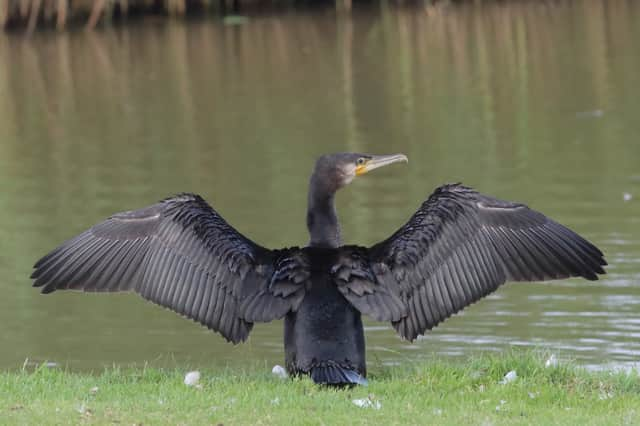

The Cormorant is one of our most distinctive birds and a species that has really bounced back from a low point of the 1970s when a mix of water pollution, persecution, and habitat loss or degradation had taken a severe toll. This is also a bird shrouded in imagery with its black plumage and the wings held out to dry to give the appearance of a devil-bird and full of foreboding.
The characteristic pose of the bird, wings outstretched, as the bird dries itself after a fishing foray, is because this is a waterbird with an apparently serious design fault – since its plumage is not waterproof. However, there is a good explanation and justification for this. These birds have permeable, wettable feathers and they do become waterlogged and you might think this is a disadvantage.
Nevertheless, this brings about an evolutionary adaptation and advantage because it means that with reduced buoyancy, they can dive deeper and fish for longer. They lack the oil-producing, waterproofing glands and so need to dry out.
In culture and folklore, with their voracious fishing habits, Cormorants, are taken as symbols of greed and gluttony, but resourcefulness too. With multiple meanings and interpretations, some cultures think Cormorants symbolise nobility and indulgence.
The association with the Devil is obviously to do with their dark plumage and the ominous image of the wings held out almost shroud-like and taken as an omen of bad luck. Yet the fishing abilities are also considered to be positives in places for example, across Asia, where fishing communities work with Cormorants to catch fish. In these places, Cormorants are recognised as vital partners essential to the local economy. There are other associations too, and in the mythology of Norse and Celtic cultures, these birds were suggested to be the spirits of the dead now visiting their still living loved ones, and around the world, in Australia, Aboriginal cultures viewed Cormorants as carriers of their ancestral spirits.
Professor Ian D. Rotherham, researcher, writer & broadcaster on wildlife & environmental issues, is contactable on [email protected] ; follow Ian’s blog (https://ianswalkonthewildside.wordpress.com/ ) and Twitter @IanThewildside; Bluesky @ianthewildside.bsky.social