
Sheffield wildlife column: Birds keeping cool
Increasingly hot summer weather means we need to keep cool, and for nature the same applies but it isn’t so easy. For birds, their activity levels seem to drop on hot, sultry days as temperatures peak, though they are still singing loudly from selected, shady song-posts. Indeed, for many birds, mammals, and reptiles like snakes and lizards, a good way to moderate body temperature (either too hot or too cold), is to move to spots which are either shady, sheltered, or sunny, as required. However, such manoeuvres may still be insufficient, and a response to being over-heated for example, may trigger behavioural actions.
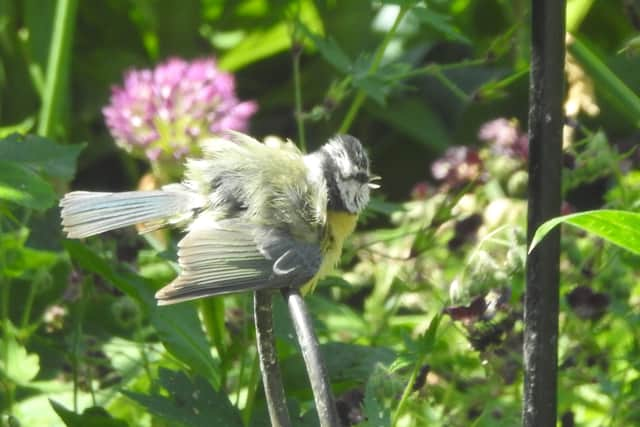

A key to understanding the problem is knowing that birds don’t have sweat glands (as we do) and like us, they have high body temperatures. So, in very hot weather, they must depend on adaptations to their physical and behavioural activities to combat the overbearing heat. Their responses include actions like panting, and in some species (particularly Owls and Cormorants) so-called gular fluttering where they use the muscles around the throat to increase air-flow and cooling effect. Many bird species also bathe and manipulate their feather positions to promote heat loss from the body. During prolonged hot weather you can observe these behaviours and adaptations as the birds try to avoid overheating. Of course, some actions like splaying of the wing feathers and lying out in the sunshine are also used to help control parasites, as well as to cool down. I have recently seen Dunnocks doing the former (parasite control sun-bathing), and Blue Tits as pictured, doing the latter (i.e., cooling down). Birds with dark plumage such as Jackdaws and Carrion Crows seem to suffer particularly badly because black feathers absorb the sunlight very efficiently, and I have seen birds of both species seemingly struggling to cope. Their activity levels drop to a minimum and the feathers, especially the wings and around the head and nape, are opened up to maximum effect. We can of course help out by remembering to provide adequate water via ponds and bird-baths and especially during dry conditions.
Professor Ian D. Rotherham, researcher, writer & broadcaster on wildlife & environmental issues, is contactable on [email protected] ; follow Ian’s blog (https://ianswalkonthewildside.wordpress.com/ ) and Twitter @IanThewildside; BlueSky @ianthewildside.bsky.social
- RELATED: Music legend joins civic celebrations as historic club honoured
- RELATED: Sheffield lions gives young players a new home
- RELATED: Sheffield social media star wins award for inspiring children with stammers
- RELATED: Sheffield Theatres appoints international arts professional to emerging producer scheme