
On the wildside with Professor Ian Rotherham: Buzzards doing very well indeed!
The ‘Common’ Buzzard is nowadays living up to its name, and I can scarcely step outside the house without seeing or hearing one.

A few weeks ago, I even had a Buzzard ‘tumbling’ (territorial showing off display) quite low over the house. This is in marked contrast to my first ever sighting over Meersbrook in Sheffield back in the 1970s, which was a single bird just a tiny dot high in the sky and presumably migrating.
The next individual was also quite high up but over Peveril Castle at Castleton in the Peak District. Indeed, I think that was the sum total of my local records of ‘not-so’ Common Buzzards in the 1970s. But now they are back with sightings of five or six birds together over Graves Park this spring, and similar reports from Meersbrook and from Gleadless Valley.
Of course, the distinctive, rather plaintive, mewing’ cries can be heard at a good distance and so if they are around then you generally know. Occasionally readers do mistake a large, female soaring Sparrowhawk for a Buzzard but the Hawk’s wings are short and in proportion, the tail is longer. Also, whilst they do soar in good, hot-air thermals, a Sparrowhawk will eventually fly with its trademark ‘flap-flap glide’ motion of its wings.
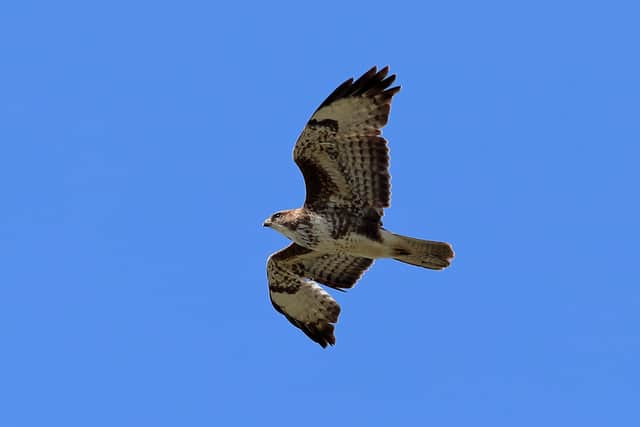
The picture this week is a photograph taken and kindly sent to me by local naturalist Peter Gribbon. It is worth noting how the patterns of dark brown and white on the plumage do vary considerably from one individual to another, and this also varies with age.
However, the markings can make for confusion between different species of birds of prey, but generally the experience suggests that the safest bet, if you are unsure, is ‘a Buzzard’. We do have the rather large and spectacular Rough-legged Buzzard, but that is very rare and only an occasional winter-visitor to the high moors of the Peak or to lowland sites like Doncaster’s Thorne Moors. The other species which does occur regionally, particularly in around Sherwood Forest, but is very rare, is the Honey Buzzard.
Professor Ian D. Rotherham, researcher, writer & broadcaster on wildlife & environmental issues, is contactable on [email protected] and Twitter @IanThewildside