
On the Wildside with Ian Rotherham: Big Green Caterpillar causes quite a stir
I wrote previously about how the Elephant Hawkmoth caterpillar got its name, because the large, thickset larva looks rather like an elephant’s trunk – basically long, wrinkled and brownish-grey in colour.
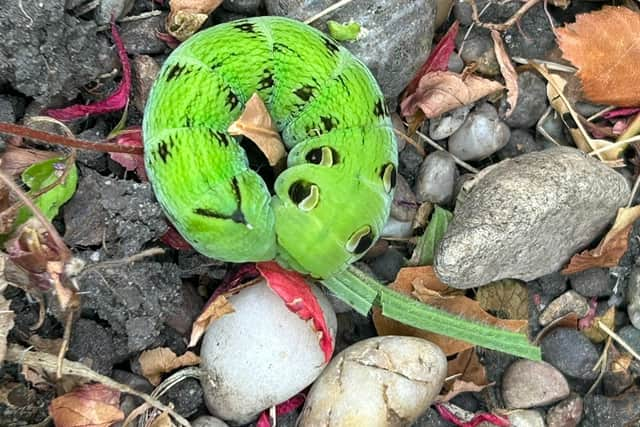

This all makes sense but there is a twist in the tale (or perhaps in the trunk?) as highlighted by a picture sent to me by reader Tristan Swain. This was a rather large and spectacular green caterpillar as shown in the attached picture.
He came across this beauty whilst gardening in Millhouses in Sheffield, and close to the edge of Ecclesall Woods. The big beast was found minding its own business in a Fuchsia bush which is indeed, one of the food-plants for the Elephant Hawkmoth, and particularly so when the caterpillars turn up in gardens. In wilder areas, along disused railway lines, and on what when I was a child we called ‘waste ground’, they are found on stands of Rosebay Willowherb.
The markings such as the ‘eyes’ and the hooked tail, give this away as Elephant Hawk rather than one of the other green hawkmoth caterpillars, but what on earth is going on?
Well, the colouring and markings are key to survival and have evolved as parts of the hawkmoth’s strategy to avoid being eaten by predators or parasitised by tiny wasps. The darker elephant’s trunk markings are typical of the older, more mature larvae and help blend with the colours and forms of the habitat as they go in search of safe, earthy places to nestle down and pupate for the autumn and winter.
However, when they are young, all Elephant Hawkmoth caterpillars are indeed bright leaf-green, and this acts as camouflage in amongst the leaves they are feasting on. As they mature and age their colour morphs into the more familiar brownish-grey – usually!
Some caterpillars, for reasons unknown, are perhaps genetically predisposed to remain bright green and so don’t change. Or maybe this is something influenced by their immediate environment, and their colour change reflects, chameleon-like, their botanical backdrop. Anyhow, Tristan’s stunning caterpillar is an unchanged Elephant Hawkmoth.
Professor Ian D. Rotherham is contactable on [email protected], ianswalkonthewildside.wordpress.com, X @IanThewildside and BlueSky @ianthewildside.bsky.social