
From didgeridoo to Human League as Lost Chord's Luke use music to reach people with dementia
It’s quite difficult finding one phrase that sums up Sheffield musician, composer and arranger Luke Carver Goss…though multi-talented is absolutely applicable.
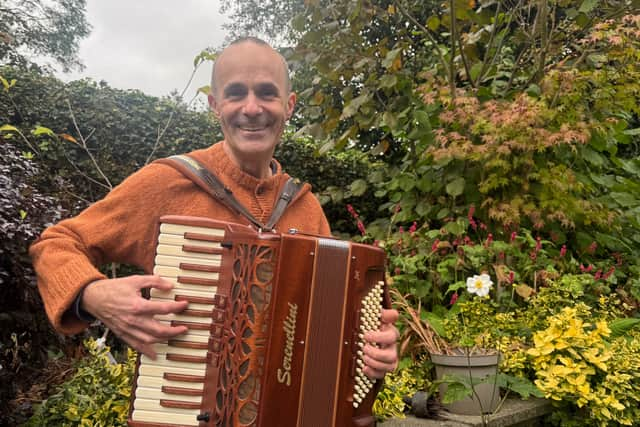

If you’re looking for a musician he’s almost certainly your man as he plays, accordion, piano, organ, guitar, recorder, tenor horn and French horn.
Then there’s the one thing on the CV that people find most intriguing - ancient Australian wind instrument the didgeridoo.
“People really are much more impressed by that than anything else I do,” he laughs.
“A large part of the skill is about circular breathing - breathing in and out at the same time.”
A classically-trained musician - he was an organ scholar at Oxford University - and a popular folk musician, Luke’s work as a composer includes commissions for BBC National Orchestra of Wales, the Cultural Olympiad and for festivals and concerts up and down the UK.
He has co-curated the Sage Gateshead’s first Words and Music festival with Bard of Barnsley poet Ian McMillan.
He was also the main writer for The Ian McMillan Orchestra, as well as writing for The Devil’s Violin group - with his regular performing partner Oliver Wilson-Dickson - and composing for the celebrated Black Dyke Brass Band, Tredegar Town Band and Grimethorpe Colliery Band.
One of Luke’s greatest passion, however, is music in the community - he works extensively in arts-and-health and community settings.
And one of the most important of those health organisations is South Yorkshire founded national charity Lost Chord UK.
Lost Chord UK’s mission is to improve the mental health, well-being and quality of life for people living with dementia and other neurological conditions.
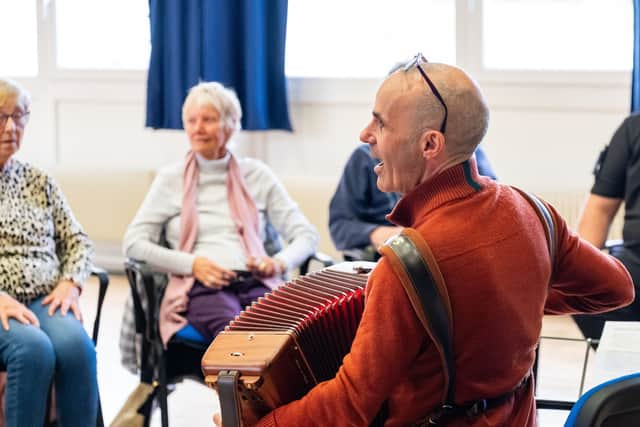
Sheffielder Luke has been playing for the charity since 1999, making him officially the charity’s longest serving musician.
“I think you are there to bring some degree of happiness to the people who are there with you," he said.
“It’s your job in the time that you are there with them to be happy with them too because if you’re not happy they won’t be.
“But I always feel happy when I am playing and even if just one person connects with you during a session, it makes me feel that what I’ve done is worthwhile.”
In those early days, performances mainly took place in care home settings but as the charity has grown in recent years, so has its approach to sharing its music.
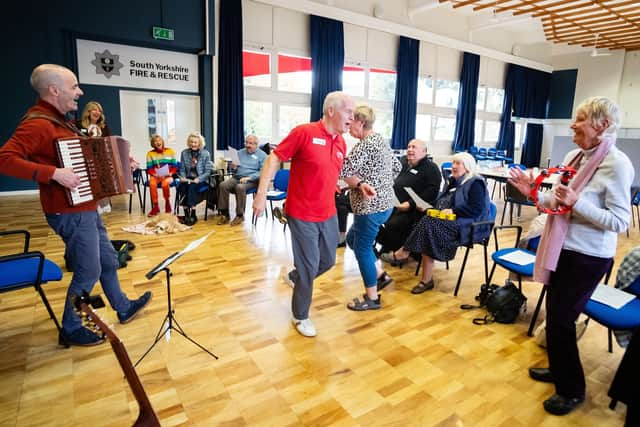
As well as going into care homes and hospices, the charity now also brings live interactive music to people in community spaces with tea and tunes and community choir sessions around Yorkshire and nationally.
Its musicians also provide highly personal one-to-one bedside live music when someone is too ill to join in a session or is approaching the end of life.
And now, for the first time, Lost Chord UK is even taking live music into private homes with its Music Made Personal pilot scheme.
More than 20 years ago, the audience might have enjoyed the memory of Dame Vera Lynne - for many years Lost Chord UK’s patron - and the sounds of the war years but time moves on and If that means performing a version of the Human League’s Don’t You Want Me, then Luke is happily up to the challenge.
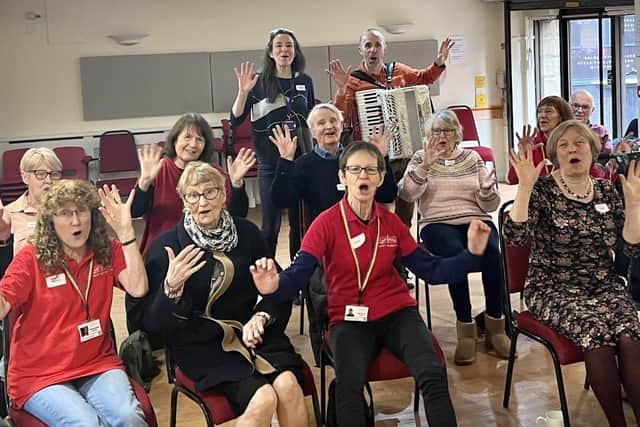
“Of course you have to move with the years and the material you are performing has to change,” Luke says.
“It’s good to have those vintage numbers to hand because every now and again they do get requested, those golden numbers that stand the test of time.”
Even after so many years with the charity, Luke remains fascinated by the ways that music can reach out to people who might perhaps have lost all other means of communication.
“In some way, music and the words connected with a song are somehow lodged in people’s brains in a way that is different to normal everyday language,” he says.
“People can still access lyrics to songs and melodies and you will see people who are mainly non-verbal singing complete songs if they knew them in their youth.
“Sometimes you will be with a family member and you will see tears when they see somebody they love singing when they haven’t spoken for many months.
“It proves again and again that music connects with human beings in a way that is very tangible and very real.”
The real strength of the Lost Chord UK approach, he adds, is that the music is always live.
“It is completely different from having a tape or a CD or a streamed performance,” he says.
“You are in the room with your audience, reach out to them and even the simple vibration of the instruments can have a big impact .
“Those vibrations are important because it’s all about human beings connecting with each other - it’s taking the music to a higher level than you could ever get with a recording.
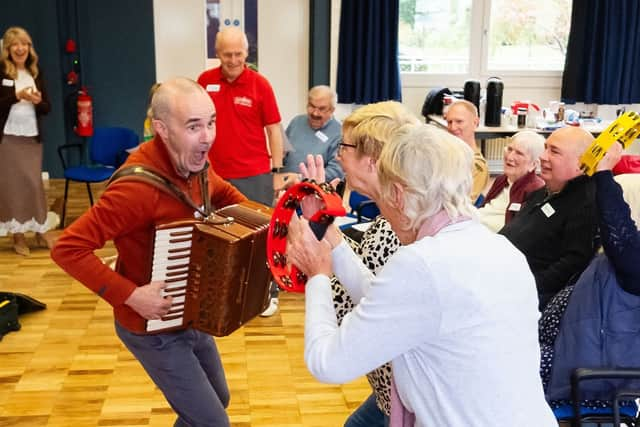
“The important thing about the work we are doing with Lost Chord UK is that they are truly interactive, the idea is to get the people we are playing for physically engaged through singing, movement and even using instruments.
“The reason I carry on doing it is because I love it - you can feel apprehensive when you first arrive at a new venue but you quickly relax into what you are doing.
“And then you see somebody perhaps just gently tapping their foot and and you know you have that very special connection.”
To find out more about the work of Lost Chord UK and how together involved visit lost-chord.org.uk