
Exclusive:Error, fallout and whether he dived - Linesman from Paolo Di Canio's Sheffield Wednesday ref push tells all
Aside from Paul Alcock and Paolo Di Canio, nobody was closer to one of the most important moments in Sheffield Wednesday history than Michael Ryan. Here, he tells his story for the very first time, with Alex Miller.
“Anyone in football will tell you that the changing room, particularly half-time, is sacrosanct. That’s your space to regroup and discuss everything and get back out there. Usually there would just be the officials, the referee liaison officer and a pot of tea.
“That wasn’t the case that day.”
It was sometime before 4pm on September 26 1998 and as Michael Ryan left the field to the sound of a Hillsborough stunned to a strange and subdued hum, he wandered down the tunnel and into the officials’ changing room just around the corner. The linesman had been but a few metres from the incident that saw players from Sheffield Wednesday and Arsenal come together in fisticuffs - and was closer still as Paolo Di Canio delivered the moment that many believe changed the course of Wednesday history.
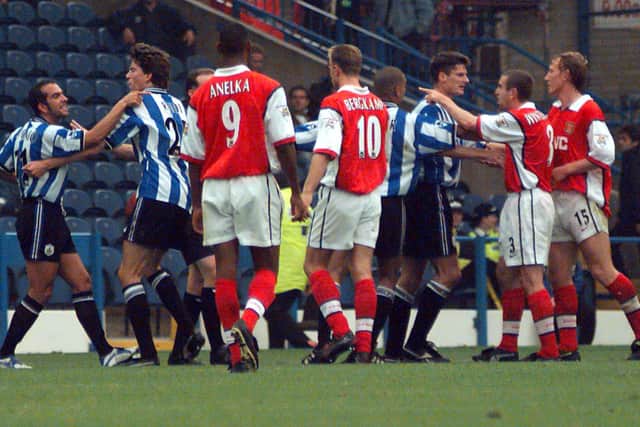
All hell had broken loose in the 43rd minute of the match as Patrick Vieira’s handling of a Wim Jonk tackle had spilled over into a melee. Hothead Di Canio had kicked out at Martin Keown, Keown had grabbed him by the throat and the latter pair, locked in a grapple, were to be sent off. What nobody expected of course was for the Italian to lay hands into the chest of Paul Alcock and for the referee to go sprawling to the turf, stopping the Sheffield Wednesday world in a moment.
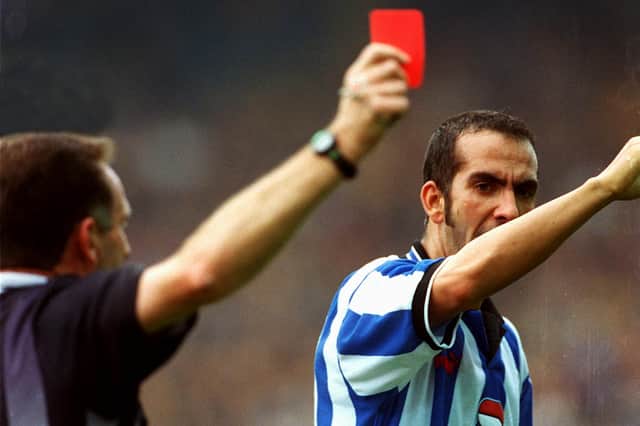

Together with Alcock - who sadly died in 2018 aged just 64 - and fellow linesman John Holbrook, Ryan bundled himself into the changing room to regroup and take a deep breath. There to greet them was indeed the referee liaison officer, but so too were the referee assessor, Owls manager Danny Wilson and two members of the local constabulary.
“There was a lot of shock,” Ryan remembered of that wander into the changing room speaking to The Star nearly three decades on. “It was a rather interesting half-time to say the least. From an official’s point of view you’re sat there with each other in complete shock, thinking to yourself ‘Has this actually happened?’
“The assessor has come down and is trying to speak to us about what’s gone on, Danny is there to make sure Paul is OK and told us not to worry because Paolo had left the stadium, he’d gone before half-time. The police wanted to know if we needed anything. We said no and eventually they left.
“And Paul’s sat there. He's had this incident. I could only speak for myself, but I wasn't sure that Paul was in the right frame of mind to go out and referee the second half. That's my personal opinion and unfortunately Paul's no longer with us to tell us whether that was the case or not. It was a tough 10 minutes. You’re sat there and you know it’s going to be all over the press. It’s news item number one and you’re part of it.”
Di Canio was later banned for a total 11 matches and fined £10,000 - having earlier been immediately suspended by Wednesday themselves. In the moments after the push, manager Wilson had approached Alcock with Ryan in earshot to enquire as to his well-being and seemed to shun the Italian, condemning his actions in strong terms during his post-match press conference.
.jpeg?trim=66,0,67,0&crop=&width=640&quality=65)
Wednesday’s handling of the situation has been a source of debate since, with Di Canio later claiming the actions of the higher-ups made him feel ‘betrayed’ and that he went two weeks without contact from the club. He’d never play for them again and would go on to cement Premier League legend status with West Ham United following what was felt to be a cut-price £1.5m sale.
Though aspects of Di Canio’s recollection are disputed by Wilson and others, a section of the Wednesday fanbase feel a more diplomatic approach akin to that of Manchester United following Eric Cantona’s infamous kung-fu kick could have helped prevent a slide that has seen them fall far from top tier contention.
Ryan replied with surprise when told of how seminal the incident is still believed to be in some parts of Sheffield and recalled a moment that could and in his mind should have altered the trajectory of the game to the extent that the coming-together would not have even happened.
“Wednesday should have had a man sent off early,” he said on an incident that saw Emerson Thome yellow carded after two minutes in the days before communication between officials was commonplace and aided by technology. “It was on my side and first of all, I think everybody needs to remember Arsenal were a tough team, a tough team to referee, a tough team to play against.
“There were some very, very strong players in that side, very well coached and they really didn't take prisoners. And they were also very quick in certain areas. I remember Nicolas Anelka having a ball pushed through to him and setting off. He just got over just the centre circle in my half and the centre half grabbed him and pulled him back.
“To my mind it was a red card because it was denying an obvious goal scoring opportunity. We're talking about Nicolas Anelka here. Had he got clear, he's certainly got a chance on goal. And from there I just found the game was a little touchy throughout. They were frustrated, the crowd was up and it was just getting a little bit nasty in midfield, one or two tackles going in. You're going, ‘hang on a minute, this is getting a little bit fractious’, you know. And then we came to the incident.”
Ryan recalls initially trying to hold Wilson back from his check-in on Alcock in fear that the Wednesday boss was acting in anger and guiding Di Canio towards the tunnel while keeping his distance given the events that had unfolded moments before. And then from the other side of the field came raging Gunners left-back Nigel Winterburn. Footage of the day shows the Lancastrian linesman jumping between the pair to prevent any further aggression, with the England defender flinching backwards as the Italian turns towards him.
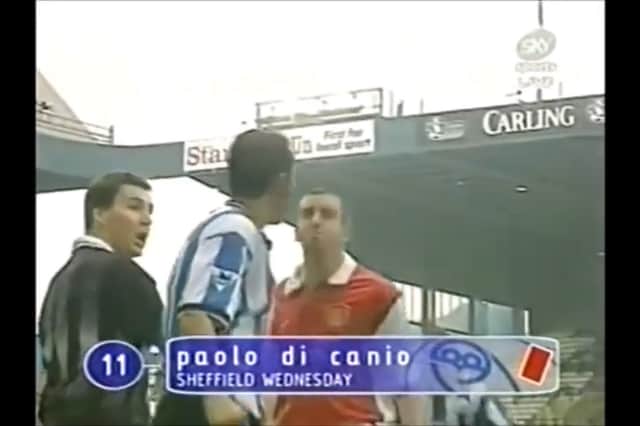
“You can see from the video I jump in and then I kind of lift my head backwards,” he said. “And the reason behind that is that I see, as I see Winterburn coming in, I see Di Canio and it looks like he's going to spit at him, in my direction. I move back and Winterburn stops and backs off. My first impression was that he was going to spit. He went down the tunnel and that was that. We’ll never know. But there was a lot going on in that moment.”
Spare a thought for Lee Briscoe, whose stunning chip beat Alex Manninger to earn three points for the Owls but is rarely remembered given what had come before. Match complete and after a moment or two of contemplation between the officials post-match, Ryan collected two family members who has travelled with him to the match and had become somewhat refreshed in the bar, warning them that they would likely be hounded by press while leaving the ground and that under no circumstances should they be snapped giggling or making light of the situation.
The three officials and their guests took a deep breath on stepping out through the doors of the Hillsborough director’s entrance to be met by an audience of zero. An accountant by trade, Ryan was relieved to go back to his life and was not once contacted or mentioned in the rabid media coverage the fallout from the match received. The same experience did not befall Alcock, whose theatrical-looking tumble encouraged widespread debate over whether he ‘took a dive’ - and still does to this day.
”It looked horrible the way he fell,” Ryan said. “It looked ungainly. But he said straight away, I tripped up. And if you look at it in detail, you can see that his foot slips and he never gets himself a base on which to stand. If somebody had done that to somebody like Jeff Winter, he'd have just bounced off.
”You look at some of the stronger referees and Paolo would have just bounced off him, he'd just have put his hands on his chest and that would have been it. Paul was very small in terms of his build. And clearly if you lose your balance, you're going to go over. I don't believe he was pushed over through strength per se.
“Clearly he was helped along his way by a push and then he lost his balance. But there's only one person can ever confirm that and unfortunately, he's no longer with us. He did say at the time that he fell over rather than he was pushed over and I haven't seen anything to disprove that.”
In the years to come Ryan would cross paths with Alcock only a couple of times. The first was at a Football League Referees' Alliance Association session which saw ‘the incident’ reviewed in front of their peers. A discussion brewed on whether Winterburn, already cautioned, should have received a second yellow card for racing across the field to confront Di Canio - a question that had never occurred to Ryan until then such was the madness.
Footage was also shown of the way Alcock moved to show Di Canio his red card, which was felt to have potentially antagonised the player. Alcock had moved several metres at speed to get to close quarters with the Italian, who pushed him away instantly. Ryan remembers that being used as an example of how not to go about it.
He said: “It was raised about the way that you issue red and yellow cards, to reinforce it calmly. Don't try and exacerbate the situation. If the player's already fed up with you, you don’t go about putting a card up his nose, he's going to get even more upset. It's about respect. He's done what he's done, but don't disrespect him by sending him off or yellow carding him in a way that's going to upset him. You can see in the footage that they might have a point there.”
Their second meeting came after a game at Southend to which the senior figure was sent to assess Ryan’s refereeing performance. In a lighter moment, Ryan was told that Soccer AM had been in touch to ask Alcock to cheekily re-enact the Di Canio incident. To the detriment of the annals of television history, the offer was declined.
Some 28 years on, Michael Ryan is two decades retired from a career as an official that saw him run the line in the Premier League and referee in Scandinavia and across the Football League. He assisted in officiating Newcastle United’s famous 5-0 win over Manchester United in 1996.
But it is one iconic moment he finds himself speaking about most often; of Paul and Paolo.