
How Sheffield Wednesday conquered the Azteca - and did their duty for Alf Ramsey's England
England’s World Cup journey takes them to the Azteca Stadium - where the environment makes Sheffield Wednesday’s success there in 1967 no mean feat. Alex Miller takes a trip through time.
Every now and then, in his hotel room or on the training ground or on the side of the pitch, Alan Brown would mop his brow and make a note in a little book.
The Sheffield Wednesday manager, a hard and legendary disciplinarian employed in no small part to take hold of the club following the controversies of the 1964 betting scandal that had come to hang over the club, was a highly-respected figure in the game and among other things would go on to become something of a mentor to a Mr Brian Clough. The two men went about the curation of public persona a little differently.
Note-making Brown was in Mexico overseeing a month-long post-season tour, a trip thrust upon the young Wednesday side at late notice after a long and arduous 1966/67 season. The air was hot and famously thin, as it will be as Thomas Tuchel’s England battle the altitude of the Estadio Azteca in the early hours of Monday morning. The contents of Brown’s notebook were being written for the benefit of the freshly-knighted Sir Alf Ramsey, whose England team would seek to defend their World Cup title in the same setting three years later.


The pair appear to have been confidants of regular contact. In 2024, a suitcase of Ramsey’s meticulous note-takings were found in the Ipswich home of his neighbours and among his own hand-written thoughts on player nutrition and tactical analysis of upcoming opponents were messages from fellow managers keen to assist the national cause. The most prominent contributions were from Sir Matt Busby (a Scot) and Alan Brown, who opined that Franz Beckenbauer ‘doesn't seem to worry too much about his defensive work’.
What exactly Brown fed back from the calefaction of Coyoacán is not known, though it may well have included advice to take care of their own ice cubes. Having blitzed past Mexican champions Toluca 4-1 thanks to braces from David Ford and John Ritchie in their first of five Azteca matches, the bulk of the travelling Wednesday squad fell desperately and quite graphically ill.
An emperor’s vengeance
The touring party had their illness pinned as a case of ‘Montezuma's revenge’, Aztec legend suggesting that ancient, defeated emperor Montezuma went on to plot a post-mortem vengeance against all tourists or invaders in his region - by gifting them with near-fatal diarrhoea.
“When I say they were really ill, I can't even begin to describe it,” Wednesday forward Jack Whitham told The Star with a haunted seriousness some six decades on. “Lads were laying on bathroom floors in pain with it, it was that bad. And before we played the Mexican national side, five or six of the lads went down with this.
“Even the ones who didn't get it too bad and made quickish recoveries, it just sapped the strength, and you could see it in their performances. Now that's not what you want playing at 6,500 feet, is it? We’d thought we had it figured out. We were told not to drink the local water, only drink bottled water. And we couldn't drink alcohol - Alan Brown had a strict no alcohol rule.
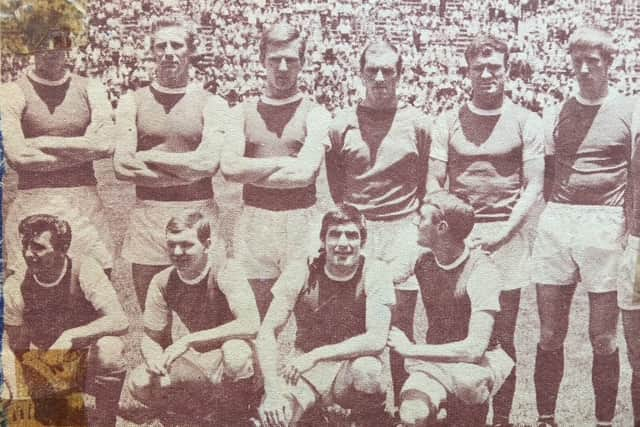
“Even if we'd trained in 120 degrees one lunchtime, he wouldn't let the lads have a pint of shandy after the session. No chance. So we stuck to orange juice, Coca-Cola and bottled water. But of course, every meal time, they brought us these jugs of orange juice and bottled water onto the table and they put ice in it.”
Whether or not ice cubes truly were the cause of the illness would have been one for the doctors - Whitham and others escaped such a fate - but Wednesday had travelled light. A 22-man party made the trip, including a club director, general secretary Eric Taylor, Brown and his assistant John Marshall. Key man Jim McCalliog was absent on duty with Scotland’s under-23s and new signing goalkeeper Peter Springett arrived late due to involvement with England.
They battled on regardless. A ‘Mexico Select XI’ made up more or less of their national team beat the Owls 5-0 a week on from the Toluca win, before back-to-back defeats to Spanish side Deportivo Espanyol and Italian giants Bologna. Their final outing, against the Mexican Cup winners FC America, saw the legendary Don Megson bag the Owls’ goal in a 1-1 draw. It later transpired that Megson had rallied against going on the trip on personal grounds; he was one of the few players with a young family and felt a month away off the back of a long season was an unfair ask.
Camaraderie like no other
For the younger, single cohort, the trip was a great deal of fun - once Montezuma had had his. Injury to Ritchie saw club hierarchy leave the players unattended for a trip to Acapulco, where the rich and famous strode through bars and - in Whitham’s words - ‘one or two of Alan Brown’s rules may have been broken’. A run-in with a local lawman saw the tourists innocently shaken-down for an off-book payment and photographs logged in Whitham’s scrapbook detail a trip well spent.

“The camaraderie at Hillsborough and how we all got on, I can't begin to explain it,” Whitham continued. “Wednesday in the 60s, it was amazing, the lads got on like a house on fire. I’ve spoken to McCalliog who played for Chelsea and Southampton, I’ve spoken to Eustace who did West Ham, I’ve spoken to David Ford who went to Newcastle. And I don't think anybody found that kind of camaraderie at all the clubs.
“In fact at some clubs, like when I went to Liverpool, Bill Shankly positively discouraged it. Because he didn't want people getting on with each other like best of pals if you were fighting for each other's position on the pitch. But what we had at Wednesday in the 60s was amazing. They’re great memories.”
A 60-year problem
Alongside the ‘guinea pig’ testing session undertaken for Ramsey and England’s World Cup trip, a member of the British Olympic Association shadowed the Wednesday side in preparation for the 1968 summer games. In rare usage of what was then cutting-edge sports science equipment, for each match Wednesday played a defender, a midfielder and an attacker were hoisted into a heart rate monitor. The lucky few chosen would have to sit for an hour after each match unable to shower while the requisite recordings were completed.
That data would be analysed to decipher the debate of the time; whether it was more beneficial for athletes to fly in and out of high altitude conditions either side of competition, or whether a period of acclimatisation was the way to go. Wednesday were not the beneficiaries of the hydration breaks seen in today’s tournament and their combatting of the conditions was largely limited to full-backs racing from the field of play in breaks in play to retrieve ice packs for teammates to pass amongst themselves. Nobody ate them.
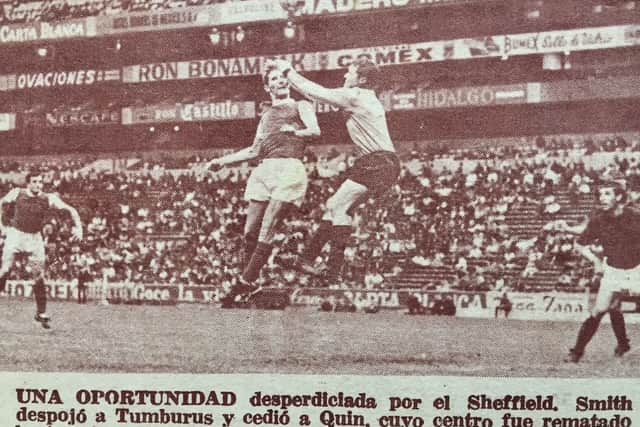
The following summer’s Olympics saw sprint records blasted in no small part due to the altitude, with bursts of speed through the air evidently easier for athletes; though also helped along by improved track technology. For longer-distance events, the reduced barometric pressure makes life more difficult, with heart and lungs having to work overtime to oxygenate blood. It’s a well-documented issue Harry Kane and his comrades will face in a few days time.
“I was an explosive player and a sprinter, so the conditions were brilliant!” Whitham laughed. “I played from the halfway line and made forward runs in-behind. You could sprint for England. The rarefied air helped the sprinters, but in football, the box-to-box people, you know what? It killed them. You saw that in the 5,000m and 10,000m in the Olympics.
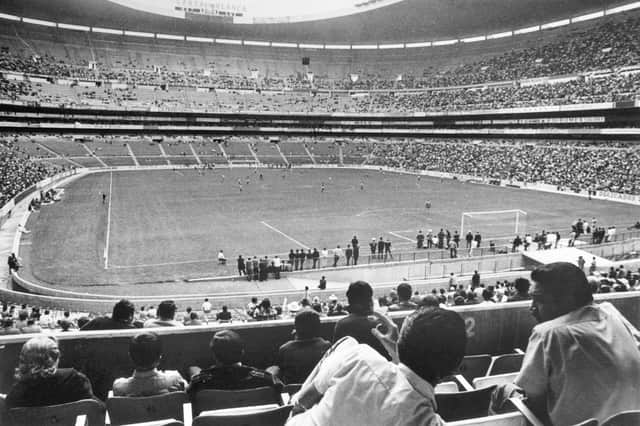
“It was hard work for them because you can't get the air in. The Mexican lads who play at that altitude all the time, their lungs are adapted to it. And that’s a problem for England. Hopefully they can do what we did when we went straight in there. Get in, get the game won, and head off somewhere else. So maybe that is in their favour, that they've not been stuck there for quite a time.
“It'll be a great atmosphere for them. These guys have reached the pinnacle of world football. Where would you rather be?”
Mexico’s record at the Azteca is among the most feared in football and stretches back to Whitham’s playing days. The advancement of modern football means that notes from Alan Brown are resources Thomas Tuchel won’t feel the need to fall back on.
A nation hopes he’s able to follow in his footsteps and beat the altitude.