
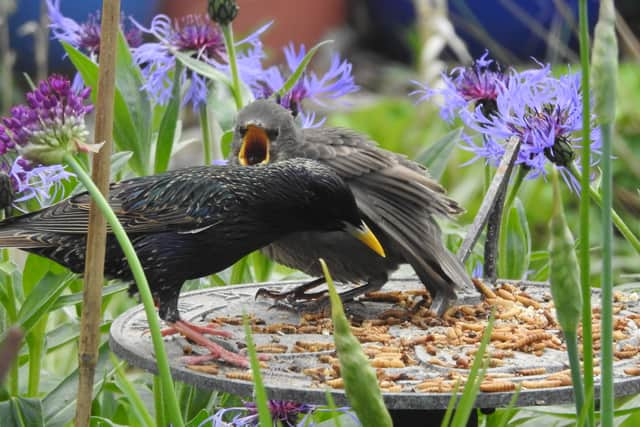
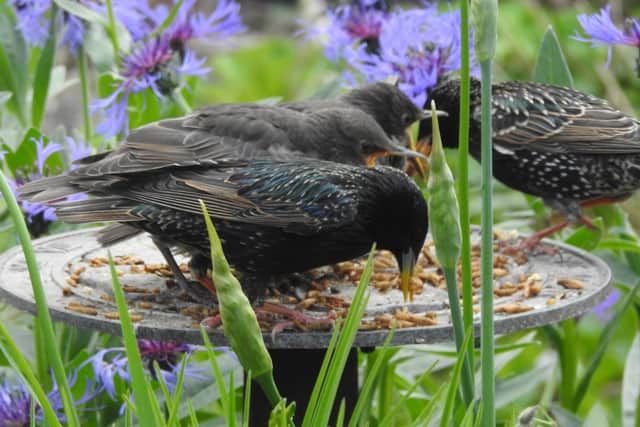
Starlings return in abundance to feeding their youngsters
Advice on feeding wild birds
Many one-time commonplace birds have suffered and still suffer population declines.
The bottom-line is mixed habitat loss and degradation, intensive farming, climate change, and increasing urban sprawl combined with clinical tidiness of buildings removing nesting sites.
The Starling is such a species and from being formerly abundant or super-abundant, its fortunes waned over recent decades, but it is perhaps at last picking up.

In this case, the loss of nesting opportunities in older buildings and sites like tree-holes certainly had an impact which has been compounded by climate change (summertime droughts) and cumulative impacts of historic drainage of wet moors and bogs through twentieth-century moorland management.
Drying the moors and bogs has led to a dramatic decline in the food availability in summer, especially significant for newly-fledged youngsters.
They love to feed on the massed emergences of craneflies from damp moors and wet cotton-grass bogs.
As moors have been drained and dried then the craneflies’ larvae (for gardeners, ‘leatherjackets’!) have gone. With synchronised hatching as adults in May and June, these were good times for the Starlings, other birds like Red Grouse, and on lower-lying wet pastures, Rooks, Carrion Crows, and wading birds like Common Snipe. With drier moors and pastures, all these and others decline.
However, we can act to help solve the problem and today this may be a little controversial.
There is current advice to not feed garden birds during the summer because of the risk of the spreading of nasty diseases.
However, my own view is that this is perhaps the wrong guidance to give when so many birds are losing out on habitat, especially with current guidance to ‘build, build, build’, on greenspaces and Green Belt.
My advice is to be clinically clean with food dispensers, avoid using a bird-table because that encourages bugs to fester and spread, and to use handing feeders like my mealworm holders and fat-balls. Well, Starlings, adults and youngsters, arrived in abundance and I am doing my bit as seen on social media (below). Starlings feasting - a problem solved in part!
Professor Ian D. Rotherham, researcher, writer & broadcaster on wildlife & environmental issues, is contactable on [email protected] ; follow Ian’s blog (https://ianswalkonthewildside.wordpress.com/ ) and Twitter @IanThewildside; Bluesky @ianthewildside.bsky.social