
World's oldest scissorsmith: A Sheffield family dynasty handcrafting scissors and shears for over 266 years
Sheffield boasts a rich heritage in craft scissors, with Whiteley holding a revered position for 266 years. Established in the pre-Industrial era, this family dynasty has pioneered key industry advancements across centuries, with 12 generations steadfastly preserving the company’s legacy
For centuries, Sheffield has maintained a rich heritage in metalwork and the manufacture of fine steel implements.


Tax records show that a quarter of its residents were employed as cutlers and smiths as early as 1379.
However, the production of scissors would begin sometime around the early 17th century, The Company of Cutlers in Hallamshire, established in 1624, helped regulate and support the trade of cutlery and scissor-making in Sheffield.
The story of Whiteley begins when William Whiteley (born February 28, 1745) registered his scissors in 1760, although the business actually began prior courtesy of James Whiteley (born around 1730–1735), and William Whiteley became a Freeman in 1776 (son of James, a scissors smith)
Around this time, the scissors were being made in a building called White Lea, at the top end of Forge Dam. It was here that Whiteley used the water pressure, from one of seven forging ponds around there, to power his water wheels, forging hammers and grinding wheels in his scissor manufacturing.
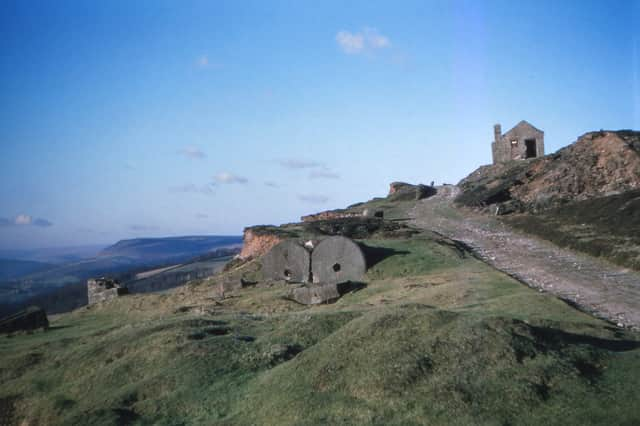
The grinding wheels (at least three feet-wide in diameter), crafted from Derbyshire millstone grit, were used to shape and sharpen steel scissor blades. These grinding wheels were essential to the task but if improperly created could be both explosive and have fatal consequences. Millstones released silica which was carcinogenic, causing ailments and death for many grinders.
It wouldn’t be until the 1900s that the millstone grit industry collapsed, as it was replaced by bonded carborundum wheels. If you were to wander around the Peak District, you would see many examples of abandoned millstones across the landscape to this day.
The advent of the Industrial Revolution, propagated by Benjamin Huntsman’s ‘Crucible Steel process’, necessitated a move to the town, first to a factory at Park Hill and then later to premises on Rockingham Street and Garden Street.
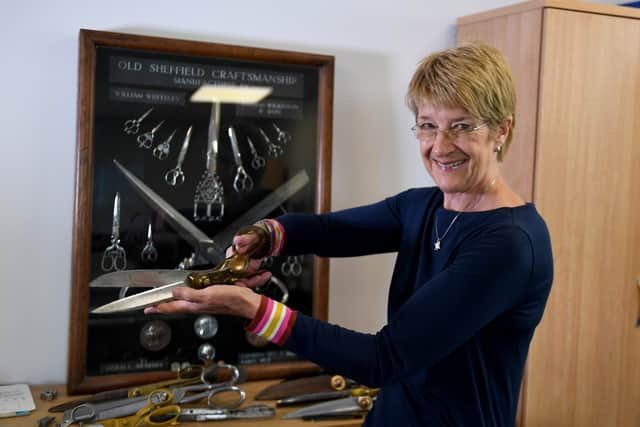
Housed in what used to be a medieval inn on Rockingham Street, William Whiteley & Sons continued manufacturing its scissors and shears.
The 11th Whiteley, Sally Ward (née Whiteley) recalled how it “had medieval cellars and things to scrape mud off your boots.”
“They were all little rooms with built-through machinery with belt-driven spindles coming through the walls. The rooms all had their own gas fire.”
A corporate mark ‘332’ was granted by the Company of Cutlers to George Whiteley, son of William in 1791. And in 1840, Whiteley would be granted a Royal Warrant for its scissors, which would allow them to display the Royal Arms and use the phrase "By Appointment to..."
Sadly, troubles followed and in 1844 the business became insolvent. William Whiteley (born in 1797), died on 9 November 1847, aged 50.
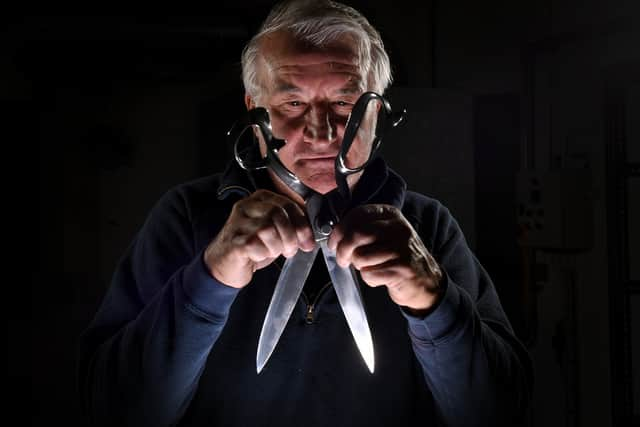
The business was turned around by the exertions of his widow, Elizabeth, a formidable woman who smoked a clay pipe and established the reputation of Whiteley scissors. Acclaim was bestowed on the family-run business, winning exhibition medals in London (1851, 1862) and in Paris (1855).
With business expanding, Whiteley’s took over Wilkinson’s company around 1879. Its founder, Victorian Master Cutler Thomas Wilkinson (1782-1863), had previously invented ‘sidebent’ scissors for tailors – elevating the handles so the entire lower blade runs completely flat against the fabric and work table to make cutting significantly easier. The quality of the cut provided by these scissors would become a favourite for Savile Row tailors to this day.
It would be the advent of stainless steel in the early 20th century that allowed Whiteley’s (and Sheffield) to produce some of the highest-quality scissors in the world, cementing its reputation in scissor-making.
In all corners of the globe, ‘Made in Sheffield’ became synonymous with high-quality, handmade scissors and shears.

The name transition to Whiteley to include "& Sons" happened organically as successive generations of the family entered the trade and took over management through the 19th century, with the firm later becoming William Whiteley & Sons (Sheffield) Ltd.
However, the rise of cheap, replaceable goods and a shift towards mass production throughout the 1980s, meant that by 1990 there were just two scissor-making companies left. Whiteley and Ernest Smith Ltd.
Today, Whiteley remains highly esteemed the world over and is now in its 12th generation of its family dynasty. One that has seen the advent and closure to the Industrial era and remains firmly entrenched in (the now) city of Sheffield.