
The remarkable story of the Sheffield home for 'friendless girls' which was ahead of its time

It is a long forgotten Sheffield institution which sounds like something out of a Dickens novel.
Now the remarkable true story of The House of Help for Friendless Girls and Young Women, which opened in 1885 in the city’s Paradise Square, has inspired a modern-day author.
The name may be antiquated, as was its stated aim to help lodgers ‘learn the error of their ways’. But in many ways the home - which was run by women and took in girls as young as 11 or 12 - was ahead of its time.


Offering a lifeline to women facing destitution or fleeing troubled households, at a time when the only alternative was the workhouse, it has been described as Britain’s first women’s refuge.
It existed until 2005 - in its latter years mostly being referred to as Oakdale House - and provided hundreds of women not just with a roof over their heads but with training and other opportunities they would not otherwise have been afforded.
Author Joanne Clague stumbled on this remarkable piece of Sheffield’s history while researching a political rally held in the square for another story, and she was instantly fascinated.
With the help of Sheffield City Archives, she found part of an original ledger from the home’s early days, listing the names of girls and women taken in, why they were there, and, in some cases, what happened to them.

Those true stories inspired her latest historical saga, The House of Hope. It tells the fictional tale of a woman called Hope - who arrives at the home in the winter of 1885, claiming to be suffering from amnesia - and two other residents hiding dark secrets, whose lives could be forever changed by Hope’s appearance.
Joanne grew up in Sheffield, in Crookesmoor and Upperthorpe, but now lives on the Isle of Man, from where she writes historical fiction about her native city.
She told The Star: “This house was run by women and it was really ahead of its time.
‘It was a lifeline, in many cases’
“In those days, the only real option for destitute girls - and some who were taken in were as young as eleven or twelve - and women was the workhouse.
“The house was run on the principals of not just providing a roof but also training, offering opportunities these girls wouldn't have otherwise been able to access. It was a lifeline, in many cases.
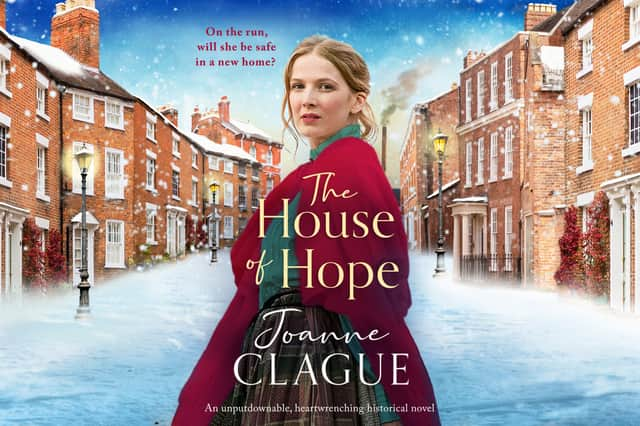
“The House of Hope is inspired by this incredible institution, and I've tried to capture the flavour of it.
“The truthful elements include the way in which girls and women were brought to the house, the fact that it relied solely on public donations - there was no government support at that time - and some of the dire circumstances these women were in.
“Every single character involved with the house is an invention. I knew that the female warden would be a central, pivotal figure so obviously she is a work of complete fiction, as are the trustees of the house and all the girls and women who fetch up on the doorstep. “I was surprised to learn such a place existed and I think that's why it really captured my imagination.
‘Rules for admission’
“Women were generally treated as second class citizens, especially the poor. Across all social divides, women were expected to remain in their 'sphere' but there were an enlightened few who battled to improve their lot, and the house was one of the tools of this new way of thinking.
“I imagine the girls and women who were lucky enough to go into the house were treated kindly. I do have my warden tell a new arrival that it's not a prison.
“They celebrated birthdays and Christmas and former residents would write to the house to express their thanks for the opportunity they'd been given.
“There was a set of rules for admission, including denial for any girl or woman who was intoxicated or 'uproarious in conduct'.” Joanne worked for many years as a journalist, and her first published story appeared in The Star when she did work experience there aged just 14.
Her previous works include The Ragged Valley, which was inspired when she came across some information about the Great Sheffield Flood of 1864, while she was researching my grandparents' lives as file cutters before the Second World War.
Fond memories of growing up in Sheffield
Despite living on the Isle of Man, Joanne regularly returns to Sheffield.
“I come back once or twice a year if I can, and it's been lovely to see so much regeneration in the centre of town,” she said.
“I remember Rag Week and how well the uni students and the townies mixed. Sheffield is such a friendly place. For me, it's always been more like a town than a big city.
“I used to live in Upperthorpe Library - which is now also the Zest community centre - as a child and it's a dream come true to have my novels stocked there.” The House of Hope is out on August 15 in paperback, ebook, audio and large print. It is the first novel in Joanne’s new trilogy.