
300-year-old historic South Yorkshire building finally given recognition
A new information board explains the site’s history
A more than 300 year old ‘anonymous’ Doncaster building, passed by thousands of people every year without realising its true historical value, has been given the recognition it deserves thanks to a group of volunteers.
The Sprotbrough Water Engine, built around 1700 for landowner Sir Godfrey Copley, pumped water more than 150 feet uphill from the River Don to his then Sprotbrough Hall stately home.

Sadly, over the years the Grade II listedstructure has fallen into neglect.
Lying next to the Trans Pennine Trail, around a quarter of a mile east of Sprotbrough’s Boat Inn, little of the original construction now remains.
It prompted members of the Don Gorge Community Group (DGCG) to look for ways of funding an information panel to explain the ingenious engineering design of the pump, which used to supply water to Sprotbrough Hall and homes on Copley’s estate.
DGCG Chair Ian Carpenter said: “For a few years a small metal sign which was difficult to read gave a brief description about the pump.
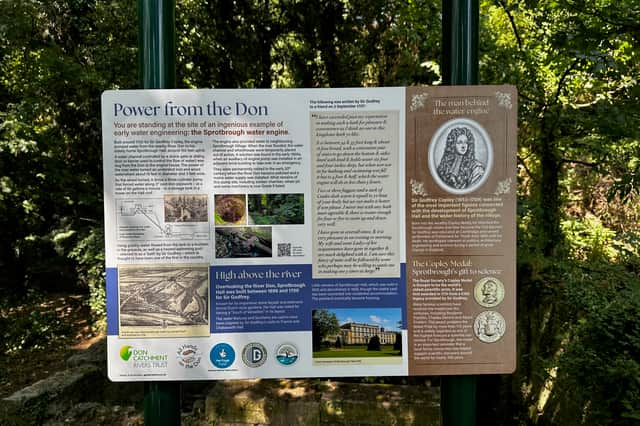
“Other than that the site was pretty much anonymous. We wanted to install something that would make visitors to the Gorge stop and read all about its historical significance.
“Situated alongside the cross-country Trans Pennine Trail, thousands of walkers and cyclists have passed by a superb example of early water engineering without realising.
“The National Lottery Heritage Fund paid for a professionally designed and illustrated panel through the All Hands on the Don community grant scheme, managed by the Don Catchment Rivers Trust, and the installation work was carried out by our volunteers.
“Visitors to the Gorge can now learn how, via the pump, the River Don supplied Sprotbrough residents with the water they needed for many years.”
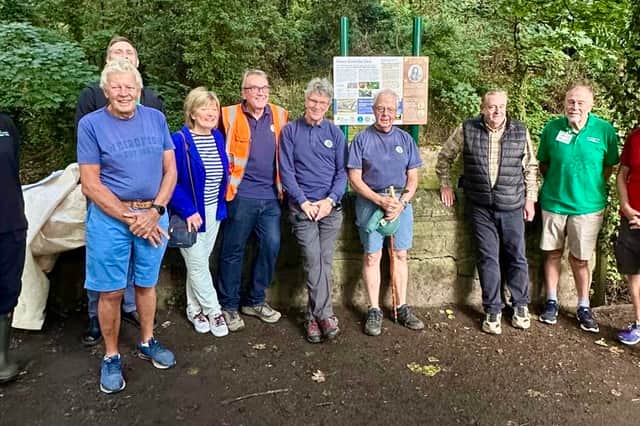
The new panel was officially unveiled at a riverside ceremony by South Yorkshire historian and author Giles Brearley, who is currently co-writing a book on impressive Sprotbrough Hall, which was built between 1685 and 1690 and demolished a century ago in 1926.
Giles said: “The engineering utilised to transport water up to the lake above and create a fountain was ahead of its time. By controlling the water pressure the designers of the day were able to create a fountain to rival the magnificent one at the palace at Versaille in France. This board brings the remnants to life.”
Alex Liversidge, Don Catchment Rivers Trust Development Manager, said: “We were delighted to help DGCG celebrate this unique piece of river related heritage through an information board. Their proposal is exactly the sort of thing the grant scheme was set up to do, provide funds to local people, to help them celebrate the natural and historic heritage of their river.”
The pump was a clever design commissioned by Sir Godfrey Copley, a Fellow of the Royal Society and former MP, who was born in 1653 and died in 1709. A water channel controlled by a sluice-gate was dug from the Don to the engine house.
The power of the river water turned a large waterwheel, which drove a pump that forced the water along cast-iron pipework to a storage tank in a tower of Sprotbrough Hall roof. Using gravity, water flowed from the tank to a huge fountain in the grounds as well as a heated swimming pool – thought to be one of the first in the country.