
This Sheffield man was a pioneer of modern metallurgy, visionary industrialist, and a dedicated philanthropist
Sir Robert Abbott Hadfield was a steel manufacturer and metallurgist who led his family's business, Hadfield's Steel Foundry Co., based in Sheffield – he is renowned for inventing manganese steel and silicon steel, discoveries that (like the metal) only hardened his legacy in Sheffield’s industrial era
Born on November 28, 1858, Robert Abbot Hadfield was the son of steel manufacturer Robert Hadfield, founder of Hadfield's Steel Foundry in 1869. The elder Hadfield developed proprietary machinery instead of using patented French designs, establishing a foundation for what became a leading British armament manufacturer.
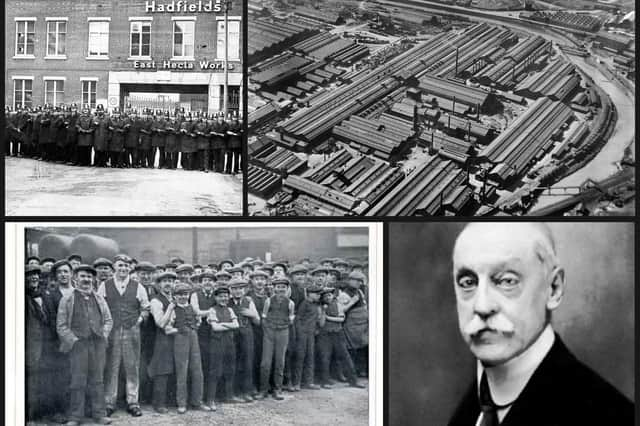

Robert Hadfield the younger attended the Collegiate School, now Grade II listed and part of Sheffield Hallam University, and studied chemistry under William Baker at Firth College in Sheffield. Declining university at Oxford and Cambridge, he joined his family's business as an apprentice in 1875.
Driven by a passion to advance steelmaking, Hadfield attended the 1878 Paris Exhibition. There, he learned of the Terre Noire Company's research into adding small amounts of manganese to steel. Returning home with a pamphlet on the subject, he translated it and began experimenting with manganese and silicon.
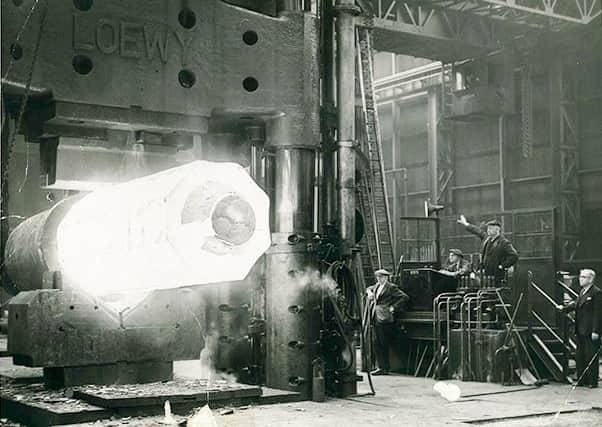
His experimentation with these chemical elements led to his 1882 creation of mangalloy, an invention named Hadfield's steel.
This discovery was the first alloy steel to both become a commercial success and to exhibit behavior that differed hugely from carbon steel. As such, it is generally considered to mark the birth of alloy steels.
Rapid cooling in water from temperatures reaching 1,000°C served to harden this alloy, making it ideal for the production of durable tramway wheels.
Hadfield’s Steel would be utilised for many purposes, from mining and rock-crushing machinery to railway tracks and beyond. The hardness and malleability of the metal alloy worked incredibly well for prison cell bars, which would appear soft at the first cut with a saw before destroying the teeth on the second cut.
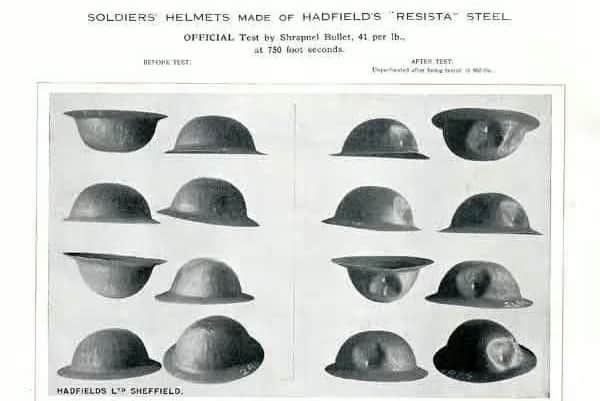
Its hardness and non-magnetic properties would later create an advantage in the arms industry, especially for British helmets, notably the Brodie helmet.
In 1888, he invented silicon steel for mechanical uses like springs and fine blades (which he patented 1886), though its magnetic properties later made it essential for electrical applications due to its magnetic capabilities.
When he was 30-years-old, Hadfield took over the family business in 1888, following his father's death. The firm was immediately made into a limited company, Hadfield's Steel Foundry Co. Ltd. He removed half of his father's workforce, replaced them with his own men and took over the position of chairman.
Although he was a hard taskmaster, Hadfield was one of the first employers to introduce the eight-hour day in 1891 and co-wrote a book on the subject, ‘The Shorter Working day’.
In 1894, Hadfield married an American woman, Miss Frances ‘Bunnie’ Belt Wickersham, of Philadelphia, who would earn a CBE in 1918 for her services in World War One as the founder of a hospital.
Frances was a force of her own reckoning and despite a number of philanthropic endeavours, including during World War Two, it could be argued that she deserves a much more pronounced legacy than there is currently. Sadly, they never had children.
🎞️ Did you enjoy this fond look back to the Sheffield in the past? Well, why don't you sign up to our free retro newsletter.
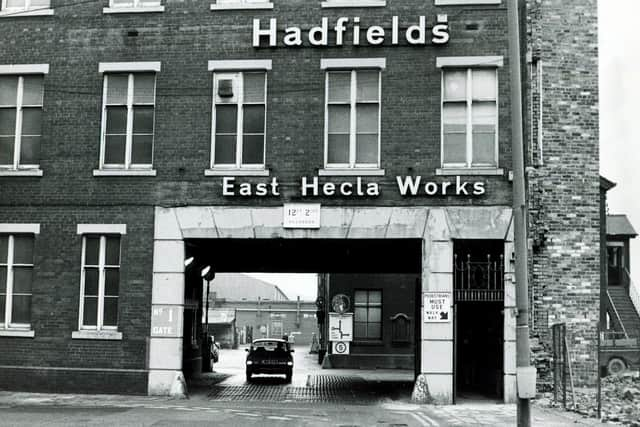
During this period, Hadfield's Steel Foundry Co. Ltd. expanded rapidly, and made a move from Attercliffe's Hecla Works to the larger East Hecla Works in Tinsley (now part of Meadowhall), which opened in 1897.
Hadfield was appointed Master Cutler in 1899, knighted on July 21, 1908, made a baronet on June 26, 1917, received the Freedom of the City of Sheffield 23 years later, and was nominated for the Nobel Peace Prize in 1912. He also earned honorary degrees from Oxford, Sheffield, and Leeds universities.
After a major illness and surgery in 1921, co-directors assumed main operations, though Hadfield remained involved via telegrams, telephone, and annual board meetings. The 1920s brought challenges, including a slump in weapon orders, labour strikes, the 1927 bankruptcy of its Ohio firm, and the 1926 acquisition of carmaker Harper Bean, which was sold in 1936 after failing to generate expected profits.
Meanwhile, Hadfield's reputation as a top metallurgist grew. He published over 200 papers and lectured widely, consistently championing Sheffield's prominence in steelmaking and his own role in pioneering alloy steels.
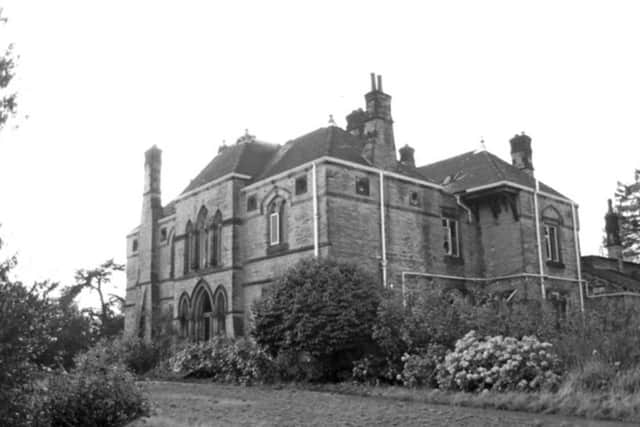
For much of this era, the newly minted Sir Robert resided at Parkhead House in Whirlow, calling it home from 1898 until 1939. He died September 30, 1940 in Surrey, with more than 200 papers to his name on metallurgical research.
Today, the Hadfield name lives on through the Sir Robert Hadfield Building at the University of Sheffield – housing the Departments of Materials Science and Engineering along with Chemical and Biological Engineering – as well as a dedicated wing at Sheffield's Northern General Hospital.