
The Sheffield teacher and WW2 Spitfire pilot who took off but never returned
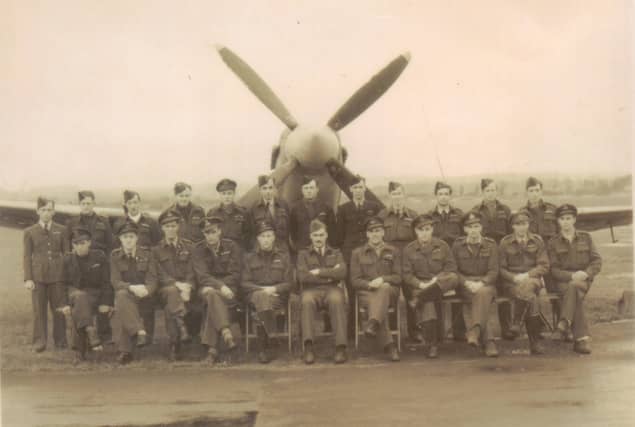

Flight Lieutenant Arthur Gordon Richardson was a Sheffield schoolteacher who volunteered for the RAF shortly during the Second World War. After completing at least 32 combat operations, he took off once more for a strategic allied attack mission — it was to be his final flight. This is his story.
On January 22, 1945, the Alblasserdam region in Holland was in the midst of a brutal, sub-freezing cold wave that brought widespread snow showers and freezing temperatures across the country.
In Woensdrecht, a southern municipality, Flt Lt. Gordon Richardson - a pilot in the 127 Squadron - boarded his Spitfire mk XVI serial RR236 and started the plane’s engine, as he made preparations to take off from B.79 Woensdrecht.
The airfield previously known as Fliegerhorst Woensdrecht had previously been captured in 1944 after the Luftwaffe abandoned it as the Germans battled the Canadians for control of the Antwerpen harbour, a key strategic supply point in the allied advance towards Germany.
The runway would have likely been covered in snow, during what was the infamous ‘Hongerwinter’ (Hunger Winter), one of the coldest and snowiest months – officially considered the most devastating humanitarian and nutritional disaster in 20th-century Holland.
At 10:25 hrs, Gordon’s Spitfire departed and took off from the runway for an armed recce operation that saw him flying towards Alblasserdam in Zuid-Holland, for a dive-bomb attack on the De Alblas oxygen plant. The liquid oxygen being produced at the factory was used to fuel German V-2 rockets.
Sadly, Gordon’s mission was to be his last flight.
At 10:45 hrs, his plane was hit by what was presumed to be German anti-aircraft fire from the Vinkenpolder region, resulting in the Spitfire going down in Polder Zuidzijde, Oud-Alblas.
The specific circumstances around his fatal descent are unknown. But what is certain is that his Spitfire crashed at least six-metres deep into the soft ground, which was covered in a blanket of snow.
A day after the crash of the plane. Arthur and Florence, Gordon’s parents, received a telegram from the Air Ministry. It read:
“We regret to inform you that your son Flight Lieutenant Arthur Gordon Richardson 120591 is reported missing as the result of air operations on 22nd January enquiries are being made through the international Red Cross Committee and any further information received will be communicated to you immediately should news of him reach you from any other source please advise this department letter follows shortly.”
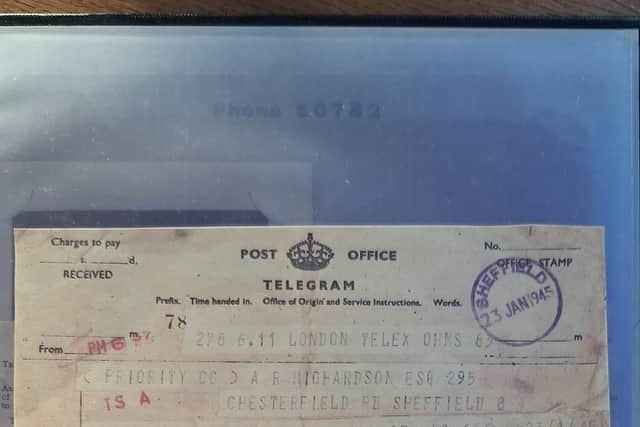
The wait for further updates will have been agonising for both Arthur and Florence Richardson, as well as their families. Gordon’s fate was unknown and the emotional limbo would have been heart-wrenching.
It was not until February 1946 that the aircraft, still containing the body of Gordon, was found by a British missing and research recovery team. But it would be a while longer until Gordon’s parents, Arthur and Florence, were informed.
Almost two-years later, another letter arrived from the Air Ministry, that said:
“Dear Mr. Richardson,
I wish to refer you to previous correspondence from this Department and to inform you that a report has now been received from the Royal Air Force Missing Research and Enquiry Unit in Holland regarding your son, Flight Lieutenant A.G. Richardson, Royal Air Force.
It is now known that your son’s aircraft was shot down at Oud Alblas approximately 4 miles north of Dordrecht and he was buried in the Communal Cemetery Algameene Begraafplaats, Dordrecht, Plot N, Row A, Grave No.16. Arrangements have been made to have the grave registered and the cross suitably inscribed.
In conveying this information I trust the knowledge that your son’s last resting place has been located and will be properly cared for will afford some consolation in your grievous loss.”

His Sheffield life
Born in the Ecclesfield part of Sheffield on May 3, 1918, Arthur Gordon Richardson (known as ‘Gordon’ to differentiate him from his father Arthur Reid Richardson) spent the first part of his life on Lynmouth Road (which is just off Abbeydale Road), before his parents Arthur and Florence made the move to Wortley Villas on Chesterfield Road.
His father ran a successful haulage business operating from the Woodseats part of Sheffield.
Gordon’s grandfather, Charles Ebenezer Richardson, was an inventor who came up with popular toys, such as the ‘Finbat’, and he was also the producer of the Richardson Light Car in 1919 – a 1921 model of this car is still being exhibited in Sheffield’s Kelham Island Museum.
Gordon undertook his education at High Storrs Grammar School for Boys (now known as High Storrs School), where he was a keen footballer and talented artist.
He performed in musicals, later training as a schoolteacher. The subject he taught is unknown, but according to Wendy Varley, his first cousin once removed, who along with a Dutch historian has brought light to this story, he may have specialised in art, such was his talent and ability in both photography and illustration.
His career as a teacher came to a pause in 1940, when he enlisted in the RAF following the outbreak of hostilities during the Second World War. Gordon went to Calgary, Canada, in order to undergo pilot training.
While there, he chronicled his experiences through photography (contained within his photo album). He also passed the time by exploring Canada, playing softball, horse-riding, he even documented his visit to the Calgary Stampede – a key driver in boosting morale during the war.
During his time in Canada, Gordon trained as a Hurricane pilot and following the completion of his flight training, he was then stationed in Egypt with the 74 Squadron. While there he was hospitalised with severe burns after an awful incident where he had unwittingly wandered into a petrol-soaked tent holding a lit cigarette.
Once he had recovered from his injuries, Gordon could possibly have chosen an easier means of seeing out the rest of the war, undeterred and no doubt duty-bound to his task he returned to flying once more.
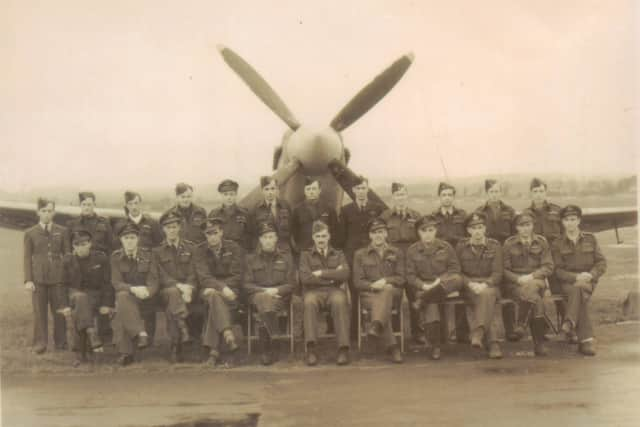
After another year in the Middle East, he returned to England in 1944 and joined 127 Squadron as a Spitfire pilot, where he had flown 32-combat missions.
Before the fatal downing of his plane on January 22, 1945, Gordon had served for approximately 3-years and 8-months following his commissioning as a Pilot Officer on January 30, 1942.
Flight Lieutenant Arthur Gordon Richardson was buried with military honours at the Commonwealth War Graves Commission's Cemetery in Essenhof, Dordrecht. His gravestone bears the inscription:
'FROM THE RISING TO THE SETTING OF THE SUN WE SHALL ALWAYS REMEMBER'
The story of Flight Lieutenant Arthur Gordon Richardson has been beautifully brought to life in a series of Substack blog posts by a relative of Gordon, Wendy Varley. Who kindly contributed so much to sharing part of his story with us.
Further details about his life story can be read at Wendy Varley’s wonderfully insightful Substack blog page: https://wendyvarley.substack.com/p/champagne-unopened-1945