
Why America still can't ignore 'Prince' Naseem Hamed
For many American fight fans of the 1990s, 'Prince' Naseem Hamed was impossible to ignore
The Naseem Hamed roadshow is rolling into America again, with the film Giant now on release in selected cinemas across the United States and on video-on-demand platforms.

But how did the world’s biggest boxing market view the flamboyant Sheffield fighter when he was in his pomp - and will attitudes change because of a gritty film rooted not in Las Vegas glitz but in the hard realities of northern England?
For many American fight fans of the 1990s, 'Prince' Naseem Hamed was impossible to ignore.

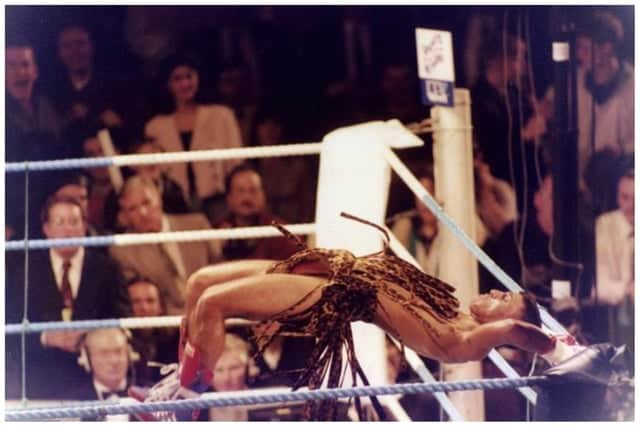
He was the boxer who arrived on flying carpets, somersaulted over ring ropes and taunted opponents before flattening them with punches launched from seemingly impossible angles.
He was part Muhammad Ali, part rock star and part pantomime villain.
Long before social media created influencer athletes and viral combat sports personalities, Hamed understood that attention was currency.
In hindsight, America may simply have encountered him too early.
Today’s fight landscape is filled with self-promoters, YouTube stars and trash-talking showmen.
But in the late 1990s, Hamed’s act shocked traditionalists in the United States as much as it thrilled television executives desperate for stars.
HBO loved him.
The American broadcaster marketed Hamed as must-see television during boxing’s boom years, helping turn the Sheffield featherweight into an attraction on the other side of the Atlantic before most casual U.S. sport fans could have pointed to South Yorkshire on a map.
His unforgettable 1997 war with Kevin Kelley at Madison Square Garden remains one of the most entertaining fights of that era - four knockdowns, chaos from the opening bell and Hamed climbing off the canvas twice before stopping the American.
For U.S. audiences, it was bewildering and exhilarating.
“He was must-watch TV,” is still a common verdict among American boxing fans revisiting Hamed online decades later.
Others compare him directly to Conor McGregor, arguing that Hamed pioneered the modern combat sports blueprint - outrageous confidence, theatrical entrances and highlight-reel violence packaged perfectly for television clips and future viral fame.
One fan recently wrote on Reddit: “There’d be a billion views on every crazy video of his fights.”
Yet America never fully embraced Hamed.
Like in parts of the UK boxing scene, many respected his talent while resenting the arrogance.
Traditional American boxing writers and purists sometimes regarded him as overhyped, technically reckless and protected by clever matchmaking.
His refusal to conform grated in a sport still deeply conservative beneath the bright lights.
And then came Marco Antonio Barrera.
The Mexican great’s comprehensive victory over Hamed in Las Vegas in 2001 permanently altered how many Americans viewed him.
To critics, the defeat confirmed long-held suspicions that the showmanship had masked flaws all along.
In some corners of U.S. boxing culture, that one night still defines Hamed’s legacy more than the 36 victories and featherweight titles that came before it.
But time has shifted perspectives.
Modern audiences raised on UFC hype machines and social-media swagger increasingly may see Hamed differently - not as an irritant, but as a visionary performer years ahead of the curve.
That changing perception may help explain why Giant has generated intrigue in America beyond boxing circles.
Directed by Rowan Athale and starring Amir El-Masry as Hamed alongside Pierce Brosnan as legendary trainer Brendan Ingle, the film explores not only the fighter’s rise from Wincobank to world titles but also the racism and Islamophobia he encountered growing up in Britain during the 1980s and 1990s.
For American viewers unfamiliar with the social backdrop behind the ring entrances and bravado, the film may provide a different lens through which to judge him.
Because beneath the cockiness was also a gifted fighter from a Yemeni immigrant family who became one of Britain’s most unlikely sporting superstars.
And beneath the fireworks was Ingle’s old base - a church-hall style boxing club in Sheffield that produced one of the sport’s most unconventional champions.
That may ultimately be where Giant changes the conversation in America.
For years, U.S. audiences largely consumed Hamed as spectacle - the dancing, taunting knockout artist who either thrilled or infuriated depending on taste.
The film invites them to see the person underneath, warts and all.
Whether it fully rewrites America’s verdict on Prince Naseem remains to be seen.
But one thing has not changed since his HBO heyday.
Even now, America still cannot take its eyes off him.
*Hamed’s U.S. fights:
Kevin Kelley - Madison Square Garden, New York (1997)
Wayne McCullough - Mirage Hotel and Casino, Las Vegas (1998)
Cesar Soto - Joe Louis Arena, Detroit (1999)
Augie Sanchez - Foxwoods Resort Casino, Connecticut (2000)
Marco Antonio Barrera - MGM Grand, Las Vegas (2001)