
The Ladies Football Club Review: Sheffield the setting in energetic tale of women, war, camaraderie and the beautiful game

In the week The Star kicked-off a campaign to try and breathe more life into Sheffield's status as the birthplace of football, it was fitting that the pioneering women in the game should also be championed in The Ladies Football Club, which opened at The Crucible this week.
Set here in Sheffield during World War I, a group of women, brought into work in a factory that had been converted to manufacturing munitions while the men previously employed there were on Europe's battlefields, pass their breaks by kicking a ball around the yard.
The Ladies Football Club encapsulates the struggles women faced in, at first, simply trying to bring some light into the dark days of the war, away from fretting about loved ones or raising their children alone.
Inspired and egged on by storyteller Violet (Cara Theobold), whose father wanted a centre-half for Sheffield Wednesday and whose mother wanted a nun, and her best friend Rosalyn (Jessica Baglow), whose brothers always made her go on goal, the women face adversity from the beginning at the hands of the factory owner, Mr Walker whose only communication comes via written notes sent through a chute from above.
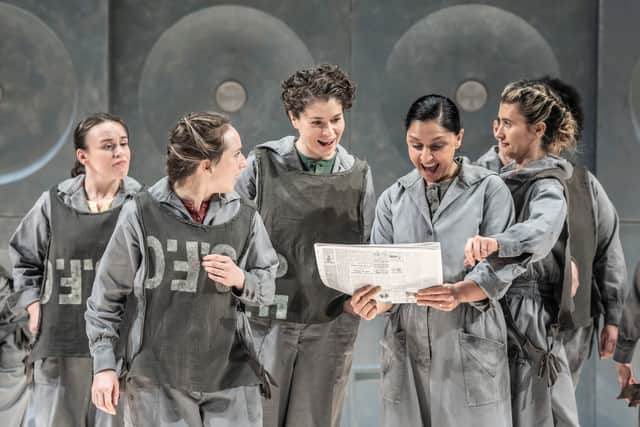

The journey charts the dismissiveness and scorn placed upon women playing football before their rising popularity prompts exploitation and ultimately, as the war ends, their joy is swept from them by their being banned from playing - a ban that would last for decades.
It's a play full of energy, finely choreographed, particularly in the 'action' scenes which I did wonder beforehand how the production was going to achieve but football itself is just the canvas on which The Ladies Football Club is illustrated.
A bit of a slow-burner, this is a story of warmth and camaraderie with each character in the bringing their own unique aspect to the show and importantly with humour scattered through all of them.
From socialist Hayley (Leah Brotherhead) and her fighting the system at every turn, Brianna's (Ellie Leach) obsession with Joan of Ark, extremely well-read Olivia (Bettrys Jones) to Scot, Berenice (Lesley Hart) and her attempts to distance herself from a religious and authoritarian father who has kicked every man in the town out of the pub.
Anne Odeke's somewhat mouthy Justine, who is unmarried, gets the big laughs but a softer side shines through as she reflects on her yearning for love.

One of the more touching moments comes when Melanie (Clair Norris), a grumpy, quiet latecomer to the team whose previous conversations with the women involved mere grunts and rolled eyes, opened up about what forced her to come to the factory from another, explaining why she had kept herself to herself until football had fostered a bond with the rest of the team.
And the theme of love stretches through, not only amongst the women themselves, but at times for the men at war and sometimes the lack of love they received from their husbands, as was the case for the philosophical-in-her-own-way, Penelope (Chanel Waddock).
As a parent of two teenage girls who both play football and have done so from a very young age, The Ladies Football Club resonated and despite the fact that women and girls continue to face hurdles while just wanting to do something they love, it's important to show the hardship those visionaries faced and also highlight just how far the game has come, as depicted in a poignant final scene.
The Ladies Football Club is written by Stefano Massini, adapted by Tim Firth and directed by Elizabeth Newman. It runs until March 28 at The Crucible.