
Inside the room where a small team keeps Sheffield on the move
There is a room somewhere deep in Sheffield Town Hall where a small but dedicated team has but one task in hand which is to keep Sheffield moving.
Whether it’s a major event, an unexpected emergency or disruptions – the one thing in common in all these three is cars, cars and more cars on Sheffield’s roads. The result is never-ending queues, frustration, missed appointments, and so on.
However, behind the scenes, there’s a team pulling the strings. They can’t widen the roads or change lanes but they can plan ahead, respond swiftly and adapt on the fly.
In a quiet room deep in Sheffield Town Hall resides the council’s Urban Transport Control Centre.
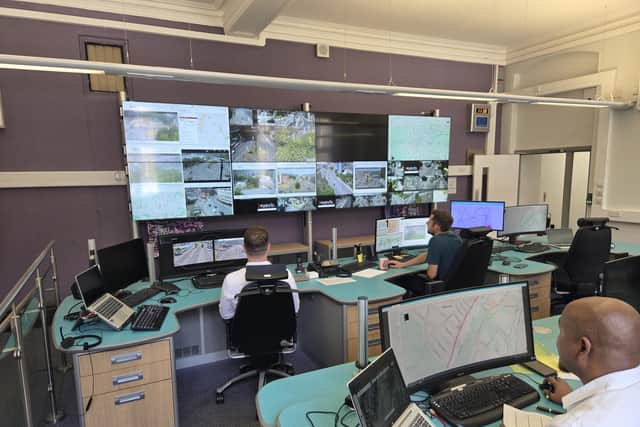

Upon visiting the room, Andy, the Principle Engineer Network Manager, and Rob, a service manager, are walking up-and-down, checking if everything was going according to the plan. A colleague sitting at a desk is liaising with South Yorkshire Police.
The six-strong group are sat watching a number of big TV screens.
On them, Sheffield’s most busy roads from high above.
Andy explained most big cities had a setup just like this one – some bigger, some smaller. In London, he added, the size of the room at TfL is “a couple of football pitches”.
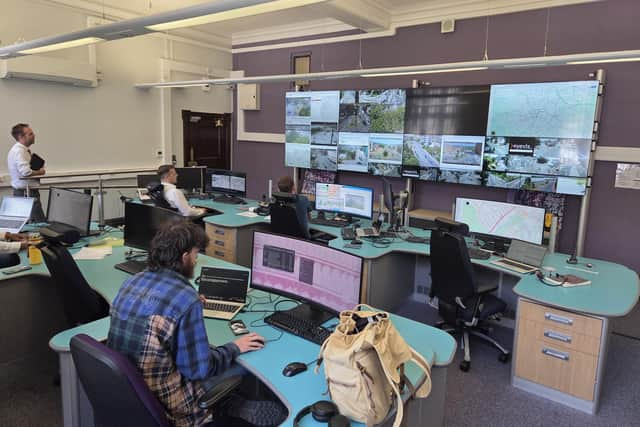
He described Sheffield’s room as “moderate sized”.
Andy said pre-Covid bus operators also sat with his team to ensure the network was managed efficiently.
“Now, with everyone being here, we can react very, very quickly then if we have a problem”, he added.
He added: “The whole premise of what we do is to keep Sheffield moving.”
Andy said unless they are on the front page of The Star, they are doing a good job.
“That’s my litmus test”, he added.
Rob agreed. He said if people started noticing, something has likely gone wrong.
Operating the network is a bit like a balancing act, Andy said. It’s a bit like a circus with all the plates going.
He said: “We’re trying to keep all the plates going without any of them fall off, and that means balancing the needs of vehicular traffic, public transport, cyclists, pedestrians, trams… It’s about getting that balance right in line with policies.”
Take Penistone Road, for example, which is one of the busiest roads in Sheffield.
Andy said it handles 55,000-60,000 cars in a 24-hour period. It’s a main corridor to the city.
Running parallel to Penistone Road is a public transport corridor – Middlewood Road, Langsett Road, Infirmary Road.
“There are measures on those roads which encourage other vehicles to go onto Penistone Road”, Andy said.
He said Penistone Road is a good example of what they are trying to achieve. With setting a lower speed limit, it allows them to squeeze them all and maximise the available space.
If there is a higher speed limit, people tend to hold back a little.
Andy added: “A lot of what we do is based on sound principles.”
He said it used to be more engineering involved, whereas these days it’s more data-driven.
Technology has advanced so strategy must follow. Flow and volume have to be considered as well as the number of pedestrians.
He said: “We are now entering AI so wouldn’t it be great if we knew there is a train coming up from London and there are 300 people?”
Most of those would get off, go to the crossing during the evening peak when the traffic volumes are high.
“That’s balancing again, we are trying to balance the needs of everybody”, he said.
Andy said his team was not a 24/7 service as Sheffield is still a “very traditional”, 9-5 city.
There are on-call officers and the room can be accessed remotely. It’s all about communication.
Does this mean, for instance, that the team can change the traffic lights? Yes, it does. It’s just one thing of the many they can amend to help traffic flow.
Also, the system is programmed so the tram can respond very quickly if there is an emergency or a sudden snowfall.
While we’re speaking, there is a protest on one of the major roads. What does the control team do?
It comes up with a plan to mitigate the effects so the impact on traffic is the minimum.
Is it a stressful job? Andy said the guy who is on the phone with the police has been working there for more than 10 years and he’s still got all his hair.
Cllr Ben Miskell, the chair of the council’s transport, regeneration and climate policy committee, told the Local Democracy Reporting Service (LDRS) that the plan was to open up the town hall and let the public have a peek behind the scenes “to show people what we do to tackle many of the issues that matter to them”.
One of these issues is the traffic congestion in and around Sheffield.
He added people “perhaps” don’t always see the work being done to tackle congestion – particularly during big events or disruptions.
Most of the work is being carried out in a traffic control room at Sheffield Town Hall.
Cllr Miskell said: “The last budget that we had that went through Full Council contains lots and lots of different things but one of them was about investment in the traffic control room.
“We think that’s really important because it actually helps us keep Sheffield moving; it allows us to prioritise buses, which is really important as you move towards bus franchising in 2027.”
He added thanks to the control room, the city can be made safer, especially for pedestrians.
Cllr Miskell said the control room is able to dynamically shift prioritisation as key events unfold in order to keep people moving.
He noted congestion has an impact on the economy (people sitting in traffic can lose work, miss appointments, cannot spend money where it’s needed etc) so tackling it in Sheffield is a necessity.
So if the room has been in place (and it has been in place for a very long time), some in Sheffield may ask why am I sitting in a congestion right now?
If the room is operating as it should, why am I stuck in traffic every day? What is the point of this control room?
I’m just asking Cllr Miskell and Andy the questions others may in the comment section, I’m trying to prepare them.
Cllr Miskell said it was important to acknowledge that Sheffield was a growing city – and in order to accommodate the rising number of people, so the economy can grow, for example, the council is investing in centres, such as the control room.
“If we didn’t have this approach (the control room) to managing congestion, it would be significantly worse in our city”, he added.
Andy added if the group laid back and put all the communication off for half a day, “I’ll guarantee you traffic lights would work, you still have red, amber, green, but what they won’t do is they won’t coordinate movement.”