
How a local project is battling flooding in a historic Sheffield park
A community-led project, called Bringing Back the Brook, aims to restore natural water flow, reduce flooding risk and boost biodiversity in a Sheffield park.
Passionate locals, experts and councillors have been working hand-in-hand around a historic watercourse in Meersbrook Park over the last couple of years – and it’s already showing promising results.
Coun Marieanne Elliot, a Green councillor representing Gleadless Valley, told the Local Democracy Reporting Service (LDRS) that Meersbrook Park Users Trust (MPUT) has been “really instrumental in bringing people together” around the Bringing Back the Brook project.
She said: “It’s all about slowing the flow of the water and the attenuation ponds help with that as it comes down.

“But it’s also helping with the silt – so there is less silt in the watercourse.”
Another key goal is flood prevention. Coun Elliot noted that the new dams called beaver dams are essentially doing “the work the beavers would do in Meersbrook Park if we had beavers there.”
The ecologist Angus Hunter, who died earlier this year, played a significant role in shaping the vision for the project. Coun Elliot described him as an “amazing ecologist” whose ideas were focused on natural flow management and enhancing local ecology and biodiversity.
An additional ambition of the scheme is to uncover and restore a historic watercourse that predates even the park itself.
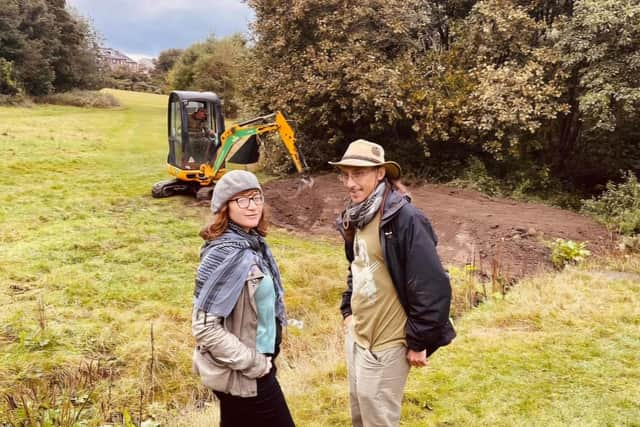
Planning for Bringing Back the Brook began in 2023, with on-the-ground work starting in early 2024. The initial phase included tree thinning in the wooded area at the top of the park.
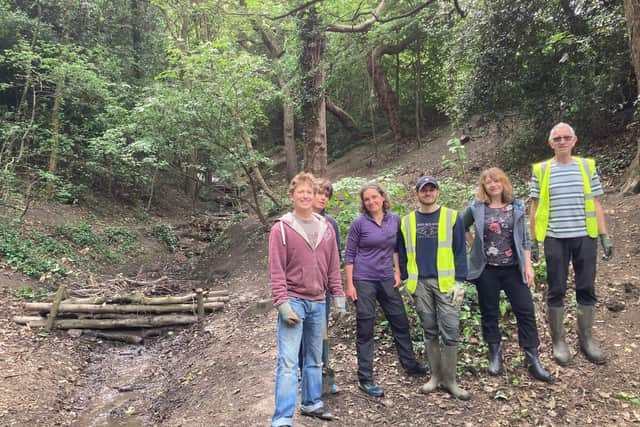
Over the last 20 months, volunteers have carried out extensive work: dead-hedging, planting, pond creation, and dam building — all largely led by the local community.
Coun Elliot said: “Bringing Back the Brook has multiple elements to it but essentially we wanted to open up this water course (on the top of the park) and make it more of a feature of it.
“Before we started the work, it was just a narrow channel, and then the banks down to it were quite steep.
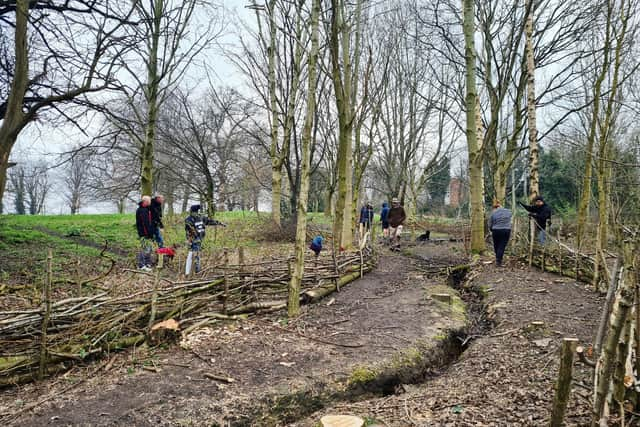
“I think it was affectionately called the legbreaker because it was kind of almost covered, you couldn’t really see it.”
Today, the water flows more openly, and the landscape has been reshaped to make it both safer and more accessible. Volunteers have even built two small bridges, so people no longer have to jump across the stream.
“We thought, if we’re doing this work, we need to make sure it’s really accessible,” CounElliot said.
In some areas, visitors will notice an unusual form of natural fencing used to protect vegetation — a method called dead-hedging.
Coun Elliot described it as one of the most enjoyable and rewarding community-led activities.
She, along with dozens of volunteers, learned the proper way to dead hedge through hands-on experience.
Despite its scale, the project has been carried out “on a very minimal budget.” Local councillors contributed a few thousand pounds, with a bit more added through grant funding.
She said: “Because there have been so many volunteers, it’s not been a big expense to the council.”
- RELATED: Sheffield man smashed up house and punched holes in walls
- RELATED: Quest for justice continues 25 years after murder of sex worker
- RELATED: 'It fills me with horror that the killer may still be walking the streets'
- RELATED: Discovery of real spell book conjures entrepreneurial spirit in Sheffield