
Sheffield high-rise tenant calls for action to tackle overheated council tower blocks
A Sheffield high-rise flats campaigner has highlighted a problem with overheating of city high-rise flats during summer hot spells.
Peter MacLoughlin, who lives in the Robertshaw block in Netherthorpe, says several factors lead to the overheating and is asking Sheffield City Council to take action to ease the problem for distressed tenants.
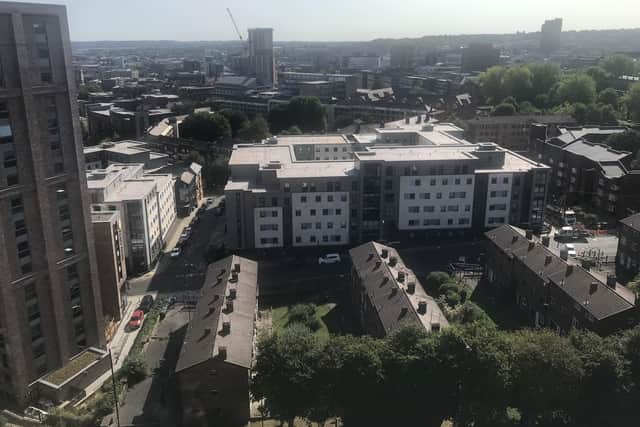

He believes that the blocks in Netherthorpe are in an ‘urban heat island’ because of their location near the busy Netherthorpe Road ring road, university buildings and student flats.
Urban heat islands are caused by buildings being close together. Their dark-coloured surfaces, plus those of roads and pavements, absorb the sun’s heat instead of reflecting it, meaning they become warmer than surrounding rural areas.

A lack of greenery and trees will also mean that moisture from plants does not evaporate into the air which would cool it down.
In turn, this means buildings use more energy to run air conditioning or fans to cool down their interiors.
A 2011 council planning document said that Sheffield was showing the effects of an urban heat island, with “buildings and roads acting like giant storage heaters, absorbing heat during the day and releasing it at night”.
Cladding
It said: “Green roofs significantly reduce summer air temperatures at roof level and keep buildings cooler.”
Peter said that cladding on the blocks also prevents heat loss and the flats have no cooling system, plus district heating system pipes running through flats are not properly insulated.
He said: “We have all that heat and now we’re being told not to use the windows because of safety. On certain days you can’t use the windows anyway because of the noise and pollution coming from the ring road and other disgusting smells because of the open bins policy we have.
“Basically you’re in an oven with no fan extraction. We have extractor fans on the roof but look at the size of them and then just have a look at the size of the private and commercial ones – there’s no comparison.
“If they work at all, they’re highly inadequate.”
Peter has complained to council leader Coun Tom Hunt, who represents Walkley ward, and housing policy committee chair Coun Douglas Johnson.
Housebound
Peter said that many vulnerable people live in high-rise blocks. One of his neighbours is in her late 90s and housebound.
He wants the council to start monitoring the situation, especially on hot days like in the recent heatwave, and look for solutions.
Peter said he noticed a set of extractor fans being fitted on the Cornhill block near his, which he said houses homeless people. He believes they are being fitted because council housing staff are being moved into the basement of the block, in order to free up more of the building currently used as offices for flats.
He said that he supports decent conditions for council workers, which they are entitled to, but wants the same for tenants, who don’t benefit from health and safety regulations inside their homes.
“The whole issue around decent standards of council homes needs to be reconsidered,” said Peter. “We’ve got heating issues, window issues and various other issues.”
Sheffield City Council said that it has commissioned a consultancy called Baily Garner to undertake a review of the thermal efficiencies of each of its 24 tower blocks.
The aim of this is to get an up-to-date picture of the implications of climate and heat in council high-rise buildings.
It is anticipated the outcomes of this work will be reported to the housing policy committee in quarter four of this financial year.