
"I am going to die earlier than I expected, and that knowledge is a gift"

Paul Besley was lucky to survive when he fell from a crag and had to be airlifted to hospital with horrific injuries.
He probably owes his life to the members of the Coniston Mountain Rescue Team and the RAF who came to his aid that day.
Paul’s near-death experience inspired the Rotherham-born former steelworker to join his local Woodhead Mountain Rescue Team, which comes to the aid of stricken walkers, climbers and riders in the Peak District and South Yorkshire, including Sheffield.


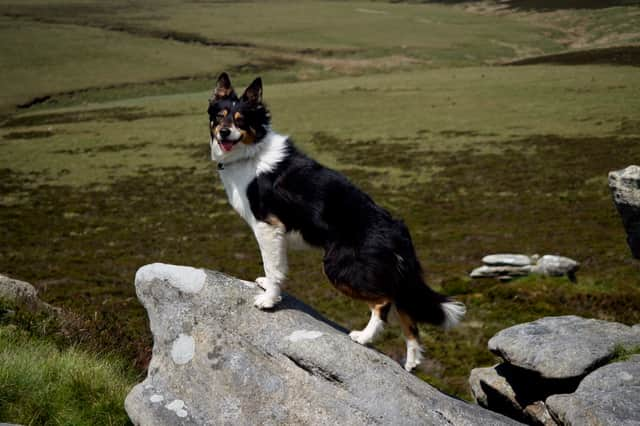
Now, he has written a book looking back over nearly a decade volunteering as a mountain rescuer, first on his own and then with his trusty border collie, Scout.
The Search - The Life of a Mountain Rescue Search Dog Team describes the pair’s complex training they completed and the many search and rescue missions they have completed together.
It also chronicles Paul’s earth-shattering diagnosis of asbestosis, a chronic lung disease which was the result of his years working in a steel mill, and how he is determined to make the most of his limited time left.
Below, Paul, who is now a writer, shares his story in his own words, from his formative years in Rotherham to the accident which nearly claimed his life and the industrial disease he knows one day will.
‘I loved it in the mills and melting shops’
“I grew up in Rotherham in the 60s and 70s. It was a lovely place with lots of interesting independent shops and money in the town from textiles, construction, manufacturing and the big two coal and steel.
“There was little expectation in my family that after school I would not be working in one of these sectors. I went into the steel works, BSC, much to the dismay of my English teacher who wanted me to carry on to college and university.

“I loved it in the mills and melting shops, they were very dangerous, exciting, incredibly hard work and had community, a family of people with a common purpose.
“I was a pipefitter, tough work that required skill and strength. They were good jobs with good pay that enabled people to have a decent standard of living and to give a little back to society. That ethos resonated with me.
“Outside work we enjoyed a good social life, pubs, clubs, dancing. Everyone would get dressed up at the weekend, we had handmade suits, money in our pocket and an eye for that special partner we knew was out there.
‘Money began to leak out of the town’
“They were good times but that all changed in 1979 when Labour lost to the Conservatives. Six years later the mills, pits, factories were closing, and money began to leak out of the town and like many other towns in the north it became a place that had seen better times.
“I left and got a job selling engineering parts, but nothing had that sense of community I found the steelworks, that feeling of belonging where we all looked after each other.
“I had always liked hill walking and spent free time walking the hills in the Peak District and further afield.
“The outdoors had always been a restorative place for me since my early teens, it was how I got life right sized and ready for the next day.
‘Fall left me with broken limbs and big hole in my head’
“My fall was a turning point in my life. It was Valentines day 2012, I’d be 52 years old.
“I’d gone to the Lake District to do some scrambling, by afternoon strong winds had arrived and with snow and ice on the ground it made walking very difficult. People were crawling on hands and knees.
“I had to get down into the valley before the weather worsened as I and my partner Alison were going out that evening.
“Somehow I fell off a crag and as it began to get dark I found I’d been unconscious in the snow.
“Despite having multiple injuries, I managed to get help from Coniston Mountain Rescue Team and the RAF.
“It took a long time to stabilise me before they could helicopter me into the hospital, my injuries included broken limbs and ribs, damaged shoulder, a big hole in my head and lots of teeth broken. To this day I still do not know what happened.
‘Why I joined mountain rescue team’
“It has always been important to me to say thank you. So, aside from the usual letters, flowers, chocolates and donation, the best way was to join my local mountain rescue team, Woodhead Mountain Rescue Team.
“I became a full team member in 2013 and a dog handler, with my Border collie Scout, in 2019.
“My team covered the northern part of the Peak District and most of South Yorkshire.

“Most people will not be aware that Mountain Rescue will operate in urban and semi-urban areas, but they are often called upon by the police because of their specialist skills in searching or dealing with casualties in difficult terrain.
“Mountain Rescue is run entirely by volunteers who are on call twenty-four hours a day, every day of the year.
“Their purpose is to help people in distress irrespective of the circumstances, time of day or weather.
‘Training filled with disappointments and triumphs’
“Many of my callouts with Scout are to assist the team, mountain bikers in Grenoside woods were almost a weekly callout.
“Some callouts were exciting, extracting a fallen climber with thunder and lightning rolling across the sky and powerlines close overhead.
“The search dogs are a national asset and can be called on to operate anywhere in the country. At the time we operated there were only 29 dogs available.
“It takes around three years to train an air-scenting dog search team. It’s a period of time filled with disappointments and triumphs that can be wearing emotionally, so the support of a very understanding partner is crucial.
Scout lives with us and our other two dogs, Bedlington’s Monty and Olly. Including training, Scout and I would work 600 hours per year.
‘Without Scout, they would have been in serious trouble’
“Lost walkers and missing people were the dogs’ most common callout. Scout’s most important find was a walker who had become overwhelmed in a winter storm and was becoming hypothermic.
“If Scout had not found them they would have been in serious trouble, Scout making a difference to that person’s future and many others.
“During the pandemic all teams and dogs attended twice the number of annual callouts. This had a significant impact physically and mentally on many team members.
“We all had to wear masks, goggles and be fully sealed in our outdoor waterproofs when attending.
“Like many, I began coughing, I thought through the strain of carrying casualties on stretchers in the heat of summer.
“In early 2021 I went to the doctor who referred me to Respiratory Clinic at the Northern General Hospital.
‘I lost 50 per cent of my lung function’
“Because of my level of fitness it took a while to establish what was causing the coughing, but by November they told me I had asbestosis.
“Early in 2022 I stood down from the team, and Scout stood down with me. By 2023 I had lost fifty percent of my lung function, which makes walking in the hills an activity I can no longer do.
“The doctors and nurses at the hospital have been superb in looking after me. The Brearley Respiratory unit at NGH has extensive experience and skill at treating Interstitial Lung Diseases because they see so many sufferers due to the area’s history of heavy industry.
“I take a drug that slows down the progression of the asbestosis but does not halt it. How much time I have left I do not know, but it is limited.
‘Companies knew asbestos was fatal if breathed in’
“The companies that made the asbestos products I used as a pipefitter in the steelworks knew the material was fatal if breathed in, whether they told their customers I do not know, but the damage asbestos caused was well known and well documented for many decades before I came into contact with it.
“Am I angry? I don’t think I should have to fight for compensation for what has been done to me and many thousands more.
“People knew about the dangers and chose not to say anything to protect their own profits. SARAG – the Yorkshire and Humberside Asbestos Support Group have been incredibly helpful and put me in touch with specialist solicitors to deal with my case and I also have the support of my union Unite.
“Whatever happens, legally, will be in the hands of the system. But would anger help?
‘Knowledge I’m going to die earlier is a gift’
“What would anger profit me and where would it lead me to? I am going to die earlier than I expected, and that knowledge is a gift.
“It means I don’t waste time on things that are of no consequence, or anything or anyone that has a negative outlook on life.
“Time is now my currency and my partner, and we choose to use it wisely, to live and let live, enjoy life in the moment and not live in yesterday or tomorrow. To laugh and cry, dance and sing, scrape the very marrow out of each day and be able to say we have a life well-lived.
“It is a fascinating journey, the freedom that comes with knowing time is limited is very exciting.
“The book began life as a piece of landscape writing about the Chew Valley near Saddleworth Moor where Scout and I trained.
“Then Scout insisted on being written in to the story and I thought it would interest people to know a little more about training a search dog and the kind of work they do.
‘I hope the book brings joy’
“I had to be careful to avoid making it a training manual, so wove into the story threads about my own life, and experiences Scout and I had when we were not working. That turned it into a memoir.
“When Covid happened, few people knew the work that Mountain Rescue did, the toll that it took, so I felt it was important that was recorded.
“Finally, my own story and the part Scout played in it came to the fore.
“Many areas were painful and difficult to look at, but the story took me there eventually.
“It wasn’t all darkness, there was plenty of light too, many wonderful characters to write about that made the memoir amusing and reflective.
“At the end all the threads that weave through the pages and my life come together with acceptance and contentment and the realisation that my life is a life well-lived.
“I hope the book brings joy to people, that there will be tears and laughter and people will know a little more about the work mountain rescue search dogs do.
“I guess in the end I learned about the impermanence of life and Scout taught me to live in the moment and that brings a great deal of freedom and happiness.”
The Search - The Life of a Mountain Rescue Search Dog Team, published by Vertebrate Publishing, is available from book shops now.
For more about Woodhead Mountain Rescue Team, including how to support them and how to become a volunteer, visit: https://woodheadmrt.org/.