This is why a huge whale skeleton was seen hanging from a Sheffield bridge
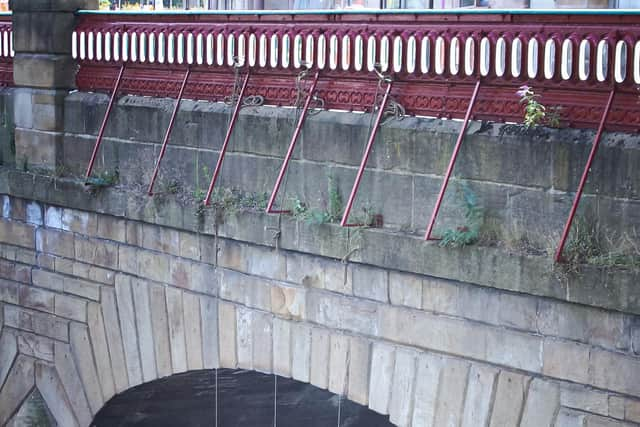
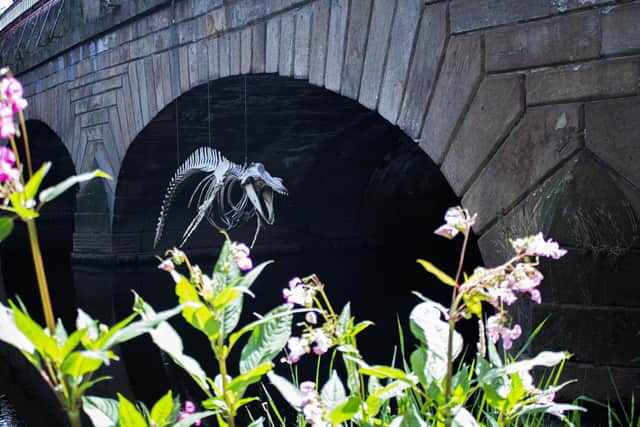
It must have been a startling sight – a full-size skeleton of a whale hanging from the Blonk Street bridge in Sheffield city centre.
The bones were there for just a day, puzzling passers-by after mysteriously appearing over the River Don.
And now the man behind it all has come forward to explain everything.
Dave Clay, a biology lecturer from Crookes, found the carcass of a long-finned pilot whale buried in the sand on a beach on the island of South Uist in Scotland two years ago, and later painstakingly rebuilt its skeleton from head to tail.


“I assembled the skeleton in my garden during lockdown,” said Dave.
“I wanted to do a temporary installation over the Don, just as an artwork that would make passers-by on the Five Weirs Walk pause and wonder what it was there for and why.”
The answer, Dave said, is ‘whatever people want it to be’.
“I think that during this Covid-19 crisis all sorts of thoughts have been going through people’s minds. This installation has no political agenda or particular meaning but hopefully made people pause and reflect, and hopefully find it wonderful.

“No damage or alterations were inflicted to the bridge or left there at the end of the day."
The whale bones were kept in place only on Sunday, July 19.
Dave, who has mainly worked at The Sheffield College, said he had a ‘passion for evolution’.

“If you look at the front limb of a whale you can see that it is a 'hand', the basic pentadactyl structure of mammalian limbs,” he said.
“Some, during the course of evolution, have reduced the number of digits from the ancestral five to, for example in the case of a cow and other ungulates, just two digits. Whales and dolphins evolved from a land-dwelling ungulate that walked on two toes – during their evolution into aquatic forms they regained their ancestral five digits on the forelimb and completely lost their rear limbs apart from two rudimentary pelvic bones.
“Biology is fascinating and I dislike the way that it is often dumbed-down in many features on natural history. I think most people would marvel at the fact that a cow is more closely related to a whale than to a horse.”
Dave said there were no future plans for the skeleton yet, but that he might offer it to Sheffield’s Weston Park Museum as an exhibit.
Editor's message: Thank you for reading this story. The dramatic events of 2020 are having a major impact on our advertisers and thus our revenues. The Star is more reliant than ever on you taking out a digital subscription to support our journalism. You can subscribe here – www.thestar.co.uk/subscriptions – for unlimited access to Sheffield news and information online. Every subscription helps us continue providing trusted, local journalism and campaign on your behalf for our city.