
Northern Lights: The environmental significance of the River Don, its health and its rights
Our new exhibition fæthm opens at Kelham Island Museum on Thursday. The exhibition, which runs until Sunday, is a collaboration between Sheffield Hallam University’s Creative Industries Institute and the River Don Project and explores the cultural and environmental significance of the River Don, its health and its rights.
But what does it mean for nature, and the River Don, to have rights?

It’s a growing global movement in response to the climate crisis.
The rights of nature move away from treating nature as property or something to extract and exploit, and move towards acknowledging that nature, and all its life forms, has the right to exist, thrive, and sustain natural cycles.

The River Don is a barometer for all life in the region. Flowing as it does through Sheffield, Barnsley, Rotherham and Doncaster, it is always communicating with us – but perhaps we have not always had the tools to listen or taken the time to understand.
Arts and culture can play a vital role in deepening our understanding and offer a powerful lens through which to explore our relationship with the natural world.
Curating this exhibition was thought-provoking and stirred up ideas and questions around our complex relationship with the River Don.
For some, it is a joy to visit and being beside the River improves wellbeing and unites communities.

For others, the Don is a source of concern or frustration due to flooding, pollution or lack of access.
The name fæthm felt fitting for the exhibition, an Old English word meaning ‘outstretched arms’ and the origin of the modern English ‘fathom’, which we can take to be either a measurement of the depth of water or the depth of our own understanding.
The exhibition offers the unique perspectives that artists bring to their environment and communities.
Through installations, the written word, soundscapes, textiles, film, found objects and a public art installation in the Don, we are seeking to investigate how art and culture might be beneficial to the River?
And to ask ourselves, what might a collaboration with the River Don mean when creating art?
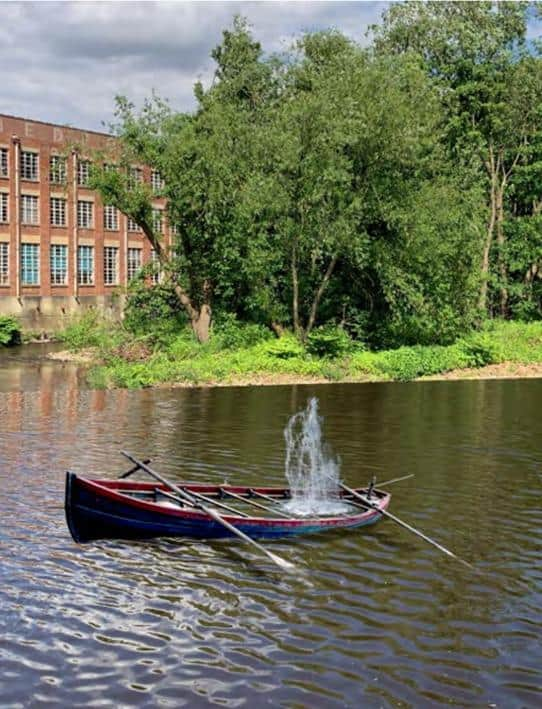
Outside at Kelham Island Weir, we will debut BIDE by Professor David Cotterrell.
You will be able to view BIDE from Ball Street Bridge and witness a rowing boat continually flooding and bailing itself in response to data gathered from the River.
Inside Kelham Island Industrial Museum, we will reflect on the industrial heritage of the River and its links to migration as we explore the stories of how fig trees came to thrive alongside the Don.
Dr Rose Butler presents Ground Truths, large-scale photographs of fig leaves made from analogue film using analogue processing and fig phenols.
Wherever the river may take us / wherever it wants us to go by Joanne Lee considers the cyclical processes of the River and the sudden periods of transition it has experienced.
This work was developed through repeated visual essaying of the River and artist-led walks by Joanne around the River and its tributaries.
Experimental prints and drawings from Joanna Rucklidge, in Drink it in, represent the juxtaposition of the indiscernible riverfly larvae with the littered plastic found on the riverbank, inspired by a community walk along a short stretch of the River Don.
A live citizen laboratory will allow visitors of all ages to learn about microbiology, chemistry, and the health of our rivers.
Using cutting-edge equipment from Sheffield Hallam University, you can test samples from Sheffield’s five rivers to see the challenges of river pollution.
Through advances in artificial intelligence, the River Dôn Project, Dark Matter Labs and Hive IT are rapidly breaking down barriers in communication with our natural world by creating a chatbot to enable more intimate communication with the River.
Bringing together art, culture, science and policy research, these installations are just a few examples of how fæthm invites us to consider the ways we relate to the River.