
Lessons from the past
In the late 1800s, Dadabhai Naoroji exposed the violence of empire. More than a century later, empire’s logic of exclusion and control still shapes who is allowed to belong in Britain.
Dadabhai Naoroji was born in September 1825, just over two centuries ago. A founding member of the Indian National Congress, and among the first MPs of colour elected to the House of Commons, he dedicated his life to challenging the injustices of British imperialism. Yet despite his achievements, Naoroji remains largely overlooked in our national story. In a political moment defined by an emboldened racist right, it is necessary for us to revisit the struggles of people like Naoroji and the clarity with which they confronted racist systems of exploitation.
Naoroji exposed how the British colonisation of India led to the systematic transfer of wealth from colony to coloniser. In his 1876 paper Poverty of India, he laid out his “drain” theory, showing that it was this extraction of Indian resources by the British Empire that was accelerating poverty across the subcontinent. India, as he revealed, was poor because it was being made poor.
As MP for Finsbury Central, Naoroji took his fight to the heart of the Empire, challenging its apologists on their home ground in the Commons. He accused the British government of constructing an economic system designed to funnel Indian resources to ‘the hands of British capitalists.’ In her landmark book Asians in Britain: 400 Years of History, Rozina Visram describes how Naoroji used every opportunity possible to reveal to Parliament that Britain was governing India for wealth extraction. That might seem self-evident now, but in Naoroji’s time he was confronting a deeply entrenched political and cultural consensus that cast the British Empire as a civilising force – benevolent, enlightened, even moral. He knew better and reminded MPs that while not a penny had been sent from Britain to India, ‘hundreds of millions of the wealth of India have been constantly poured into this country.’ He exposed empire not as a moral endeavour, but as the violent extractive horror it truly was.
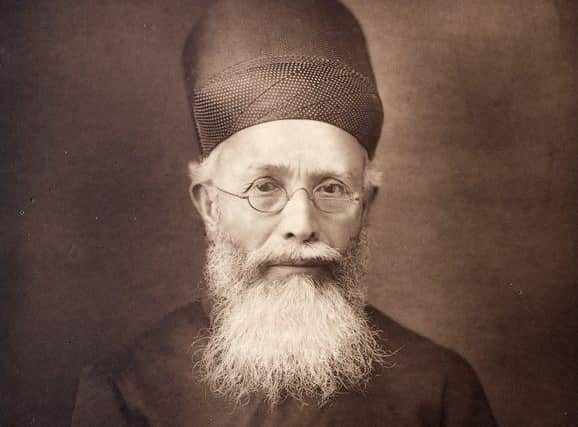

Naoroji’s resistance to empire was also a resistance to the racism that underpinned it. And for that, he paid a price. When he stood for election, the British press waged a vitriolic campaign against him. He was branded an ‘Asiatic foreigner’, a ‘Baboo from Bombay’, and a ‘stranger to English civilisation and Christianity.’ The Conservative Prime Minister, Lord Salisbury, openly doubted whether ‘if we have yet got to that point when a British constituency will take a black man to represent them.’ And even when Naoroji did win, the press condemned the people of Finsbury for electing a ‘fire-worshipper from Bombay.’
Despite being a British citizen and having lived in the country for over two decades, his very presence was treated as a threat – because he was intruding into a space that was not meant for people like him.
That same racist hostility is re-emerging in our politics today. We are seeing the growing normalisation of racist abuse and violence. Recent months have seen a rise in openly racist rhetoric, with calls insisting that only those deemed “truly” English should hold political office and demands for the deportation of people like me and many others. But this is not about individuals – it is an attack on entire communities. This is part of a broader effort to intimidate, silence, and delegitimatise all people of colour in this country.
As Sivanandan once said, ‘all of us non-white… we wear our passports on our faces.’ Our presence in this country as people of colour has long been treated as conditional. That is why the rhetoric of “integration” has always been a dog-whistle, rather than a serious political solution. Nothing will ever be enough for the racists. The problem is not, and never was, our so-called “failure to integrate,” but their continued racism.
This is evident in the government’s latest proposals requiring migrants to “earn” the right to remain by jumping through arbitrary conditions or taking part in a compulsory Duke of Edinburgh-style national service. Such measures are not merely misguided but deeply unjust. These policies are about drawing a line between who gets to belong and who must constantly prove their right to exist.
Naoroji’s relentless focus on imperial exploitation reminds me of another truth from Sivanadan: ‘We are here because you were there.’ Centuries of colonisation, extraction, and violence have reshaped the globe. The imperialist wars this country has waged – or armed – have made people’s homelands unliveable. So people flee, seeking safety and an opportunity to rebuild their lives elsewhere. Instead of refuge, many encounter detention centres, immigration raids, and deportation flights.
This is the violence of border enforcement – racism manifest – which seeks to deny people not only the right to move but the right to survive. It rests on the same logic that Naoroji exposed over a century ago: that the Global North will plunder the Global South with impunity – extract its wealth, fuel its wars, displace its people – and then deny us safety, dignity, or a place to belong.
Naoroji’s courage in exposing the cruelty of empire and the racism that sustained it offers vital lessons for our present moment. As we face a resurgence of racism and fascism, we must remember that our struggle is not new – it is a continuation of a fight waged by those who came before us. They faced the same lies, the same violent systems, and still insisted on a politics grounded in solidarity and our shared humanity. We honour that legacy in refusing to retreat, and by building a future that rejects the politics of division, the violence of borders, and the logic of empire,
Minesh Parekh is a Labour and Co-operative Councillor on Sheffield City Council.