
On the Wildside: Winter thrushes make an appearance
Early in the autumn, around late September into October, there were flocks of fieldfares and redwings passing through the region, and at night, overhead.
Fieldfares in flight have a characteristic rising and falling behaviour as they close their wings, and their call, a harsh ‘Tchak Tchak’, is distinctive too. Together these make fieldfare flocks very obvious.

The redwing is more subdued, but especially on a clear, crisp evening, the soft ‘Tew, Tew’, notes of birds on long-distance migration are easy to recognise. However, since these early movements, the mostly mild weather meant numbers were generally down. The same applies to those spectacular winter visitors from northerly climes, the waxwings, although I have heard of records coming into the East Coast.
Nevertheless, the recent snowy weather brought a change and Jan Turner of Meersbrook in Sheffield called to say she had had three redwings visiting her garden.
Closer to my home in Norton, I have seen an occasional bird in the late afternoon in nearby Graves Park. The other migrant visitors either from northern and eastern Great Britain, or else from continental Europe, have been blackbirds.
Throughout the entire autumn period I had almost no blackbirds in the garden, with perhaps just an occasional, solitary female. Then, firstly with a few frosty days and followed by snow, the numbers have increased. There are now maybe three or four females and four or five males at any one time. I guess these are continental migrants as they seem happy to flock with no pretence of territorial behaviour and aggression.
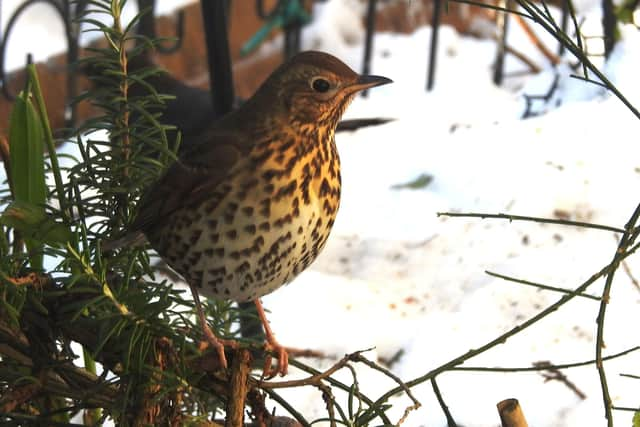
About the same time, we have had a song thrush or maybe two birds, almost constantly for a number of weeks. Smaller, more compact, and a generally warmer colour than its larger cousin the mistle thrush, this is one of the species that sadly declined nationwide in the early 2000s. At least in Norton, Sheffield, they seem to be doing OK. During the summertime they love the yellow-and-brown banded snails which they smash on a stone ‘anvil’. Now they are feeding under the fat-ball feeders and on berries.
Professor Ian D. Rotherham, researcher, writer & broadcaster on wildlife & environmental issues, is contactable on [email protected]; follow Ian’s blog (https://ianswalkonthewildside.wordpress.com/) and Twitter @IanThewildside