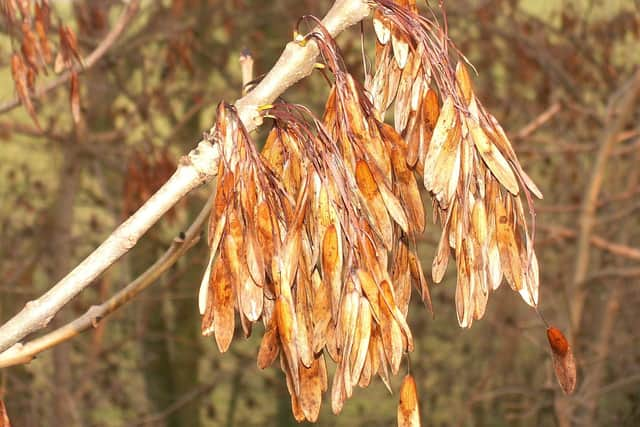
On the Wildside: When we were kids we made our own entertainment
I wonder if children today play with sycamore keys and ash keys. When we were kids and found these to be fascinating, a modest part of nature’s wonders, there were few televisions (and they only had two or three channels!), and no computers or computer games.
So, we made our own entertainment, and the wing-bearing seeds of sycamore trees and ash trees were a part of this, along with of course, horse chestnut conkers in the autumn. Of course, the latter was without oven-hardened conkers or even steel ones. I noticed one particular ash tree this winter was festooned with keys and during the stormy weather they came fluttering down en masse. The evolved design of the keys is very effective with the weight of the ripened seeds pulling down and the wing of the key, or wings in the case of a pair of sycamore seeds since they remain conjoined, acting like helicopter blades. Sycamore seeds are also known as ‘helicopter seeds’, ‘whirlybirds’, ‘spinning jennies’, and ‘wingnuts’, and both sycamore seeds and ash keys are also called ‘samaras’ after the dry, winged fruit. Whilst the fruits ripen and dry though the autumn, they remain dangling in bunches through the winter until storms begin to rip them off and disperse them far and wide.
For these trees, the system works well to get lots of highly fertile seeds windblown and spread over a wide area. There are four common British species employing this mode of operation, being sycamore, field maple, Norway maple, and common ash. Norway maple is an exotic species, and sycamore may be questionably native, but there is no consensus. All these trees have what we call a ‘weedy’ strategy when it comes to their reproduction and this means small, very fertile seeds, produced in huge amounts, and contained in fruits designed like miniature, self-propelled helicopters or whirligigs. The seeds are carried long distances by prevailing winds to new habitats and new sites. Even these are outdone by birches which have tiny seeds with gossamer wings like miniature insects, and they blow for miles.
Professor Ian D. Rotherham, researcher, writer & broadcaster on wildlife & environmental issues, [email protected]; follow Ian’s blog (https://ianswalkonthewildside.wordpress.com/) and @IanThewildside