
On the Wildside: Watch out for the ‘yellow brain fungus’!
Fungi, or at least their fruiting bodies (such as ‘mushrooms’) do tend to grab the attention during autumn and into winter, and particularly so after a long drought followed by wet weather. However, some species such as the ‘bracket’ fungi growing on trees and dead tree-trunks, are pretty much year-round or in some cases, perennial.
That is indeed the case with one I have pictured, and this is an especially distinctive fungus we spotted recently in Ecclesall Woods. This is called (scientifically) Tremella mesenterica meaning trembling and ‘mesentery’ i.e., folded tissue usually attached to intestines or gut. Its overall appearance has led to evocative common names such as ‘yellow brain’, ‘golden jelly’, ‘yellow trembler’, and lastly, ‘witches’ butter’. The fungus grows on dead wood, with a fruiting season when the yellow fruit-body is seen, throughout the year, and particularly in winter.
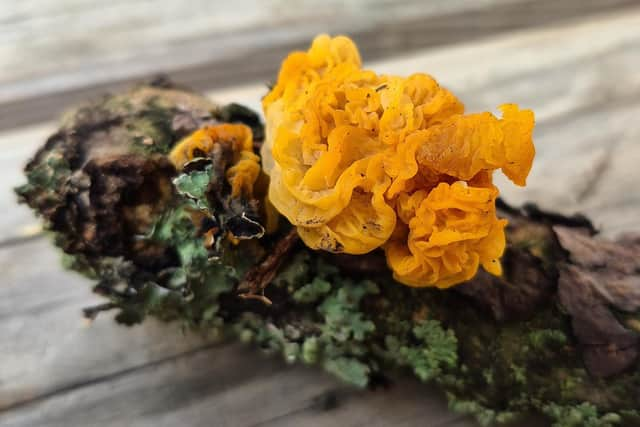

Interestingly, this does rot the wood but parasitises specialist rotters which breakdown dead wood like fallen branches and litter. Brain fungus feeds on these wood-decomposers, a common target rosy crust fungus (Peniophora incarnate) often totally enveloped by the parasite.
Common names reflect the peculiar appearance basically like orange, quivering, gelatinous blobs, the smooth fruit-body characteristically irregular with soft, jelly-like texture but quite tough and slimy if wet and hard if dry. The colour varies from pale yellow to bright orange, but when dry, changing to rusty orange. With its weird appearance, yellow brain fungus has mythological superstitious connections across Europe. Yellow brain (known as ‘witches’ butter’) appearing on your door or gate to the house, meant the local witch had cast their spell on your family. However, the problem seems easily solved by removing the spell through repeatedly piercing the fungal blob with straight pins, to make it depart. In Sweden for example, the dried fungus was burnt in order to ward off evil spirits. It is described as ‘inedible’, flavourless with little substance, but in China provides texture in soups. Like many fungi, it may have medicinal properties with anti-inflammatory and anti-allergic uses, but these are still being investigated and tested.
Professor Ian D. Rotherham, researcher, writer & broadcaster on wildlife & environmental issues, is contactable on [email protected]; follow Ian’s blog (https://ianswalkonthewildside.wordpress.com/) and Twitter @IanThewildside