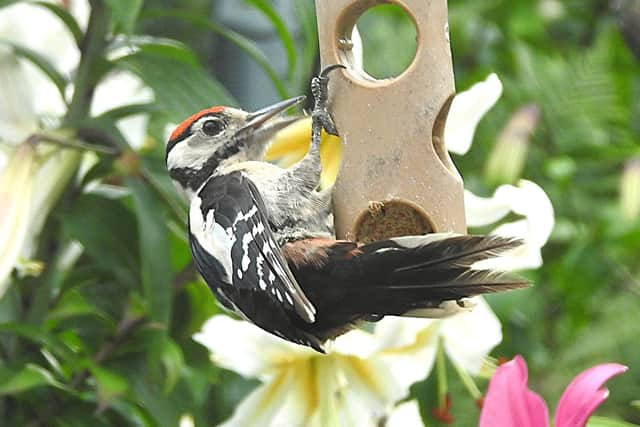
On the Wildside: Time for the baby woodpeckers…
July and August really are a time for juvenile birds to visit the wildlife garden. I feed the birds throughout the year including the summer, in part because with habitat loss etc. this is still necessary, and also so the young birds learn where to come when the weather gets colder and the wild pickings slimmer in late autumn.
I generally reduce the amounts of food, but this year, probably because of the drought, lots of birds keep coming. The adult great spotted woodpeckers have been visiting over the period but now is the turn of the babies with their distinctive red caps. Often confused with the red-capped adult lesser spotted woodpeckers, the latter are about house sparrow sized and now very uncommon, whereas great spotted are around blackbird sized. You hear them approaching with their high-pitched ‘chip-chip-chip’ calls delivered from the tall branches of nearby treetops. At the feeders the woodpeckers are very dextrous and agile and use their rigid tail-feathers to great effect.
There are still lots of young blue tits, great tits, and coal tits on peanuts and fat-balls, plus adults and young of goldfinches and greenfinches too, with an occasional bullfinch calling in the distance. The latter is a soft ‘hueeet’ call, almost plaintive but at the same time, very distinctive. My robins are also still around with a pair of adults, and I think, two broods of youngsters, with the older offspring starting to lose their juveniles plumage and gain the typical red breasts of the adult robins. Their behaviour and that of their parents will soon begin to change and by the autumn the adults will be holding and defending their individual territories to live for a few months in isolation. The young birds and their mate will be chased out as the robin’s song changes subtly from the summer tune to that of the winter and the serious business of holding an individual territory takes over. By late winter things will revert, and the male and female will once again come together to share a suitable breeding territory.
Professor Ian D. Rotherham, researcher, writer & broadcaster on wildlife & environmental issues, is contactable on [email protected]; follow Ian’s blog (https://ianswalkonthewildside.wordpress.com/) and Twitter @IanThewildside