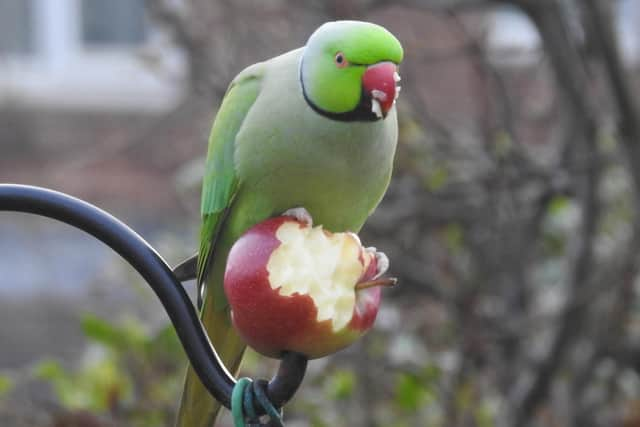
On the Wildside: These birds are long-lived, highly intelligent and very adaptable
It appears that alongside Greater London, the Sheffield region is one of the national centres for the exotic ‘ring-necked parakeet’. These stunning birds are non-natives with their origins around the Indian Ocean. From the mid-to late 20th century they have been escaping from pet-shops and from aviary collections and establishing in the wild.
Of course, as an invasive, non-native or alien species there are worries and concerns about possible impacts on locally-native, breeding birds. To be quite honest the jury is out in terms of competition with those native woodland birds that nest in tree-holes for example, or of occasionally reported predation of other species. The parakeets mainly feed on fruit, berries, and seeds, and will freely visit garden feeders where they take anything from peanuts, to apples, to sunflower hearts, or mealworms. These birds are long-lived, highly intelligent and adaptable, which of course is why people love to keep them as pets. It also means that once they escape then these sub-tropical birds quickly learn to survive in our temperate, and frequently cold, damp, climate. Undoubtedly, climate change and warming weather do however benefit these exotic parrots.
At present there are concerns about impacts in and around London, where the numbers breeding are much higher than in Sheffield, and the establishment has been underway since the 1960s. Around Yorkshire and Derbyshire, these birds are still viewed as being a remarkable and distinctive addition to the region’s bird fauna. Big, brash, bold, and noisy, the parakeets are noticeable and apparent from when they first arrive to them establishing resident populations. They love parkland and woods with big, old beech trees full of rot-holes, and will come to garden feeders too. In the late summer and early autumn, they will visit old oak trees with crops of green acorns on which to feed. In wintertime, by the late afternoon, it seems that the resident birds of breeding adults and their offspring, now gather into pre-roosting flocks at favoured sites. In Sheffield at least, these then head, down into a suitably warm and sheltered location in the urban lowlands.
Professor Ian D. Rotherham, researcher, writer & broadcaster on wildlife & environmental issues, is contactable on [email protected]; follow Ian’s blog (https://ianswalkonthewildside.wordpress.com/) and Twitter @IanThewildside