
On the Wildside: The common dog violet makes an early appearance
Viola flowers i.e., ornamental pansies, are well-known to gardeners. They come in punnets to plant out for winter-flowering and for summertime too.
Perhaps less known are the wild cousins of these gawdy domesticated flowers, two particular species being the ‘sweet violet’ (viola odorata) which is sweetly scented and, for a wild violet, quite large flowered. Various recipes were advocated for making sweet concoctions such as ‘blew violets’ to make ‘a dainty sirrup of violets’, which with lemon syrup was used to produce Oriental sherbet. They were used especially in French cuisine and also often had folkloric associations such as with death and melancholy. In Ancient Greece, the Athenians used preparations of violets to ‘moderate anger’, to ‘procure sleep’, and to ‘comfort and strengthen the heart’. In Gloucestershire, people avoided carrying violets into their cottages because they were believed to harbour fleas. With larger, more brightly coloured flowers described as rich in honey, it was the sweet violet’ and cultivars of that species which were widely used. These bloom from around February and finish by April, with a second period of very small but fertile flowers produced in the autumn.
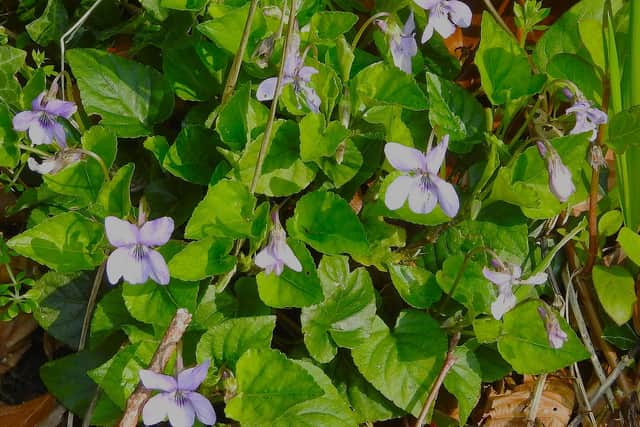

The violet pictured is the common dog violet (viola canina), the name being nothing to do with dogs but simply meaning ‘common’ and unscented. These can be found flowering in drier hedge-banks, and woodland edges from March through to August, and are considerably smaller and often paler that the sweet violet. Despite the more diminutive stature it is suggested that the dog violet has the same herbal medical uses being ‘powerfully cathartic or purgative’ and ‘emetic’ and was used to treat skin ailments. At the start of the season, the plant grows from a short root-stock, but by the end of the summer these may spread up to a foot or so in length. However, there is a further reason for interest in this often unnoticed flower, and this is because it is the food-plant for the caterpillars of fritillary butterflies which appear to be spreading. For success, they need violets in abundance!
Professor Ian D. Rotherham, researcher, writer & broadcaster on wildlife & environmental issues, is contactable on [email protected]; follow Ian’s blog (https://ianswalkonthewildside.wordpress.com/) and Twitter @IanThewildside