
On the Wildside: The blackthorn sweeps northwards as spring arrives
So-called because of its dark, black bark contrasting with brilliant white flowers, the blackthorn lights up the countryside as spring arrives. The flowers burst through before the leaves to trigger the contract of black and white.
This contrasts with the behaviour of the common hawthorn or ‘May blossom’ the leaves of which emerge in early April, but whose richly-fragrant flowers burst forth in May. This is the ‘whitethorn’ on account of its pale bark differing from that of the blackthorn. Blackthorn is now out and providing plenty of opportunities for the pollinators and so this is vitally important for insects and birds that feed on them.
Great tits and blue tits are singling, whilst chiffchaffs and linnets join with robins in good voice. At Doncaster’s Potteric Carr Nature Reserve, reed warblers, sedge warblers, and whitethroats are to be heard.
Early butterflies have been showing well in the warmer, sunny weather with plenty of sulphur-yellow brimstones, peacocks displaying, and small tortoiseshells too.
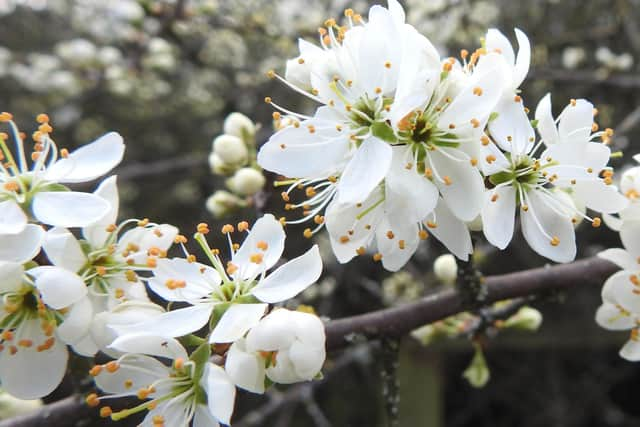

The flowering of the blackthorns sweeps up the country and across the region as a blaze or wave of white, nationally moving from southern England northwards. This is tangible proof of spring having arrived.
However, in folklore blackthorn was regarded as being sinister tree and associated with witches and malevolent spirits. This was probably due to the shrub’s dark, spiny appearance and consequently it was used to make wands with which to cast evil spells.
Apparently, children stolen by fairies might be left under blackthorn bushes and grew-up as changelings, or the creation of fairies. To prick yourself on blackthorn was also bad luck and might bring ill-fortune.
At the same time, blackthorn branches and prickles were able to ward off evil spirits and thus were protective. Associated with its season of flowering, a ‘Blackthorn Winter’ is one with heavy snowfall in April.
Meanwhile this year, across the region, the other signs of spring are the swathes of golden daffodils, cowslips on roadsides and motorway verges, and primroses along woodland edges and hedgerows. Overhead, common buzzards circle and make their mewing calls.
Professor Ian D. Rotherham, researcher, writer & broadcaster on wildlife & environmental issues, is contactable on [email protected]; follow Ian’s blog (https://ianswalkonthewildside.wordpress.com/) and Twitter @IanThewildside