
On the Wildside: Tadpoles are causing quite a stir!
Recently-constructed wildlife ponds are appearing at sites across the region and indeed have been doing so for nearly 30 years now.
The importance of significance of this is that it follows nearly a century of inexorable decline of ponds and pondlife due to urban sprawl, industrial impacts, and intensification of farming. Back in the 1980s and 1990s, we noticed the growing importance of one-time industrial ponds on what were increasingly derelict post-industrial sites. It was clear that such places, often strewn with debris, boulders, bits of sheet metal, and even shopping trolleys, were great places for grass snakes, great crested newts, and in summer, for spectacular dragonflies and pretty damselflies. Then, at sites like the Woodhouse Washlands Nature Reserve, and the Shire Brook Valley Countryside Management Area (now Local Nature Reserve), we developed strategies for future ‘Pondscapes’, in effect, rolling programmes of pond creation. Once you make a pond it begins to go through an ‘ecological succession’ and the associated wildlife changes over the years. This means it is good to have a mix of ages from newly-created sites to ones which are more mature, and the work goes on.
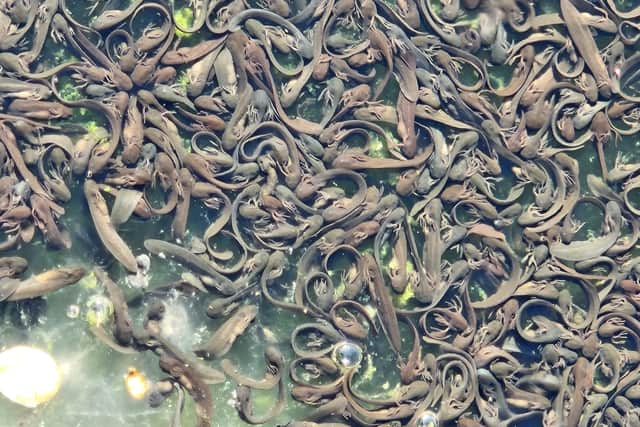

Along with garden ponds, such nature reserve habitat creation proves a real boon for local frogs and toads. Indeed, the massed spawning of frogs in Shire Brook cause a lot of excitement as the frog larvae hatched en masse to produce a wriggling, squirming, seething bundle of amphibian life in the new ponds. The scene was captured in pictures by Christine Handley, all taken on March 18, 2026. This was in one of the new ponds in Shire Brook’s Rainbow Meadow. These creatures also caused a little confusion as to whether they were frog tadpoles or newt larvae! Well, when you see a mass of frog tadpoles on top of a pile of former frogspawn, this is what they look like, and yes, in their juvenile stages the youngsters do have gills rather like the much smaller, transparent newt larvae. These are then reabsorbed into the body as the froglets grow and metamorphose.
Professor Ian D. Rotherham, researcher, writer & broadcaster on wildlife & environmental issues, is contactable on [email protected]; follow Ian’s blog (https://ianswalkonthewildside.wordpress.com/) and Twitter @IanThewildside