
On the Wildside: Rare plant discovered at Graves Park
One of the great things about nature is that you just never know what you might find, as was the case as a small group of stalwart nature-lovers headed back in the almost darkness from a bird survey afternoon in Graves Park, Sheffield.
Yet the same or similar experience might happen almost anywhere. We got back to where our cars were parked, and somewhere I have stopped many times before, and looked up from the usual ceremony of boot-changing.
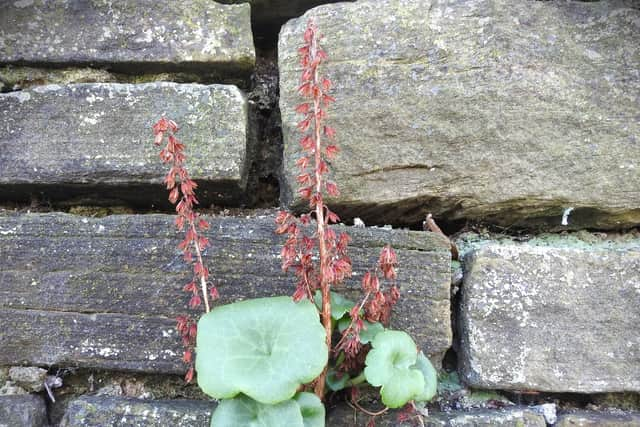

On the old stone wall dating from the early nineteenth century, I spotted the wintergreen, succulent leaves of a plant which regionally is a real rarity, one of the stonecrop family, the navelwort or wall pennywort. There are a few locations recorded from the west of Sheffield and I have found a few new ones too, but none as easterly or indeed, southerly as this site.
Its name of navelwort is because the leaf stems grow through the centre of the leaves and from a little dimple in the centre top. Children used to prick a hole through this point and
put posies of small flowers through the green, succulent leaves, and another childhood use was apparently to use the circular leaves as imitation coins for games. The only folk name appears to be ‘coolers’ which was because the sap from the crushed leaves could be used as a curative salve for burns, as can some of the other stonecrops including wild orpine (or ‘ice plant’ in gardens). The latter was called ‘poor-man’s house-leek’.
Anyhow, this is a really exciting find and not far from another wall on which I recorded a very rare fern, the ‘rusty-back’. These plants tend to grow on the lime-rich mortar of old walls, have recovered considerably with falling air-pollution, and importantly, need moisture. They are commonplace in the southwest , particularly Devon and Cornwall, but rare in the drier east. It may be that they were more widespread in the Middle Ages with a cooler moister climate, and what we see now is the remnant of their former distribution.
Professor Ian D. Rotherham, researcher, writer & broadcaster on wildlife & environmental issues, is contactable on [email protected]; follow Ian’s blog (https://ianswalkonthewildside.wordpress.com/) and Twitter @IanThewildside