
On the Wildside: It’s that fungus season!
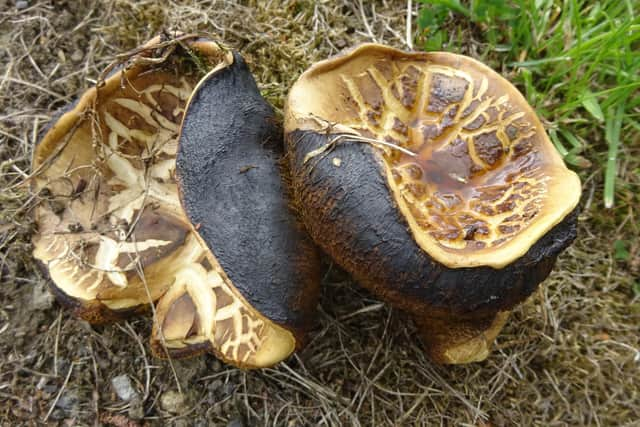
Following the hot, dry summer, subsequent wet weather means good times ahead for some fungi as indicated by the emergence of their fruit bodies, essentially ‘mushrooms’ of varying types. The specimen pictured however, was photographed near Deepcar in Sheffield by regular corres-pondent Mike Parker, during the recent long, hot summer.
This large mushroom close to a mature roadside birch tree, is a ‘bolete’ and characterised by the big bun-like cap and stocky stem of the fungus fruit-body. Particularly, if you look at the underside, it has tiny pores instead of gills. In an ordinary edible mushroom the underside has dark gills – flaps hanging vertically, which is where the asexual spores are produced in profusion.
With the boletes, these gills are replaced by tubes exiting to the air via tiny, circular pores. The cap of many boletes is edible, and some like the ‘penny bun’ are supposed to be rather good.
Others are described as ‘inedible’ though not poisonous, and a few are rather nasty. The ‘devil’s bolete’ or ‘satan’s bolete’, with its distinctive white cap and bright red stem and pores, is one such example. This is a southerly species in both mainland Europe and Britain and is highly toxic especially if consumed raw.

In parts of Italy, it is reputedly eaten after prolongued cooking, but you have to wonder why go to such efforts to use something which is essentially not good to eat and potentially quite poisonous.
Perhaps the size of the cap is one incentive as they can be up to 16 inches across or occasionally even larger.
The mushroom pictured may be the ‘common or brown birch bolete’ (Leccinum scabrum) and is suggested to be edible but not great, and these specimens are certainly well past their best!
Back in the soaring temperatures of July and August, these fruit-bodies were well desiccated and maybe even ‘cooked’ by the sheer heat that can be experienced at ground level. Indeed, this makes certain identification very difficult.
As autumn rolls on, weather depending, more fungi will appear in gardens, parks and on roadside verges.
Professor Ian D. Rotherham, researcher, writer & broadcaster on wildlife & environmental issues, is contactable on [email protected]; follow Ian’s blog (https://ianswalkonthewildside.wordpress.com/) and Twitter @IanThewildside