
On the Wildside: In search of ancient white willows in Doncaster
Our search for ancient white willows goes on, extending now throughout Doncaster district but especially Fishlake and Sykehouse, up the Yorkshire Derwent towards York and the Wharfe, plus the Hull Valley and Holderness.
This time however, we where back where it all began in the beautiful historic village of Fishlake. So far, we have recorded several thousand good-sized white willows including many hundreds of previous unnoticed and unrecorded veteran and ancient trees. This is remarkable for a region with supposedly few trees (because of the absence of woodland in the former South Yorkshire fens). Research funded by Natural England over the last two years has suggested that these groups of old trees hold a nationally significant resource of very rare insects and other wildlife found only in ancient and veteran trees. Working with a small but dedicated team, we are unpicking the landscape and ecological history of these remarkable specimens. Local people and communities, especially some of the farmers and other landowners, have already adopted the white willow as the region’s iconic tree in the landscape. Now we are seeking to add important details to the records and to our understanding of the conservation value of these old trees.
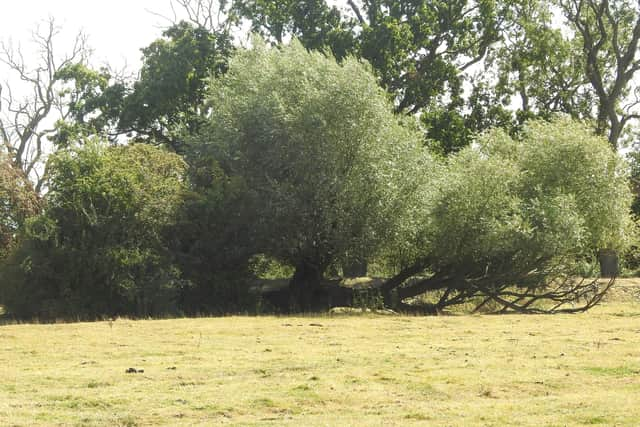

Several local farmers, such as Jill Grantham of Trundle Lane Farm, Fishlake, and whose tree is pictured, kindly offered up their land for us to visit and record. With Julian Small of Natural England and European expert Dr Keith Alexander, we were able to garner more vital information during a two-day expedition. Numerous new records were added to our running database including several nationally rare and notable species, thus pushing these trees up the order of conservation priorities both regionally, and also nationally. Some of the specimens probably go back to the time of the ‘Great Drainage’ as I have christened it, i.e., around 1600 when the fens were being drained. They are now markers of a lost wetland landscape, although specimens survived in the hedgerows and were important in working farm landscapes until the 1950s, when modern arable farming removed them.
Professor Ian D. Rotherham, researcher, writer & broadcaster on wildlife & environmental issues, is contactable on [email protected]; follow Ian’s blog (https://ianswalkonthewildside.wordpress.com/) and Twitter @IanThewildside